YA Scavenger Hunt

Welcome to YA Scavenger Hunt! This bi-annual event was first organized by author Colleen Houck as a way to give readers a chance to gain access to exclusive bonus material from their favorite authors…and a chance to win some awesome prizes! At this hunt, you not only get access to exclusive content from each author, you also get a clue for the hunt. Add up the clues, and you can enter for our prize–one lucky winner will receive one book from each author on the hunt in my team! But play fast: this contest (and all the exclusive bonus material) will only be online for 72 hours!

Go to the YA Scavenger Hunt page to find out all about the hunt. There are SIX contests going on simultaneously, and you can enter one or all! I am a part of the BLUE TEAM–but there is also a red team, a gold team, an orange team, a red team, and an indie team for a chance to win a whole different set of books!

If you’d like to find out more about the hunt, see links to all the authors participating, and see the full list of prizes up for grabs, go to the YA Scavenger Hunt page.

SCAVENGER HUNT PUZZLE
 
Directions: Below, you’ll notice that I’ve listed my favorite number. Collect the favorite numbers of all the authors on the blue team, and then add them up (don’t worry, you can use a calculator!).
 
Entry Form: Once you’ve added up all the numbers, make sure you fill out the form here to officially qualify for the grand prize. Only entries that have the correct number will qualify.
Rules: Open internationally, anyone below the age of 18 should have a parent or guardian’s permission to enter. To be eligible for the grand prize, you must submit the completed entry form by October 9th, at noon Pacific Time. Entries sent without the correct number or without contact information will not be considered.
SCAVENGER HUNT POST
briggs_elizabeth
Today, I am hosting Elizabeth Briggs  on my website for the YA Scavenger Hunt!
Elizabeth Briggs is the New York Times bestselling author of the Future Shock trilogy and the Chasing The Dream series. She graduated from UCLA with a degree in Sociology, currently mentors teens in writing, and volunteers with a dog rescue group. Elizabeth lives in Los Angeles with her husband and a pack of fluffy dogs.
 
Find out more information by checking out the author website or find more about the author’s book here!  Visit Elizabeth’s Website | Check out Future Shock |Check out Future ThreatFollow Elizabeth on Facebook | Follow Elizabeth on Twitter
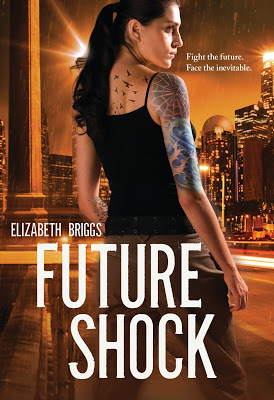
futureshock_cvr

A New York Times bestseller!

What do you do when the future is too late, and the present is counting down to an inevitable moment?

Elena Martinez has street smarts, the ability for perfect recall, and a deadline: if she doesn’t find a job before she turns eighteen, she’ll be homeless. But then she gets an unexpected offer from Aether Corporation, the powerful Los Angeles tech giant. Along with four other recruits–Adam, Chris, Trent, and Zoe–Elena is being sent on a secret mission to bring back data from the future. All they have to do is get Aether the information they need, and the five of them will be set for life. It’s an offer Elena can’t refuse.

But something goes wrong when the time travelers arrive in the future. And they are forced to break the only rule they were given–not to look into their own fates. Now they have twenty-four hours to get back to the present and find a way to stop a seemingly inevitable future–and a murder–from happening. But changing the timeline has deadly consequences too. Who can Elena trust as she fights to save her life?

The first book in an unforgettable series about rewriting your destiny in the city of dreams.

 
Exclusive Content

I always make playlists for every book I write. The songs inspire me, help me set the tone for the book, and make it easier for me to get back into the writing after some time off.


For Future Shock, I chose a lot of dark, angry songs that reflect Elena’s state of mind, along with songs about being an outcast, about running out of time, and about not being able to trust anyone. You can check out the playlist here.

Future Threat is the second book in the trilogy and comes out March 1, 2017. I’m excited to present the playlist for it, exclusive to the YA Scavenger Hunt!For this playlist I also kept the songs pretty dark, but they’re not as angry as in Future Shock because Elena is in a different place now. She’s struggling with getting over her past and trying to live in the present with the man she loves, but is forced to return to the future again for another mission. The songs are moody, a little sad, but also a tiny bit hopeful – just like Elena in the book.

If the spotify window isn’t working, click here to see the playlist on Spotify.com

And don’t forget to enter the contest for a chance to win a ton of books by me, Kaitlin Bevis, and more! To enter, you need to know that my favorite number is 2. Add up all the favorite numbers of the authors on the blue team and you’ll have all the secret code to enter for the grand prize!

CONTINUE THE HUNT
 
To keep going on your quest for the hunt, you need to check out the next author!

New to my site? Sign up for my newsletter for a free audio copy of Persephone. Want more free stuff? Comment below to enter for a chance to win an e-copy of the first book in my newest trilogy, AphroditeWinner will be chosen via random number generator on Monday, October 10th.



“No one ever knows about all my cats”: the inscrutable divine trickster Hermes

I am busy with birthday fun for my daughter this week, so the amazing Molly Ringle offered to do a guest post about one of my favorite mythological characters from her series. Hermes.

molly-ringle-sm

Thank you for having me back, Kaitlin!

I am always happy to ramble about the Greek myths, and by the end of my Chrysomelia Stories trilogy (Persephone’s Orchard, Underworld’s Daughter, and Immortal’s Spring), Hermes had become one of my sentimental favorites, and the favorite of many readers. Today I’m giving a brief sketch of who he is, and why I love him.

You might know of Hermes as a deliverer of messages between gods, or between gods and humans. Which he is. But he’s more than that.

You might know him as a trickster and thief, and he definitely is. But not just that.

You might think of him as untrustworthy, and you’d be right. But that’s not the whole story either.

You might even know he’s a psychopomp: a guide who brings departed souls to the Underworld. Again true, but it’s only one of the many jobs he performs.

In fact, he has so many facets, and is always coming and going on so many mysterious errands, that the more I studied Hermes, the more I decided no one (except Hermes himself) knows all the things he does. He’s a variety of things—nimble, clever, mischievous, untrustworthy, playful, dangerous, seductive, helpful, adaptable, irreverent, dark and light and good and bad all at the same time. He fascinates me, and when starting my mythology-based series of novels, I knew I wanted him to be one of my major characters. And indeed, after Hades and Persephone, he’s one of my main secondary characters.

However, he’s never one of my point-of-view characters. That is, I never got fully inside his head and showed his thoughts, his errands, his loves, his motives. And that’s mainly because I feel like even I, the writer, cannot possibly fathom the depths of the mind of the divine trickster. In Underworld’s Daughter, when another character discovers a trick he’s pulled, and remarks, “Your cat’s out of the bag,” my Hermes character answers, “No one ever knows about all my cats.” I still believe that. While I do reveal some of his secret plans, I’m certain there are lots more that I know nothing about.

Hermes is the quickest thinker, the nimblest thief, and one of the most charismatic of all the gods. In mythology, on the day he’s born, as an infant, he steals all of Apollo’s cattle, covers his tracks, gets caught anyway, then charms Zeus and everyone else—including Apollo—into not holding a grudge and indeed forgiving and liking him. In my version, he’s the one to call on when you need anything (or anyone) stolen or acquired; he’s a con man and sometimes plays tricks even on his friends, but he also protects and avenges them. He’s unpredictable, but mainly benevolent. Chaotic good, some might call him.

One of the interpretations that helps me understand Hermes, and ties together all his diverse personality traits, is that he’s a god of boundaries, and the transgressing of them. As the god of travelers, he helps keep you safe on the road: his name comes from the piles of stones called herms that people used to build at crossroads or countries’ boundaries to mark the way. As a psychopomp, he guides souls across the living world/Underworld boundary. As a thief and a trickster, and the patron god of thieves and tricksters everywhere, he embodies the irreverent transgression of the taboo against stealing and deceiving—stepping over the boundary between lawfulness and crime.

But even with his dark side, Hermes is generally considered a bringer of good things. He’s often described in myth as youthful, playful, and light-footed; he flies through the air in the sunlight and starlight on his winged sandals. Yes, he’ll screw you over sometimes and drive you crazy. But he’ll also surprise you with unexpected gifts. For example, as an apology for the cattle incident, he gave Apollo the lyre he (Hermes) had just invented, and graciously let Apollo become the god of music even though Hermes himself was just as enchanting a musician.

As I have one of my characters say, “It’s wise to leave room in our lives for the chaotic, the unexpected. Hermes has always been excellent at providing those elements. It’s part of the reason I like him, despite the trouble he causes. Ultimately you will find he brings more good than harm.”

And anyway, haven’t we all had friends like that?

Excerpt from Immortal’s Spring, in which Hekate encounters Hermes at a Dionysia festival:

Hermes’ presence stole up beside her. She smiled without turning, and didn’t even look when he slid his arm around her waist and said in her ear, “What a fetching young woman. I must fondle her.”

“Hello, Hermes.”

“Hush, my darling. We are all masked tonight. No names.” He drew her forward and began dancing with her.

“You’re not even trying to disguise your voice. And I can sense who you are, stupid.”

“Oh, come now. I’m many terrible things, but never stupid.”

She conceded with a shrug, and spun in the dance in harmony with him.

His mask covered the top half of his face, a fitted piece of leather that sparkled with scattered gold leaf. Mistletoe wreathed his head. “It makes me happy to see you at another of these,” he said.

“I thought it time to come back.”

“I agree. Hey, Aphrodite gave me a new perfume. I tried putting it on my mask. Smell it and tell me what you think.”

Hekate leaned her face close and inhaled. She was about to tell him she could hardly smell anything when he took advantage of her proximity and kissed her on the mouth.

She planted her hand on his face and shoved him, though her annoyance was mixed with laughter, and she didn’t bother trying to escape from his arms.

He was grinning. “Such a simple trick, and you fell for it. Now who’s stupid?”


Like what you read? For the months of October and November 2016, Persephone’s Orchard will be free on all major ebook retail sites! Download today and get started on the series. Find out more below:

Molly Ringle is the author of the New Adult Greek mythology series that begins with Persephone’s Orchard and continues in Underworld’s Daughter and concludes with Immortal’s Spring. She has also written ghost stories in The Ghost Downstairs and Of Ghosts and Geeks—and, to some degree, in What Scotland Taught Me. She stays within the bounds of reality (though still fiction) in her romance novel Summer Term. She lives in Seattle with her family, is happy when it’s cool and cloudy, and gets giddy about fandom, things that smell good, and gorgeous photos of gardens.

Visit Molly Ringle at her website, Goodreads, or Twitter.


FAQ Friday: Weird Names

Why doesn’t anyone bat an eye at all the strange names in the otherwise modern day Persephone universe? Find out below:

Juggling Multiple Viewpoints

smilies-1607163_1920

In season four of writing excuses, my favorite episode was one that focused on juggling multiple viewpoints. I primarily write in first person single narrative, however every now and then, my story leads to a place where I *have* to have another viewpoint character or two.

In Iron Queen, I had to add in Hades and Aphrodite because Persephone wasn’t where the action was. The story from her POV wouldn’t have explained how the gods found her, what was happening on their end, or the struggles they went through. If I’d only done her and Hades or her and Aphrodite, I would have been missing places where the three characters diverged,because plot wise it made no sense for Aphrodite and Hades to stick together during the entire search for Persephone given the fact that Aphrodite was a liability. Hades’s POV was needed to show Zeus going after the gods. Aphrodite’s POV was needed to show Zeus going after the demigods. Both were very important threads.

But it’s not always location based. In Love and War and Venus Rising, I had to add Medea because while Aphrodite and Medea are on the same island, Medea knows things Aphrodite can’t and make no sense plot wise for Aphrodite to learn. I needed an insider. I needed someone on the demigod side otherwise it was going to be a very short, very one-sided story.

I write them all in first person for my current series because that’s been the format so far for my series, but writing multiple viewpoints works best in third limited. I got some complaints about the change in format from Iron Queen, and I’m anticipating them for Love and War. But the story demands it, so all I can do is try to jump POV’s better.

Cue writing excuses. Some of their advice was obvious. Make it obvious who your POV character is right off the bat. My chapter names were the character names, I always had someone refer to them by name within the first few chapters or some other major identifying (“watching my wife chase after a human boy was hell” could really only be one character). And by giving them different voices. I worked very hard on those different voices and some readers will say I succeeded, others wills say I failed. So that’s something I still need to work on. It’s doubly hard for Aphrodite and Medea because the entire point of their characters is that they mirror each other. They are super similar characters that are just at different points in their development. They will be each other’s roads not taken. Eventually. And to do that, there needed to be some pretty heavy similarities.

They had a ton of great advice and pitfalls and over all it was a very informative episode of writing excuses. Take a listen here or read he transcript here.

YA Scavenger Hunt Fall 2016 Announcement!

ya_scavengerhunt_webbannerhalloween

I’ve been selected to join the YA scavenger hunt!

The hunt begins on Oct 4th and ends Oct 9th


detective-walking-90882

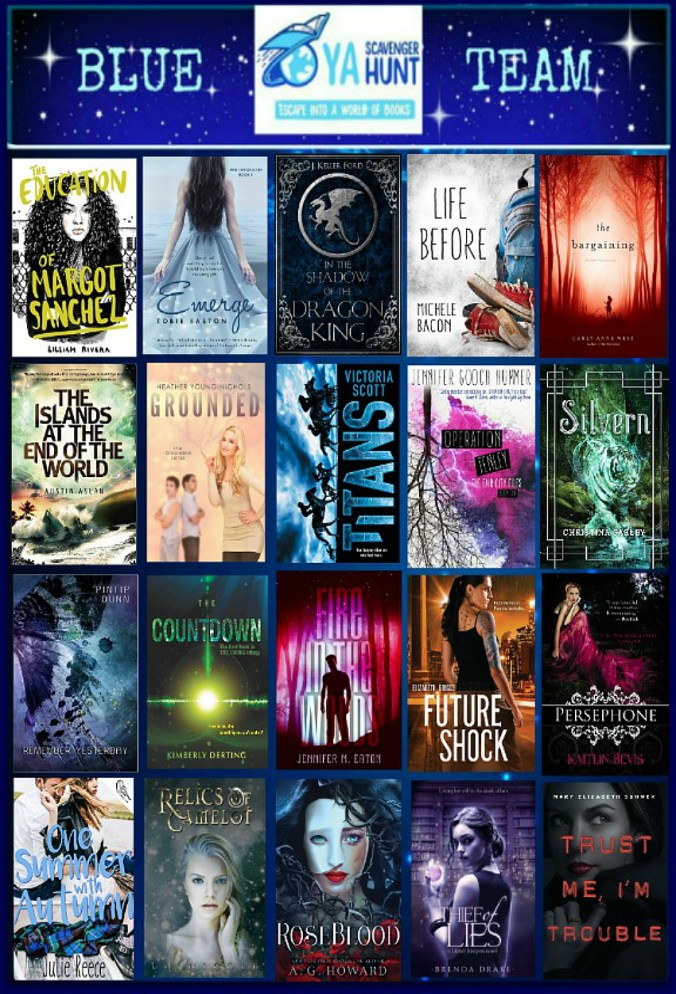
All the authors who signed up to participate in this event were put into teams of 20 by color. There are six teams total this round, and I’m team BLUE!

Check out the rest of my team!

blue-team-yash-fall-2016

Want to see the other six teams? Check them out here!

Be sure to follow along with the scavenger hunt for lots of great prizes. For how to play, visit here. To see all the books (and vote for mine 😉 ) check out this goodreads list. 

FAQ Friday: Why doesn’t Persephone recognize references to herself?

If Persephone is learning mythology, why doesn’t she recognize references to herself in the myths she’s learning about in school?

Because Persephone lives in an alternate universe where the myths are still unfolding. There IS no Persephone in mythology yet. She’s THE Persephone. Not a reincarnation, not a cyclical version of herself trapped in a recurring myth. There has never been a Persephone before her that had any mythological relevance and there won’t be one after her. That’s also why she doesn’t recognize Orpheus’s name or many of the other names of famous mythological figures she encounters. She recognizes the name Demeter, but she thought the name of her mother’s flower shop was just a play on the ancient goddess as Demeter doesn’t go by Demeter in the modern day (literally no other character that wasn’t a god ever referred to her by name, so I didn’t have a chance to explain that without it seeming info dumpy until she introduces herself to one of Apollo’s priestesses in book 3).

I tried to show that Persephone is set in a previously Persephone-less world by opening with her teaching talking about THE myth that’s used to explain the origin of Winter. In our society, that myth is the Persephone myth. In this one it’s not. They used a similar (and yes, existing. Boreas and Oreithyia are mythology figures and that is their story even outside the world of my book) myth. That’s the myth that school children everywhere learn instead of the Persephone one. Because there is no Persephone one. It hasn’t happened yet.


The Four Principles of Puppetry

child-1381797_1920


I’m almost caught up with the current episodes, but it’s been several seasons now and my favorite episode hasn’t changed, so I thought I’d share it with you. It’s The Four Principles of Puppetry with Mary Robinette Kowal. Mary explains what the four principles of puppetry are and how they relate to writing in general, and her insight is amazing. It completely changed the way I looked at character action. You can listen for free here or read the transcription here.


Talk Like a Pirate Day!

IMG_6621.jpg

Today is talk like a pirate day! My daughter has a ton of fun with this. If she dresses head to tail like a pirate, then she gets a free donut from Krispy Kreme. The donuts even look like pirates :D.

There’s all kinds of fun deals on talk like a pirate day. Go check them out.

FAQ Friday: Why Does Persephone Go by Kora?

hello-1502386_1280

In Persephone, and certain parts of Daughter of Earth and Sky, Persephone goes by her middle name, Kora instead of Persephone. This is actually a nod to the original myth. Before Persephone’s abduction to the Underworld, she was only referred to in mythology as Kore or Kora, which translates to girl or maiden.

In other words, in the myth she didn’t get a name until she became someone important.

Names mattered a lot in Greek Mythology. The gods had entirely different names or titles for different roles they played. So it only made sense to make sure that names mattered a lot in my series.Every book title is one of Persephone’s titles, and there’s a lot of character development that goes into Persephone choosing to abandon her more “normal” sounding nickname, and embracing the name Persephone. At first she lets people call her Persephone in the Underworld because she figures she won’t be there long enough, and the people there don’t matter to her enough, to bother correcting them. But over time, the people there and her time there come to matter so much, than in book two when she’s returned to the living realm, it feels strange when people call her Kora. By book three, when she’s completely given up clinging to both her idealized version of her human and the parts of her divine life she likes, and embraced her actual life, the name Kora is never uttered again because she became Persephone.

Using different names for different roles, particularly related to age, isn’t unique to Greek culture.  Childhood nicknames are common. When I was really little, my nickname was Katie, and it’s telling who still calls me that. Older family members. Because to them, that’s who I’ll always be. When I hit my teenage years, I decided to go by Kat, which I loved. But as I grew up, introducing myself as Kat started feeling strange. So everyone in my adult life calls me Kaitlin except for a few friends from high school, because to them that’s who I’ll always be. I was a different person entirely in high school, and THAT was a different person from the little kid known as Katie.

Outside of age, the names I go by today show a lot about my relationship with the person using them. People who call me Ms. Bevis for instance don’t know me at all. But the person who calls me Mommy knows me on an entirely different level than all my friends that call me Kaitlin. And that’s a whole different relationship than the man who calls me hon. Names matter.

What names do YOU go by? What do they say about you? What do they say about the people using them?


Writing Excuses: Endings

0aHT_Z2t

As you all know, I’ve struggled with my endings. Ending a book is hard. But my favorite episode in Writing Excuses season 2 focused on endings. How to write them, what to do, what not to do. The most useful tidbit that I got out of this is how Howard approaches his endings. He waits until he’s about ¾ of the way through an arc, then goes through the story with his writers group and asks “what promises have I made to the reader?”

Honestly, that’s genius. If I did that in my writer’s group, I’d instantly have 9 different opinions on how the book should end. People would make connections I hadn’t thought of in ways I hadn’t thought of it. It’s a great exercise, and one I intend to use going forward.

But not with a series, because 1. I can’t ask my writers group to go back and read the last 6 books. And 2. Series introduce their own ending problem.

When I wrote Venus Rising, my ending kept falling flat. I went through the book and asked myself what promises I made to the reader, and realized I was meeting all of those. So I went through the trilogy, what promises was I making? Well, I’d met all those, so what was the problem?

The problem was that this book, standing alone by itself didn’t make the promises I’d made to the reader in books 1 and 2 matter. If I’d ended the series at book 2, the ending I’d written would have resonated perfectly. But because book 3 was written without including more than a scene or two referencing some of the sub plots that were wrapped up in book 3 (because I didn’t have a POV character in the place where all the sub plot stuff was happening) the ending lost all its power. So identifying, yes, I’m keeping these promises is important, but identifying, well, I am keeping this promise but I didn’t make this promise this book, is also important. In the case of Venus Rising, it’s going to take some restructuring, possibly the addition of another POV character, at minimum more scenes with this specific group of characters to make those aspects of the ending feel like they matter.

You can listen to this episode of Writing Excuses here or read the transcript here.