Way Back Wednesday- Demeter

h7h4t

Kidnapping is one of the greatest fears every parent has. You’re child is playing out in the backyard, maybe picking some flowers, and in the next second, she’s gone. Vanished without a trace. The uncertainty of what’s happening to that child, of not knowing if they’re alive or dead is gut wrenching to even imagine.

I didn’t want to imagine it, which is why in my version of events, Demeter knows Persephone’s whereabouts the entire time. My own daughter was six months old when Persephone was finished. I literally could not write the missing child story. But it came up a lot in my research, and as with anything else, the more you know, the more parallels you can see in modern culture. The fear of kidnapping predates the pantheon. That universal fear of losing a child is a major reason Demeter’s role features so heavily in the myth. So I wouldn’t consider these to be retellings. More like echoes. So why way back Wednesday instead of modern Wednesday? These are adaptations that may have inspired my telling of the myth. They happened in my lifetime, prior to, or during, my writing of Persephone.

The Labrynth

Sarah, who plays a unique combination role of both Demeter and Persephone in this myth, loses her little brother to the Goblin King (Hades). To win him back, she must venture through the dark and mysterious land of the labyrinth (the Underworld), resisting all the temptations therein. Yes, technically, this is more of a changing story. But there are echoes of Demeter and Persephone here.

Man on Fire

When Dakota Fanning is kidnapped, Denzel Washington (I’m sorry, were they supposed to have other names in this movie?) razes the earth to find her. He probably kills about as many people as the first winter and his grizzly brand of justice would win the goddess’ approval.

Also in this vein is the movie Taken. Very similar plot structures, very similar violence, only in this case instead of a surrogate father figure and a younger child it’s an older daughter that goes missing.

Flightplan          

When Jodie Foster’s daughter goes missing on board a plane, she enlists the aid of the flight attendants and passengers. However it soon comes to light that no one recalls seeing her daughter on board. Gas lighting and psychobabble ensue as this mother does anything she can to find her daughter. Beyond the obvious connections of a mother searching desperately for her little girl, there’s also an echo of the silence of Olympus and the misdirection of Zeus in the film.

Silent Hill

Based on the video game by the same name, this features a woman literally going to hell and back to rescue her missing adopted daughter. The symbolism in this movie is pretty impressive. I love the way the mom’s dress slowly turns from white to red as her journey through silent hill progresses. Very loss of innocence. A key feature in the Demeter myth.

There are literally thousands of other stories featuring kidnappings. Can you think of any parallels to Demeter?

Mythology Monday: Demeter

IMG_7488

I kept trying to get over seventeen years of deception. But somehow knowing it was in my best interest wasn’t enough to forgive her for keeping my divinity…my life…everything about me a secret. She’d let me think I was human, but I wasn’t, and some part of me had always felt different from all the people around me, so I’d just grown up thinking I was a freak. That something was wrong with me. As much as I wanted to make things right between me and my mom again, I didn’t think that was something I could get over.

I took a final look at my mother’s silhouette in the doorway and tightened my grip on the steering wheel.
Hades followed my gaze. “She was trying to protect you.”
“I know. That’s the worst part. I’m just tired of her deception. I mean, keeping the fact that I was a goddess from me my whole life was one thing, but to still keep something from me? That’s just…” I couldn’t put words to the feelings that were bothering me.
“You wanted her to be as honest as you’ve always perceived her to be.”
“Yes.”
“It could be worse.”
“How?”
“My father ate me.”

~@~

The treatment of Demeter in retellings is always interesting to me. I’ve read versions where she’s an overprotective helicopter mom who loved her daughter more than words can express, and I’ve read versions where she was more possessive of Persephone than caring. Persephone was hers and no one else could have her. But she’s always, always, always, portrayed as an extreme, borderline irrational, over-protective parent, and that never made sense to me.

It is true that Demeter kept her daughter from the rest of the Pantheon, and she turned down several offers from gods to court Persephone. But the Pantheon was horrible. Almost every goddess in Greek mythology suffered rape or sexual assault, including Demeter, who was raped by Poseidon in horse form (don’t ask). The gods of the pantheon lied, cheated, and fought with no regard for the people caught in the middle. Demeter’s experience with the gods of Olympus was not a pleasant one. It makes complete sense she’d keep her daughter as far away from them as possible.

When Demeter’s daughter went missing, she scoured the earth in search for Persephone in the guise of an elderly woman named Doso. At one point in her search, she stayed with a lovely woman who had an infant son. As a thank you, Demeter planned to make the child immortal by anointing him in ambrosia and burning away his mortal self over an open fire. His mom walked in on her baby roasting over the flames and flipped out. Demeter backed off the immortality bit and instead taught the child ( Triptolemus) to farm then returned to her search.

See, At first she didn’t know that Persephone was in the Underworld or that Zeus had a role in putting her there. And for a while, no one told her. That seems cruel, and it is, but here’s the thing about Demeter.

She was terrifying.

Demeter once cursed a man with eternal life an eternal hunger because he trampled her fields and threatened one of the Melissae (Priestesses of Demeter). She was an incredibly powerful goddess that predated the Pantheon. The Greek’s and Roman’s worked her in where they could, which is why her role varies from telling to telling, but one thing came across loud and clear in every myth. If you mess with Demeter, there are serious consequences.

Eventually, Demeter did discover Persephone’s whereabouts, who told her varies depending on the myth, but the first thing the proud goddess did upon finding out was ascend to Olympus and ask Zeus to help her retrieve their daughter. When he refused, she begged, not realizing Zeus was half the equation that put her there.

That’s when she learned the terrible truth. Her daughter had been sold to the Lord of the Underworld by the very father Demeter had worked so hard to shelter her child from. Demeter was enraged so she hit Zeus where it hurt. His worshipers. Demeter showed Zeus exactly why it was a bad idea to mess with her. She needed to show him how much the pantheon depended on living in her good graces. So she went on strike. Crops stopped growing and people started starving. Tragic for the people, but Demeter was speaking the language the gods understood. Collateral damage. It worked. Zeus relented and sent Hermes to retrieve the Goddess of Spring.

Unfortunately, since Persephone had eaten the food of the Underworld, she couldn’t escape completely. She had to return every year for 3-6 months depending on the myth. During that time, Demeter mourns and crops stop growing.

In my version of Persephone, Demeter shelters her daughter by not telling her that she’s a goddess. She wasn’t planning on keeping it from her forever. Just long enough for her to have a normal childhood. Since in my version, the gods are mostly dead and the humans are unaware of their existence, Persephone needed to know how to blend. Demeter deceives Persephone in a lot of ways, violates her trust, and actually put her child in danger due to her ignorance, but she did it out of love. I tried to keep it balanced. I tried not to portray her as an extreme helicopter mom or an over possessive proud woman living vicariously through her daughter, but as a mom, struggling to make the very best choices for her child. Sometimes succeeding, and sometimes failing.

I try not to judge Demeter in either my version or the original myth. If my daughter went missing, I wouldn’t hesitate to scorch the earth if I thought that would bring her back. If telling my daughter the truth could possibly hurt her, I’d hesitate. What would you do in Demeter’s place?

I try not to judge Demeter in either my version or the original myth. If my daughter went missing, I wouldn’t hesitate to scorch the earth if I thought that would bring her back. If telling my daughter the truth could possibly hurt her, I’d hesitate. What would you do in Demeter’s place?

For Real Friday: Persephone

l-51083

There’s been this thing going around online where Mom’s take pictures of their houses in whatever shape they happen to be in and post it as For Real Friday. It’s to combat the unrealistic expectations of perfect super moms. It’s awesome. But I wanted to put my own twist on it by discussion the real issues reflected in the myth of the week. Myths, stories, they do that. They both inform and reflect the culture around them. Stories have always confirmed our worst fears, or worst faults, and our values.

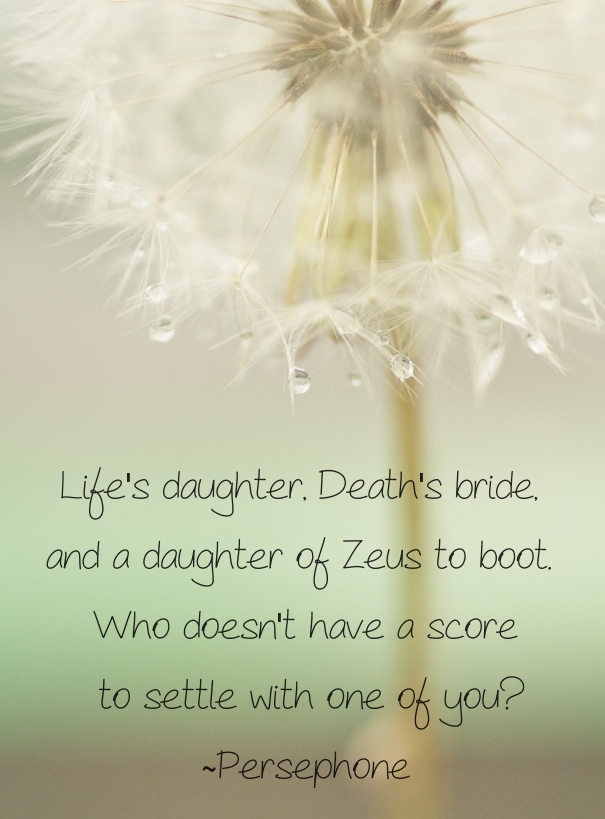
These For Real Fridays are going to talk about the reflection of modern culture in modern retellings of the myth for a couple different reasons. First, I’m interested in how the myths resonate with us now. The now is why we’re still retelling the myths, reshaping them to match our worldview. Secondly, I’m not an expert on Greek culture. I know a lot about the mythology and a passing bit about the culture but not enough for an informed piece of writing by any means. If you’re interested in learning all the potential readings of the Persephone myth and the culture they reflect, I highly encourage you to read the book Life’s Daughter/Death’s Bride. It’s amazing and incredibly informative.

Monday, I told the original (and take that word with a grain of salt. Myths work like the telephone game. They change a bit with each retelling)  Persephone myth. I also discussed how I think this particular myth inspires so many retellings because it feels incomplete. It’s missing Persephone’s voice. On Wednesday, I listed off several modern adaptations of the myth that more or less addressed that issue.

Part of the reason I feel the Persephone myth feels off to modern readers, why Persephone isn’t given a voice, is because she’s treated like an object not a person. She’s a prize for Hades, something to be given away by Zeus, something to be stolen from Demeter. Unfortunately that world view isn’t limited to ancient Greece. Women are constantly objectified in the media. There’s a great Ted Talk that goes into the realities and consequences of that fact far better than I ever could. One of the consequences of this type of objectification is that it encourages rape and rape culture.

Rape is the obvious real world issue presented in the Persephone myth.

When I started outlining Persephone, I knew I wanted Hades to be the good guy. To do that, the mere implication of rape had to be removed from his part in the myth. He couldn’t be a good guy if that was part of his character. But beyond that I struggled. Did I want to completely remove the threat of rape from the story? On the one hand, yes. Rape and threat of rape is used to raise the stakes in almost every major plot line be it TV, movies, video games, or books. The way it’s portrayed in most cases is a problem because it glorifies it. Rape shouldn’t be an exciting plot twist that resolves within an episode or two. It also shouldn’t be presented as an inevitable reality.  But on the other hand rape is a reality.  One in five women will be sexually assaulted in their lifetimes which in’t surprising given that one in three men admit they would rape a woman if they thought they could get away with it. As rape is a very under reported crime, it’s likely that particular statistic is not an exaggeration.  One in five women will be sexually assaulted in their lifetimes which in’t surprising given that one in three men admit they would rape a woman if they thought they could get away with it. . Adding insult to injury, victim blaming and cover ups are prevalent with rape. Rape is a very under reported crime. Victims are silenced and shamed either by their abuser or by society or both. I didn’t want to be a part of that silence either.

There’s a lot out there saying that Persephone wasn’t really raped because the culture viewed rape differently, pretend abductions were part of ancient Greek marriage rites and she was a willing participant, or the word rape meant something else entirely (to seize, snatch, or carry off) in the original Greek, but the Roman interpretation put the sexual spin on it. To me, that felt a lot like the way real life rape victim’s accounts are rewritten to show that they actually did consent. If they hadn’t wanted it, why would they have been there, drinking that or wearing this. Why wouldn’t they have said x or y? Clearly she was asking for it.

***Disclaimer*** As someone who studies this stuff I have to point out there is merit to the theory that Persephone was not actually raped but willingly married. More than merit actually. There’s few bits of the myth that could be interpreted to mean Persephone went to Hades of her own volition (brilliantly reimagined in the novel Radiant Darkness) and ate the seeds on purpose. I’m not trying to say that those bits of facts are victim blaming, but that to me, a modern reader living in a modern culture, they made me think of that, so I wasn’t comfortable writing that version of the myth either. ***

So, I took the middle road. There’s a threat, but it’s not from Hades. That threat doesn’t function as an exciting bit of pacing, it alters my character and her view of the world, and the character responsible for the threat is not treated with moral ambiguity. As the series progresses there’s a lot more implications of, direct threats of, and featured characters who are victims of rape. At no point are these portrayals meant to be exciting. I’m writing about Greek mythology, rape is a pretty central theme and sugar coating that is just as harmful as using it as an exciting plot point.

Rape, objectification, and rape culture are just a few of the for real issues brought up in the myth of Persephone. Can you think of anymore? Or can you expand on the way something in the myth touched on these real world issues? I’d love to hear your thoughts.

Way Back Wednesday: Persephone in Popular Culture

l-49215

There’s a reason myths survive for centuries on end. Something within them resonates with us, so we change them, twist them, adapt them to fit our current mindset and culture. Personally, I think the Persephone myth has resonated so much and sprung so many retellings is because the original tale feels incomplete. We don’t get Persephone’s perspective. I went over the Persephone myth on Monday. Here, I’m going to share some of my favorite variations on the myth. I’m limiting this list to stuff that’s come out in my lifetime. Ovid’s twist on the myth was great and all, but looking at the way we’re transforming the myth now, can tell you a lot about what’s changed from now to then and what hasn’t. The retelling I grew up with shaped my view of the myth and influenced the way I changed my own.

So here are the top five favorite Persephone retellings that influenced my view of the myth when I wrote Persephone. Chime in the comments below with your own 🙂

Beauty and the Beast

Yes, this is based on the classic fairy tail, but the classic fairy tale has strong roots in the Persephone myth (and the Psyche myth and about a dozen others, but right now we’re not focusing on that one) and the Disney retelling took it a bit further. Think about it, you’ve got your beautiful, bright, sunshiney girl (come on, Belle’s color is even yellow) imprisoned over a misunderstanding with a flower. She’s held captive from spring to winter in a dark castle shrouded by magic.

That alone would be enough, but let’s look at the other parallels. You’ve got a massive age difference (Beast was 21 when the castle was cursed. I’m assuming it froze his age in place otherwise what a jerk of a witch to curse an 11 year old for not answering the door for a stranger?) There are major levels of hell happening (or would you enjoy spending twenty years frozen as a fork?). And I haven’t even gone into the magical flower significance thing.

Phantom of the Opera

Okay, so the broadway and subsequent movie of Phantom are adaptions from the book Phantom of the Opera by Gaston Leroux, which is in and of itself a retelling of the Beauty and the Beast fairy tale with an opera house twist. But then it got really popular as an opera so there are some echoes of this in Disney’s Beauty and the Beast. So layers upon layers in this. But it’s absolutely a Persephone retelling, only unlike most of my other examples, the Hades character is considered the bad guy at the end of the movie. Oh sure, the “angel of music” is a tragically misunderstood bad guy, but no one was cool with him dragging Christine to the dark and creepy underworld of the Opera House for a forced wedding. And again, we’ve got a flower of great significance. She’s not flattered by his romantic attentions, she’s terrified. It’s important that there are versions of this myth being retold that acknowledge the darkness of the original myth.

The Forbidden Game series by L.J Smith


I *loved* this book when I was younger. To the point of obsession. Seriously, read it. It’s amazing. Technically, this book was about Norse mythology, but the Persephone/Hades comparison was brought up by the characters in the book and it fit really well. Julian is a shadow man who falls in love with a bright, sunny, Californian native named Jenny. He tricks her and her friends into crossing into his realm through a game. They’ve got until Midnight to win/escape. But if they lose, he gets to keep Jenny’s soul.

So again, you’ve got the naive girl who personifies spring and all things innocent a new catching the eye of a dark soul living in a “shadow” realm. He lures her there through trickery, not unlike the pomegranate seeds Persephone was tricked into eating. And spoiler alert, she escapes, only to realize she’s still bound to him because of something she did while in his realm. There’s also a lot of flower symbolism.

Spirited Away

There’s a lot more undertones happening in Spirited Away than the Persephone myth, so I wouldn’t exactly call it a retelling, but it still has a lot of elements from the Persephone myth. Chihiro’s family is trapped in the spirit realm because they ate the food there. When Chihiro is accepted into the realm, she is given a new name, just like Kora/Persephone.

Legend

This movie essentially is the Persephone myth, only she gets rescued and there are unicorns. Unicorns, by the way, symbolize innocence, so there’s some significance there.

So basically, the Lord of Darkness decides he wants to kill the last two unicorns of the forest (innocence) and bring darkness to all the land. To do this, he needs a certain princess who is pure of heart, to touch the unicorns and make them vulnerable. When the princess sees the unicorns while playing in the forest and touches one, the trap is sprung. The unicorn she touched has his horn cut off and winter descends upon the land with the loss of that innocence.

Later the princess herself is captured and dragged down the the Lord of Darkness’ realm. He’s attracted to her because she’s innocent and pure so he tries to make her his queen. She’s eventually restored to the normal world and winter ends. A lot more happens in Legend, there’s this whole other protagonist and Lilly is an intelligent princess with some major agency. I’m just pointing out the Persephone parallels.

Those were my top five retellings of the Persephone myth when I was growing up. One thing they all have in common is giving the Persephone figure a voice. I really do think the reason this myth is set on repeat in our culture is that it feels unfinished in its original form. What retelling or Persephone inspired story finished the tale for you?

Mythology Monday: Persephone

cropped-kaitlinbanner1.jpg

I touched the flower, feeling the silky petal brush against my hand. The wind pushed me forward forcefully. My bag of pomegranate seeds blew over, spilling around the poppy. My dress flapped against my ankles as chills shot across my skin. I heard crackling and spun around to see the ground freezing around the flower.
The frost crept toward me. The branches above me stretched toward my face, ice inching along the branches. I heard a loud snap and a massive branch broke from the tree and hurtled toward my head.
I screamed and stumbled backward. The branch crashed in front of me, scraping my legs. I ran for the parking lot as fast as I could. The frost closed in, surrounding me. I’d never been claustrophobic, but as the frost cut off my escape path with a solid white wall, I panicked.
Fog rolled in, like cold death, cutting off my view of the park. It curled around me, brushing against my face, arms, and legs. I turned back to the tree and ran faster, my dress tangling between my legs as the fog and icy wind blew against my skin.

The parking lot is the other way! my mind screamed. The other way was cut off by a mountain of ice. I felt as if I was being herded. By ice?
I slipped on the icy ground, falling face first into the frost. Ice crept up my toes and along my legs. I thrashed and screamed. I felt the fog becoming a solid mass above me, pinning me to the ground. The ice piled around me. Am I going to be buried alive?
I dug my nails into the frigid snow in front of me and tried to claw my way out of the frosted death trap. I was so panicked I didn’t feel it when my nails broke against the impenetrable wall of ice, leaving red crescents of blood welling up on sensitive skin. An hysterical sob worked its way out of my throat as I gouged red lines into the ice. The ice was above my knees, snaking its way up my thighs. I shivered.
Shivering’s good, I reminded myself. It means your body hasn’t given up…yet. The cold was painful, like a thousand little knives pricking my skin. A violent tremor went up my spine, sending waves of pain through me.

“Help me!” I screamed, knowing it was futile. I was going to die here.

Except I couldn’t die. Could I? Mom said I was immortal, but was that all-inclusive? Did I have a weakness? Was snow my Kryptonite? If I got hurt, would I heal or would I be trapped in an injured body in pain forever?

I suddenly didn’t know if immortality was a good thing or a bad thing. The cold hurt. I was kicking, screaming, and clawing my way out of the frost, but for every inch I gained a mountain piled around me. I thought I heard a man’s laughter on the wind, the sound somehow colder than the ice freezing me into place.
The ground before my outstretched hand trembled. The shaking increased. The earth lurched beneath me. The surface cracked and the sound was so loud that for a moment all I could hear was high-pitched ringing in my ears. The ground split into an impossibly deep crevice. My voice went hoarse from screaming as I peered into the endless abyss, trapped and unable to move away from the vertigo-inducing edge. A midnight black chariot, drawn by four crepuscular horses that looked like they’d been created out of the night sky, surged from the crevice. I ducked my head into the snow with a frightened whimper as they passed over my prone body.
The fog around me dissipated as the ice melted away from my body. Terrified, I sprang to my feet, stopping when I was eye-to-eye with one of the frightening horses pulling the chariot. For a moment I could do nothing but stare into its huge, emotionless eyes. A strangled whimper tore from my throat and the horse snorted at me.
They weren’t black; they weren’t anything. They were an absence of color and of light, a nauseating swirling void. They hurt to look at. My head ached, and my stomach lurched in mutiny. I clenched my fists and turned to the driver.

His electric blue eyes met mine, and he seemed to see everything I’d done and everything I’d ever do. I had the strange sensation I’d been judged and found wanting. No way this guy was human. His skin could have been carved from marble; his hair was the same disorienting black as the horses. A terrifying power emanated from his tall, statuesque frame.

I couldn’t speak. I couldn’t move. His ebony cape billowed behind him as he marched toward me. At the grasp of his hand I snapped back to life and jerked away from him.
“We have to get out of here.”
“Let me go!” I yelled, yanking my arm away. He closed in on me, pushing me toward the chariot. I struggled against him, shrieking with rage when he picked me up and slung me over his back like a sack of potatoes.
I punched his back, kicking my legs. “Let me go! Someone help me! Help!”
I recalled the instructor of some self-defense class long lost in memory reminding me dead weight was harder to carry than a thrashing captive. My body rebelled at the idea of going limp so I pushed aside his cape, pulled his shirt up and raked my torn and ragged nails across his bare skin. His hands jerked in surprise and I slid off his back and onto the hard ground.

My breath left my body as I hit the ground with enough force to make me dizzy. With strength I didn’t know I possessed, I scrambled away, clawing at him as he pulled me back.
“Enough!” he shouted. “We don’t have time for this! I have to get you out of here!”
“No!” I yelled. Did he really just expect me to go Okay, strange creepy man, I’ll get in your scary chariot of death. No problem?
His furtive gaze took in the empty park, and he swore in a voice as smooth as silk. “I’m sorry.”
My eyes widened in surprise as his lips pressed against mine. I went wild, hitting and scratching and pushing for all I was worth. He didn’t budge. He exhaled, and I sank lifelessly into his arms.

~@~

Kore/Kora as she was called before her rise to Queen of the Underworld, was the Goddess of Spring, and by all accounts gorgeous. Almost every god wanted to court her, but her mother, Demeter, was determined to keep her child sheltered from the corruption of Olympus. Little did Demeter know that Zeus had already negotiated their daughter’s hand in marriage to Hades, Lord of the Underworld.

Technically, as her father, it was Zeus’ right at the time to give away his daughter to whomever he chose. But Demeter was a terrifying goddess when she was angry, so he advised his brother to keep the whole him giving permission to marry Kora thing under the radar.

Hades complies and instead of a long engagement, he waits until Kora wanders off alone/with a nymph friend or two to pick some flowers in a meadow. Then, with some help from Gaia, he breaks open the ground and charges forth with his creepy chariot of death, grabs the startled goddess, and drags her to the Underworld.

The moment Kora is raped/married, her name changes to Persephone. That’s not uncommon in Mythology. Names change to reflect a god’s purpose or role. Most gods had a whole slew of names depending on the occasion. Think of them more like titles.

Naturally, Demeter is furious and terrified for her daughter when she learns of her abduction, but more on her next week. This myth is about Persephone. Actually, part of the reason I wrote Persephone is that every version of the myth I heard growing up focused on Demeter’s anguish at losing her daughter, Hades and Zeus’ backroom deal, and the people suffering through winter. Not a single one of them focused on what Persephone was going through or her perspective of the myth. She’s treated like an item, a prize, by literally every being in the myth and every telling of it. Never as a personified concept like the rest of the gods.

Persephone’s transformation should be a fascinating story in and of itself, but we never get to hear it. In this one fell swoop, she goes from an innocent victim content to pick flowers all day to The Iron Queen. People didn’t fear Hades the way they feared Persephone. He was, by all accounts, a pretty laid back god. Persephone on the other hand was a force to be reckoned with. I wanted to tell that story. And I wasn’t the only one. Persephone has been retold to account for that lack over and over and over again throughout time. But more on that Wednesday.

Meanwhile, Persephone knows that eating the food of the Underworld will bind her to the land and negate any hope of future rescue. Apparently gods don’t actually need to eat to stay alive, because she resists the temptation for months until she’s tricked into eating 3-7 pomegranate seeds (the number varies depending on the myth, as does the flowers she’s picking, the number of nymphs with her, and any other detail. Myths were oral retellings and when they were written down, every author added their own spin. So never assume anyone got the details “wrong.” They’re just telling a different version) by the god Ascalapus, Hades’ gardener.

The pomegranate wasn’t just chosen for its taste. In terms of symbolism, it’s a pretty loaded fruit. It stands for death, fertility, and royalty. All things Persephone.

Ascalapus gets turned into a screech owl in retribution for his crime, and when Persephone is finally rescued from the Underworld, she’s still forced to return to the Underworld for a month every year for each seed she ate. And that, friends, is where Winter comes from.

Myths evolve and change over time with each retelling. Wednesday, I’ll be talking about some Persephone retellings throughout time, but I want to hear your favorite version of the myth? What details changed? Why?

Some Changes Coming Soon

Photo on 1-20-15 at 12.00 PM

Hi everyone! Sorry for the long absence, I got caught up finishing my latest book. But now that I’m back, I’ve taken a look at my blog and decided it needs some major work.

I love doing the Mythology Mondays. It’s very helpful to me in continuing my research, but just typing out my research verbatim isn’t all that entertaining. So I’m going to go back through and re-do the Mythology Monday’s I’ve done, but better.

Starting next Monday, I’m going to include a scene featuring each character and then go into the more interesting aspects of the myth (if you really want to know their genealogy, check out theoi.com, it’s amazing). Wednesdays, instead of doing a book review, I’m going to pull an example of that myth used in a modern way, and chat about that, and Friday we’ll be talking about issues that resonate with that myth today.

In the meantime, I’ve got a favor to ask you guys. If you see or can make any cool artwork, memes, or images that make you think of the god or goddess of the upcoming week (and you have permission to use it) send it my way. For next week, I’m focusing on Persephone.

Hope you guys enjoy 🙂

Mythology Monday: Primordial Edition The Ourea

old-man-of-the-mountains

The Ourea were primordial mountain nymph, but they weren’t youthful, slender, nymph like figures. They looked like old men of the mountain. There were ten, Aitna, Athos, Helikon, Kithairon, Nysos, Olympus 1, Olympus 2, Oreios, Parnes, and Tmolus, each belonging to their own mountain region. For the most part, the Ourea were children of Gaia that she made…without assistance. The exception to this was Tmolus.

Tmolus was a son of Ares and Theogone. As a mountain, he was considered as old and wise as the hills. When Pan and Apollo had their musical duel (think The Devil Went Down to Georgia. Pan foolishly challenged Apollo to a duel and they each brought along followers to listen. First Pan played and the tune was so lively, that forest creatures frolicked and danced along. It was like one of the cutesy, disney side-kick songs.

Then Apollo played the divine equivalent of Let it Go with his lyre and the earth held its breath in wonder until the last note faded into the cosmos. All the votes went to Apollo, except for Pan’s follower Midas. As a reward for his stupidity, Midas was given the ears of a donkey so no one would take his opinion seriously anymore.

Thursday Review: The Selection Series by Keira Cass


The Selection by Kiera Cass is a dystopian novel that takes the same reality TV concept The Hunger Games used, only instead of making a survivor like game, this book takes a page from The Bachelor The prince of dystopia is of marrying age, so a group of age-appropriate young women are brought to the palace. Throughout the choosing, girls will be eliminated until one very special girl is chosen to become queen.
The protagonist, America Singer, is one of the girls selected, but unlike every one else who is all ready to fall for the prince, she’s uninterested because America is in love with a boy from a lower caste than her, and he broke things off before he could ruin her life by dragging her down to his level. Her disinterest is a refreshing change for the prince and the two become fast friends. In a refreshing change of pace for the genre, America also makes friends with most the girls from the competition. In an even more refreshing change for the genre, instead of the girls being cut-throat competitors, most of them affirm each other’s strengths and talk about the regal potential they see in one another. I also enjoyed the fact America is girly. She wears makeup, she likes dresses and pants. I think it’s great that there are so many examples of dystopian female heroes right now with such diverse skills and personalities, whether it be this series, the Matched series, Divergent, or The Hunger Games, each of these female protagonists are strong in different ways. What I especially like about this book is that there’s none of this “she’s not like other girls” stuff you see in a lot of YA fiction right now. That trend is damaging to young women because it sends the message that women need to distance themselves from their gender to be perceived as interesting.
The story isn’t all a Miss Congeniality reboot. There is a strong dystopian element there. The kingdom is under threat, the class differences are drastic and disturbing, and there’s a sense that things are much darker below the surface. The Selection was a good book, but I was left with the sense that the novel barely scratched the surface of a world that’s going to get infinitely more disturbing. In terms of teaching, I think this book would just be present on my classroom library for book clubs during a dystopian unit. It was a fast and very engaging read, and the rest of the series is consistently good.

Mythology Monday: Primordial Sea Gods Part 2

Oceanus was the divine personification of the world ocean, a magical ocean-stream that circled the earth at the equator. Sometimes he represented all bodies of salt water, sometimes just the Atlantic ocean. He was a huge, muscular snake man with a beard and horns. Instead of a humanoid lower body he had a snake bottom or in some depictions a fish body. He’s one of the few Primordial Titans (some of the gods kind of belong in both categories) that did not get involved with the Titanomachy.

Tethys was often listed as Oceanus’ consort. She was the daughter of Uranus and Gaia. She was mother to the Nile, the Alpheus, the Maeander, and about three thousand daughters called the Oceanids. Sometimes she and Thalassa or Thetis get swapped around in stories, but Tethys is definitely her own goddess. With the exception of raising Hera, she’s not depicted much in any of the known Greek myths or paintings, but when she is described it’s as an ancient woman. An extremely powerful ancient woman. Once, just to make Hera happy, she rearranged the constellations by sheer force of will so that Ursa Major and Minor never dipped below the horizon. One of the moons of Saturn is named for her, as is the preheistoric ocean.

Ophion and Eurynome don’t factor into many versions of the Greek myths, but in a few they ruled the universe before Cronus and Rhea. Eurynome was a daughter of Oceanus and Ophion was a giant. They fought against Cronus and Rhea and lost.

Thursday Review: Holes by Louis Sachar

Okay, so my next few reviews are going to be a bit different because they double as reviews for a class I’m taking on Adolescent Literature. Just a heads up

Holes is a middle grade novel by Louis Sachar that follows the misfortunes of Stanley Yelnats. Stanley’s family was cursed with bad luck generations ago. Incredibly bad luck. Stanley’s bad luck hits its peak when Stanley is walking along and minding his own business one day when a pair of stolen tennis shoes fall from the sky. He’s arrested for theft and sent to Camp Greenlake Juvinile Detention center. Stanley meets a unique set of characters, including (spoilers) the descendent of the woman who cursed his family.
Intertwined with Stanley’s story is the tale of Kissing Kate Barlow, whose tragic love story cursed the land of Camp Green Lake a century ago. The land isn’t green, and there’s no lake. The warden has the boys digging 5 foot by 5 foot holes to “build there character,” and to search for Kate Barlow’s treasure.
It’s an incredibly intricate plot line told in a very simplistic way to engage young readers. This is a fantastic book to use for teaching plot threads, point of view, and proper framing of stories within stories. This would be a fun book to sit down with kids and do one of those “this-happened….and so…” charts. And a class discussion on the ripple-effect after reading this book would be intense. Because the movie is such a faithful adaptation of the book (the changes would only enhance the discussion) there’s also an opportunity to compare the different mediums, which satisfies a variety of state standards.
Another great message for kids is that for all the talk of curses and bad luck, the characters are all incredibly self-motivated go-getters. I think a lot of kids can relate to the feeling of being “cursed.” The sensation that even though you’re trying to do everything right everything goes wrong is common in the drama of middle school. However due to the complete and utter lack of young female characters (the only women in the book are the Warden, Stanley’s mom, and Kate Barlow, all middle aged, all authority figures, and also vastly outnumbered by adult men), I would recommend pairing this novel (or at least following this novel) with something like Inkheart.