The Trials of Psyche Part 2

20140408-124050.jpg

“He smells like night-blooming flowers Crushed, juicy petals on the pillows His voice is full of ocean Humming like the surf He kneels before me like I am his goddess He is a god” ― Francesca Lia Block, Psyche in a Dress

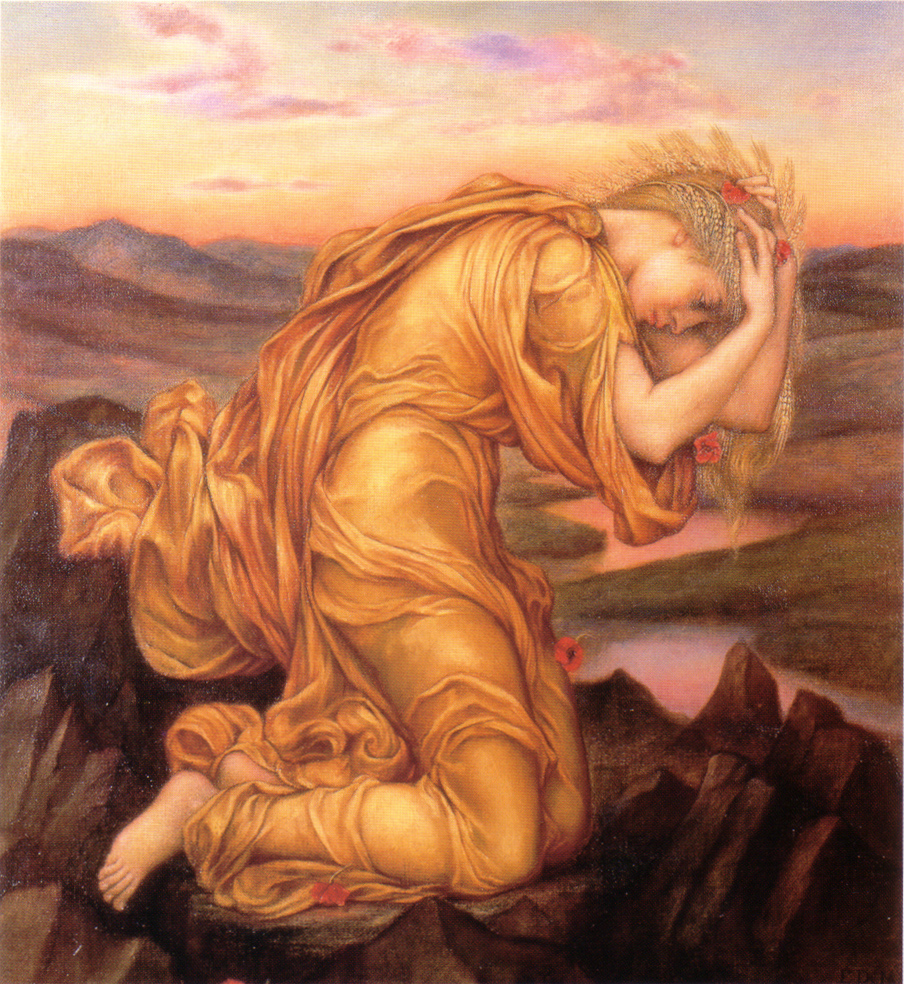
When we last left off, Psyche was sent to gather some water from the source of the Styx and the Cocytus rivers. Both of these rivers flowed through the Underworld but they also had bits and pieces of river in the mortal realm. To truly understand why this trial was a big deal, there’s some stuff you have to know about the rivers. The Styx was an important river to the gods. If they swore an oath by the Styx they HAD to honor it because the Styx was more than just a river, she was a the daughter of Oceanus and Tethys and wife to Pallus. In other words she was a full blown goddess and she was the very first to go to Zeus’ aid in the Titanomachy. As a thank you, Zeus promised every vow would be sworn upon her. If gods lived off worship, which is my take on the myths, that’s a huge deal. Sometimes those vows didn’t go well. Like when Helios swore to give his son Phaeton anything he desired. The boy wanted to drive the sun-chariot which Helios knew would end in his death. Ditto for one of Zeus’ mistresses (Dionysus’ mother, Semele) who was offered the same deal, anything she wanted. She asked for Zeus to show his true self and powers to her and since mortals can’t look upon the divine in all its glory, she was incinerated where she stood. The Styx also granted magical properties to those who braved a swim in the river. Hence Achilles’ invulnerability. His mother dipped him into the Styx by holding him by the heel. He was only vulnerable in the spot that she held him.The Cocytus is known as the wailing river, but otherwise isn’t as interesting. What’s important is that both of these rivers were sources of angst and power, so asking a mere mortal to bottle water from their source was a big deal. The cliff near the spring was dangerous to climb, the air repelled mortals, and dragons slithered through the rocks making the climb THAT much more frightening. She tried to climb the rocks but failed and started crying. Zeus felt sorry for her and sent eagles to battle the dragons and help her retrieve the water. Venus was furious because Psyche had divine help at every turn. So she set Psyche’s final trial in a place where most gods could not help her. The Underworld. More on that Friday.

Mythology Monday: The Trials of Psyche Part 1

20140326-211634.jpg

Cinderella wept, because she too would have liked to go to the dance with them. She begged her stepmother to allow her to go.

“You, Cinderella?” she said. “You, all covered with dust and dirt, and you want to go to the festival?. You have neither clothes nor shoes, and yet you want to dance!”

However, because Cinderella kept asking, the stepmother finally said, “I have scattered a bowl of lentils into the ashes for you. If you can pick them out again in two hours, then you may go with us.”

The girl went through the back door into the garden, and called out, “You tame pigeons, you turtledoves, and all you birds beneath the sky, come and help me to gather:

The good ones go into the pot,
The bad ones go into your crop.”
Two white pigeons came in through the kitchen window, and then the turtledoves, and finally all the birds beneath the sky came whirring and swarming in, and lit around the ashes. The pigeons nodded their heads and began to pick, pick, pick, pick. And the others also began to pick, pick, pick, pick. They gathered all the good grains into the bowl. Hardly one hour had passed before they were finished, and they all flew out again.
The girl took the bowl to her stepmother, and was happy, thinking that now she would be allowed to go to the festival with them.

But the stepmother said, “No, Cinderella, you have no clothes, and you don’t know how to dance. Everyone would only laugh at you.”

Cinderella began to cry, and then the stepmother said, “You may go if you are able to pick two bowls of lentils out of the ashes for me in one hour,” thinking to herself, “She will never be able to do that.”

The girl went through the back door into the garden, and called out, “You tame pigeons, you turtledoves, and all you birds beneath the sky, come and help me to gather:

The good ones go into the pot,
The bad ones go into your crop.”
Two white pigeons came in through the kitchen window, and then the turtledoves, and finally all the birds beneath the sky came whirring and swarming in, and lit around the ashes. The pigeons nodded their heads and began to pick, pick, pick, pick. And the others also began to pick, pick, pick, pick. They gathered all the good grains into the bowls. Before a half hour had passed they were finished, and they all flew out again.
The girl took the bowls to her stepmother, and was happy, thinking that now she would be allowed to go to the festival with them.

*Source: Cinderella by the Brother’s Grimm.*

~@~

Before I begin, I just need to say how much I love this set of myths. Psyche gets trials that are every bit as difficult as the heroes who have come before her. She faces challenges on par with Hercules, Jason, Perseus and Odysseus. She gets helped by gods, but so did all the other heroes. Cupid and Psyche have inspired almost as many retellings as Persephone. Since her myth is so involved, I’m breaking her trials up into three blogs and doing one Monday, Wednesday, and Friday instead of my usual Mythology Monday, Way back Wednesday (I’ll be posting book covers with retellings for each blog instead) and For Real Friday. I couldn’t resist a For Real Friday last week, but I think I can manage this week.

Without further ado…

Psyche begged Venus for help to find her husband, but Venus (I’m going with Roman names this round) was not all that kind to Psyche. Venus put Psyche through a series of trials to prove her worth. The trials kicked off with a gang initiation style beating at the hands of Venus’ gal pals, Worry and Sadness. When the beating was done, Venus mocked the pregnant, injured woman by calling her marriage a sham. Venus would have probably stuck around to insult Psyche some more, but she was running late for a party/wedding feast, so in true Evil Step Mother fashion, Venus threw down a bunch of seeds (specifically mixed wheat, barley, poppyseed, chickpeas, lentils, and beans) and demanded that Psyche sort them into separate heaps by dawn, when she expects to return.

Cinderella Psyche felt depressed by the  impossible task, but set to work diligently. In another disney princess moment, an ant took pity on Giselle Psyche and assembled an army of insects to sort the different seeds. When Venus came back from the party and saw the task was accomplished, she threw Psyche a crust of bread and took a well earned nap.

What? Partying is hard.

Refreshed from her nap, Venus told Psyche to cross a river a gather golden wool from a pack of angry sheep on the opposite bank. These sheep of course belonged to Helios, who isn’t too keen on sharing. I don’t blame him. The sheer (haha) number of myths that involved sheering his sheep is kind of ridiculous. Exhausted by the constant flow of heroes trying to snatch his wool, he set them up with a defense system. When I said angry sheep, I didn’t just mean they bleeted angrily and rammed the heroes with their fluffy sheep heads. No, these were like, man eating, super powered, angry sheep.

Psyche was so daunted by the murderous sheep that she was seriously considering drowning herself to get out of the task until she saw a bunch of briars near the sheep and got an idea. Instead of taking the wool off the violent sheep, she gathered the wool from the prickly bushes.

Unimpressed by Psyche’s ingenuity (possibly because Psyche got the idea from a talking reed but that really depends on the myth) Venus gave Psyche a crystal vase (or jar depending on the myth) for her next task. Collect the black water that spewed from the place the Styx and the Cocytus merge. But more about that Wednesday.

Mythology Monday: Cupid, Psyche and a Guest Blog

Hi guys,

This week we’re going to break format a little to do something special for a very special set of myths. Today we have a guest blog from the author of Struck: What’s Really Real?, Maya Mirza-Gill, with a peek at her work in progress inspired by her favorite myth followed by my telling of the myth (so keep scrolling). Because this myth is a long one, instead of doing the Way Back Wednesdays this week, I’m going to be posting a picture from a story inspired by the myth with each blog and skipping For Real Friday in favor of telling the rest of the myth. Enjoy 🙂

***

Untitled

“Whoever said it was a ‘damsel’ in distress was an enormous idiot,” Sky exclaimed, hitching her skirt up high above her knees.

“That’s elegant,” smirked Coop, lying on the bank behind her. “A lady standing in the middle of a river of… well…” he searched for a word, “mud, showing off her bare legs for all to see!”

Sky rolled her eyes and pulled her foot up through the sticky mud and thrust it forwards, shuddering as the mud squelched beneath her feet. “Well, I am trying to save your highness.” She scoffed, bracing herself to repeat her jagged, stilted walk across the muddy river.

“You know, I’d believe that if I didn’t know you were planning on using the box for your own beauty,” Coop rolled over onto his back.

Sky blushed. Coop didn’t know why she needed it. “I am not!” She mumbled, flailing her arms about for balance. “And its ‘Sky’.”

“Careful, Eeks,” Coop’s voice sounded playful again, “You don’t want the Thunderer to come whisk you away for playtime.”

Sky’s face went bright red, again. “Excuse me?” She put her arm on her hip, trying to look menacing and offended.

Coop reeled off laughter, watching the tiny girl in a big, pink dress, standing in mud, with a defiant expression that resembled a dirty kitten more than the menacing creature she deemed herself.

After watching him laugh for a few moments, Sky sighed, turning around again. “Will you just go away and let me do this?” Exhaled Sky, taking another trudging step forwards.

“And miss out on all this fun?”

“You’re so annoying!” exclaimed Sky. “I don’t know why I’m bothering saving your sorry butt in the first place.”

“Because I am dashingly handsome and you crave my company,” piped up Coop.

Despite herself, Sky stole a glance at him; he was staring at the sky and his brown hair was flopped over onto the grass. His blue eyes were suddenly on hers and Sky flinched. “Aren’t I, Eeks?”

Sky shook her head. “No… that’s definitely not it.” Stupid, Beautiful Deity.

“You could say you owe me,” Coop pressed a blade of grass between his teeth. “For scarring and maiming me with mortality.”

“I-…” Sky stopped short. With how cocky and annoying Coop could be, she often forgot that she had badly injured him; and he had saved her life. His back was scarred with the loss of his beautiful blue wings.

Coop sat up, wincing, “Eeks, I’m only joking!” He watched her expression become unreadable from guilt.

Sky was almost an eighth of the way into the river now, Coop was looking smaller and smaller as she made her way across.

“You might want to hurry up; I’m mortal now so I’d rather be saved before I die of old age!” Coop shouted towards her.

“Go home then!” Sky shouted back, “you’re distracting me!”

“That’s because you can’t help but be pulled in by my devilish good looks and charm!” He struck Apollo’s signature pose from the perfume ads; leaving Sky in a momentarily carefree fit of giggles.

“You seriously have nothing better to do than watch me wade waist deep into a mud and bring back a fire-breathing sheep?”

“The sheep doesn’t breathe fire! It is MADE of fire, Eeks,” Coop shook his head, mockingly, “honestly, you’re such a dunce with myth.”

I knew that…. Why did he have to be such a damn know-it-all? “Just because you’re a million years old you’re PART of the myth. And stop calling me that!” Sky retorted, getting annoyed again.

“Eeeks? Aww but, it suits you so well! You’re ickle, and you’re a scaredy-cat, and you have this mouse like expression permanently glued to your face. Eeks!” Coop carried on making fun of her, laughing at himself.

“GO AWAY!” Sky’s breathing was getting heavier as the mud was getting thicker and heavier. She was very deeply waded into the mud now.

Myth inspiration:

My all-time favourite myth is the Hades/Persephone, East of the Sun, West of the Moon (Norwegian folk tale) and Beauty and the Beast one. Because all of these seem to stem from Cupid and Psyche. I love how the tale has evolved and adapted into so many retellings and adaptations; and so when it came to writing some flash fiction, I had to go with my gut instinct love for Cupid and Psyche.

I do have an entire novel in mind, but won’t be starting it up for a while; this is a sneak peek into the story. Hence the names: Sky is a play on Psyche (changing round the sounds of this name) and Coop is like Cupid. I am excited to start this novel, but haven’t yet becase I am working on my first trilogy, and having published the first novel, Struck, I have begun work on the sequel.

The Myth as told by Kaitlin Bevis:
20140314-114621.jpgOnce upon a time there was a beautiful princess named Psyche. She was the youngest of three daughters. Her two older sisters were also beautiful, but only in an ordinary, human way. After they were married, her parents consulted an oracle inquiring what to do about their inhumanly beautiful daughter. They were a bit worried her beauty would inspire the wrath of the gods.

It already had. Poor Psyche was so beautiful that the people of her kingdom worshiped her instead of Aphrodite. They claimed she was a second coming of Aphrodite, or at least her daughter.

In truth, Psyche was neither. She was a completely typical human unlucky enough to be compared to a goddess. Aphrodite sent Eros to get revenge on the girl who dared to be beautiful. Meanwhile, the parents received troubling news from the oracle. Instead of expecting a human son-in-law, their daughter would marry a dragon that even Zeus feared.

Terrified, they dressed their daughter up for a funeral and marched her up the mountain. But Eros, sent from Aphrodite to exact her revenge, saw the princess and immediately fell in love. With the help of Zephyrus, the western wind, he spirited the princess away.

Psyche woke up in a beautiful meadow and decided to go exploring. Soon she discovered a beautiful house and a random, creepy, echo told her to make herself comfortable. In a very “Beauty and the Beast”-esq scene, she is entertained by a feast that serves itself and instruments that play by themselves. She dances along to “Be Our Guest” and eventually finds herself in a bedroom where she has sex with a man cloaked in darkness and kindness. He won’t allow her to look upon his face and always departs before sunrise.

To be continued on Wednesday

 About Myra:

My name is Maya Mirza-Gill, I am a new author, I live in London, UK and I studied English Literature at University. I love reading, and writing, including on my website www.mayamirzagill.com – where I post reviews, snippets of work and also ootd inspired by novels and characters. You can stay up-to-date with me on twitter (@mayamaomao) and Facebook (www.facebook.com/mayamirzagillwebsite).

Myra’s work:

I have recently published my novel; Struck which is a Young Adult Fantasy Fiction about a girl called Dawn who travels through time. She meets a boy called Stephan, but as she tries to get back everything gets more and more complicated; making her question what’s really real.

Mythology Monday: Cerberus

"Cerberus (PSF)" by Pearson Scott Foresman - Archives of Pearson Scott Foresman, donated to the Wikimedia Foundation→This file has been extracted from another file: Cerberus (PSF).jpg.. Licensed under Public Domain via Wikimedia Commons - http://commons.wikimedia.org/wiki/File:Cerberus_(PSF).png#/media/File:Cerberus_(PSF).png

“Cerberus (PSF)” by Pearson Scott Foresman – Archives of Pearson Scott Foresman, donated to the Wikimedia Foundation→This file has been extracted from another file: Cerberus (PSF).jpg.. Licensed under Public Domain via Wikimedia Commons – http://commons.wikimedia.org/wiki/File:Cerberus_(PSF).png#/media/File:Cerberus_(PSF).png

Charon laughed at the obvious disappointment in my voice. “Who were you hoping to meet?”

I flushed. “I was a fan of the Hercules show when I was younger.”

“He had a show?” Charon raised his eyebrows. “I only caught the cartoon.”

“I loved that cartoon!”

“Don’t let Hades hear you say that.” Charon laughed. “Or that you’re a fan of Herc.”

“Why?”

“There’s been bad blood between those two ever since Hercules stole Hades’ dog.”

“Cerberus? The myth called that a loan.”

“It was. But Hercules never brought Cerberus back, and now he’s drunk from the Lethe so he can never tell Hades where to find him.”

I blinked. Everything dead came to the Underworld. If Cerberus had never returned . . . “You mean there’s a three-headed dog running around on the surface?”

“Your guess is as good as mine.

~@~

Cerberus has come up in a few mythology Mondays before, but I wanted to go into a bit more background about the Underworld puppy.

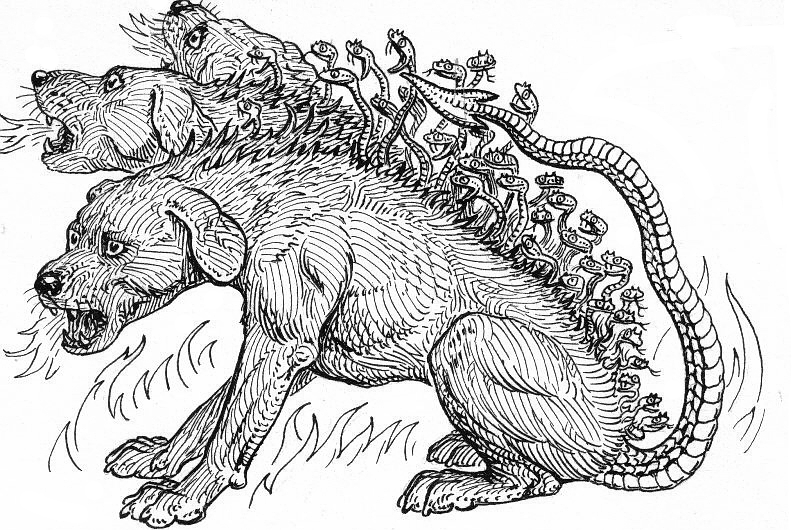
Cerberus was the child of Echidna and Typhon. This puppy has many fearful monster-siblings, such as the Hydra, Orthus a two headed hell-hound, and the Chimera.

The number of heads Cerberus has varies widely by the myth. Sometimes he has hundreds, sometimes three. Sometimes only one, with two puppies nearby that were so clingy and so alike in thought that all three dogs attacked as a unit. In art, he is almost always depicted with three, and like most things that come in threes in Greek mythology, his heads represent the past, present, and future/ youth, middle age, and old age.

Cerberus’ job was to guard the gates of the Underworld. The dead could enter, but never leave. He was borrowed by Hercules in this mythology Monday. Odysseus once put Cerberus to sleep by playing music and snuck past him. Aeneas once drugged the puppy with honey cakes and got past him that way. So as far as Underworld guards go, he wasn’t the best.

He barks once in Paradise lost, and even makes an appearance in the Inferno as a great worm, which sounds crazy at first, but makes more sense when you read into a few of the old sources and realize that Cerberus also had a serpents mane (not sure what that would look like) and a serpents tail.

In my version of the myth, Hercules never returned the dog, so he’s still wandering the surface somewhere (possibly at Hogwarts), but we’ll never know since the search for Cerberus never turned him up :(. I’ll try that contest again one day.

Mythology Monday on Tuesday: Poseidon

sunset-592796_1280

**posting delayed a day in honor of Memorial Day**

I turned to see a tall man striding toward us through the shallow surf. He had a flowing blond beard, a deep tan, and was dressed casually in board shorts and nothing else. I raised my eyebrows at his six-pack and gave Hades a speculative look. I’d never seen Hades with his shirt off. Were all gods built like that? I really hoped so.

“Poseidon,” Hades said in a civil voice. He shifted, subtly placing himself between Poseidon and me. “It’s been a long time.”

To anyone who hadn’t spent months overanalyzing Hades’ every move, he looked perfectly calm. But I could feel the tension radiating off him.

Poseidon stopped an arm’s-length away from us and looked at me. I saw his eyes and caught my breath. They swirled with shades of green, blue, and brown-white waves crested in miniature. They were so deep I could feel myself falling into them. I forced myself to meet the crashing and churning waves, not looking away until Poseidon chuckled.

“You’re the spitting image of your mother.” He grinned at me. “Uncanny. Pleased to meet you in person.” He extended his hand.

Hades pushed my hand down before it could meet his. “Don’t.” His voice was full of warning. I followed his gaze to Poseidon, confused by the sudden malice in Hades’ eyes.

Poseidon laughed. “Oh Hades, you’ve got it bad. There’s little need to worry. I don’t often have interest in children.”

Interesting wording. “Didn’t often.” “Little need.” No wonder Hades looked so tense. This guy was slimy. What would have happened if I’d shaken his hand?

~@~

In Greek mythology, Poseidon is god of the sea, earthquakes, and horses. He is one of the “big six” (thank you Rick Riordan); children of Cronus and Rhea which also includes Zeus, Hera, Demeter, Hades, and Hestia. Some versions of his birth-story indicate that he, like Zeus, was not eaten by Cronus, but hidden among a flock of lambs. His name may mean husband of the earth, which links him with Demeter, but that’s only one possible interpretation. He has also gone by Neptune and Nathus.

He competed with Athena to become patron of the city which would later be known as Athens (i.e Athena won). In the contest, whoever gave the city the best gift won. Poseidon stuck his trident in the ground and a salt-water spring popped up. Not seeing the use in salt water, the city chose Athena’s gift of the olive-tree.

Poseidon was once stripped of his divinity by Zeus, and sent to work for King Laomedon of Troy way before the Trojan war. He and Apollo built the wall around the city. When the wall was done and his divinity returned, he sent a sea-monster to attack Troy, which Hercules defeated. More on this myth in this blog.

He was married to Amphitrite, a once powerful sea-goddess in her own right in Ancient Greece that was eventually downgraded to a simple sea-nymph that was the daughter of Nereus and Doris Or Oceanus and Tethys, which either makes her a Nereid or an Oceanid sea-nymph. Their children included seals, dolphins, Triton, and in some myths daughters named Rhode and Benthesikyme. Poseidon either saw her dancing and carried her off, or had his dolphins track her down after she rejected Atlas and convince her that Poseidon was awesome.

Poseidon was married, but he had many, many, many other trysts, most of which were not-consensual. In one version of the myth, he made Medusa famous by raping her on the steps of the temple of Athena (she’d been running there in hopes her patron-goddess would save her from Poseidon. Athena instead made Medusa into a monster for defiling her temple.

He also raped Demeter. She turned into a horse and tried to flee, but he turned into a stallion and they had one to two (depending on the myth) horse babies named Desponia and Areion. Areion could talk. These were the horses Persephone met on Cumberland Island in Daughter of the Earth and Sky.

He may have been the father of Theseus, more on him in a future blog. He tricked a woman named Tyro who was in love with a river god into sleeping with him my disguising himself as the river god. He seduced one of his granddaughters named Alope by disguising himself as a kingfisher. She had a child and left it outside to die, but a passing mare and some shepherds saved it. Her father walled her up in disgust, but Poseidon sort of saved her by turning her into a spring.

Amymone was rescued from a sater by Poseidon and in gratitude bore him a son.

There was one romantic story that didn’t end in rape. He fell in love with a mortal named Cleito, and created a sanctuary for her on top of a hill surrounded by rings of water. She gave birth to five sets of twin boys, and the first became the founder of Atlantis.

Poseidon was also father to several monsters, giants, and cyclopes by way of Gaia and other monsters.

Poseidon plays a vital role in Homer’s The Odyssey, keeping Odysseus from his home for a great many years out of spite. He plays a lesser role in The Illiad, where he took the Greek’s side in the battle.

I don’t gloss over Poseidon’s dark side in my books. He’s a pervert, and a creep. Frankly, most of the myths featuring Poseidon disgust me. But I can’t deny his important role to Greek mythology, which is why he still has a role in my books.

Mythology Monday: Hestia

pixabay

pixabay

Hestia arrived right on time. The goddess was soft-spoken and diminutive. After looking askance at my papasan chair with her smoldering gray eyes, she created a side room for our lessons that contained a simple wooden table and two wooden chairs. The most interesting thing in the room was the fireplace.

Then she took one of the seats, motioning for me to take the other. In her soft voice she gave me a brief rundown on all the living gods and proceeded to tell me the history of the gods of Olympus. She spoke for precisely one hour and fifty minutes, leaving ten minutes for questions.

~@~

Hestia was one of the original six children of Cronus and Rhea. She was the goddess of the hearth and home. The Romans called her Vesta. She is both the oldest and the youngest daughter (born first, thrown up last). However, I replaced that bit of her with Demeter for story telling purposes. Hestia never married, swearing to always be a virgin (hence the vestal virgins). She chose no symbol for herself, and for a god as widely worshiped as she was (every house honored Hestia) was remarkably quiet and drama free. When any offering was made to any god, a small offering to her preceded it. In my story, she teaches Persephone the history of the gods.

Mythology Monday: Mother’s

h7h4t

In honor of Mother’s day next week, I’m dedicating this week to the amazing mom’s in Greek mythology. Ancient cultures may not have had the most respect for women in general, but they respected the role of motherhood. Here’s the top three mommy myths in Greek mythology. By the way, I’m leaving both Hera and Gaia off this list because in my opinion they sucked as mothers.

Demeter

I’ve already went into Demeter’s myth at length several Mythology Mondays ago, but I can’t leave her out of this list.

She was by all accounts, an awesome mom. She took great care of Persephone, protected her, and kept her out of the drama of Olympus, no small feat.

When her daughter went missing, she scoured the earth to find her and didn’t rest until her daughter was returned to her arms.

It’s a pretty epic myth, all things considered and in my opinion the most powerful myth about motherhood in Greek mythology.

Rhea_MKL1888

Rhea

Rhea was married to a kind of awful guy. And yes, it took him eating a couple of her kids to realize the true depths of his depravity, but eventually that mothering instinct took over and rather than allow Cronus to kill Zeus, she, at great risk to herself, snuck him away and tricked her husband. Later, she gives Zeus the tools he needs to save her other children. This decision cost her a kingdom, a husband, every bit of status she had ever gained. She wasn’t killed with the rest of the Titans but she faded into obscurity.

"For two days and two nights the boat was and hither and thither" by Walter Crane - The story of Greece : told to boys and girls (191-?) by Macgregor, Mary. Licensed under Public Domain via Wikimedia Commons - http://commons.wikimedia.org/wiki/File:For_two_days_and_two_nights_the_boat_was_and_hither_and_thither.jpg#/media/File:For_two_days_and_two_nights_the_boat_was_and_hither_and_thither.jpg

“For two days and two nights the boat was and hither and thither” by Walter Crane – The story of Greece : told to boys and girls (191-?) by Macgregor, Mary. Licensed under Public Domain via Wikimedia Commons – http://commons.wikimedia.org/wiki/File:For_two_days_and_two_nights_the_boat_was_and_hither_and_thither.jpg#/media/File:For_two_days_and_two_nights_the_boat_was_and_hither_and_thither.jpg

Danae

Danae was a princess whose child was fated to kill her father. Her dad locked her up so no man could reach her, but that didn’t stop Zeus. As punishment for getting knocked up, her father locked her and her baby in a coffin and threw them out to sea so Poseidon would get the blame for killing them, not him. Poseidon didn’t cooperate so mom and son, Perseus, made it to shore, where a king fell in love with her. She wasn’t interested in marriage (no doubt emotionally scarred from her horrible treatment with her father), but the king raised Perseus and agreed not to pursue her for awhile anyway. When Perseus grew up, the king lost patience and tried to marry Danae, but Perseus used Medusa’s head to turn him to stone.

That tells me a few things about Danae. The main one being she’s an awesome mother. Perseus loved her enough to go to great risk and kill a father figure for the love of his mom. That means rather than shutting down or blaming Perseus for all the trouble he brought her, she kept mothering on like a good human being. Given her insane childhood, that’s kind of awesome, so props to Danae.

So there you have it. My top three favorite Mom myths in Greek mythology. What’s your favorite Greek mother?

Mythology Monday: Hypnos

art-645612_640

“You have absolutely no talent for dreamwalking,” Hypnos hissed in frustration.

“I’ll say,” Hades muttered from the divan.

“Maybe if my target was actually sleeping,” I snapped.

“I can only sleep so much in a day. If I sleep any longer I’ll be in a coma.”

“Let’s try again.” Hypnos took a deep breath. “Hades, sleep.”

Hades fell mercifully silent, and I sank into the soft leather couch. The room Hypnos had selected to teach me dreamwalking looked like it should belong to a therapist. Aquamarine curtains covered the windows, casting the room in a soft blue glow.

I closed my eyes and felt Hypnos’ powers settle over me, pulling me through layers of sleep. Hades. I directed my thoughts. I could sense the energy of other sleeping deities. It was a weird sensation, like catching a glimpse of something out of the corner of your eye only to have it move before you turned your head.

The minds of the gods twinkled in the darkness, reminding me of stars scattered in the vast emptiness. Hypnos had spent the last month getting me to the point where I could sense who was who. It was easier to identify gods I’d met. Thanatos was a guarded cloak of darkness; Hypnos shone like the sun; Hestia smoldered in the night; Charon cast an amicable glow. I found my mother, green and thriving, and Boreas’ frozen fortress.

Despite the name, dreamwalking was nothing like walking around. I couldn’t keep my distance from gods I didn’t like, or get close to another. They all existed, suspended in this disorienting space; the only thing that changed was my awareness of them. If I stopped concentrating on them, they faded into darkness and I could slip into my own dreams without fear of Boreas following me.

Boreas hadn’t tried anything since that last awful dream. Maybe Hades was wrong. Maybe Boreas would back off, now that I was protected on all fronts. I doubted he wanted Hades to come after him, but maybe being unprotected in my sleep had been too much for him to resist.

“Persephone!” Hypnos’ frustrated voice startled me as it flooded my consciousness. Right . . . . I was supposed to be concentrating.

Since it was the middle of the day, there weren’t as many gods to navigate. It was easy to find Hades. He was a bundle of dark energy. I concentrated on sending a small pulse of energy his way. It was a weird feeling, gathering the energy in my mind and aiming it at someone without intention.

To do anything else with my powers, intention was half the battle. I had to keep my mind on exactly what I was doing and what the desired outcome was. It was the difference between planning an arrangement—placing every flower just so to complete my vision—and throwing a flower in the general direction of a vase.

After several tries, I found myself in the library. The bookshelves blurred around me and I rubbed my eyes.

“Thank the gods,” Hades said. He was in hyper focus in the center of the blurry room.

“Okay.” Hypnos clapped his hands. He looked at Hades and then around the library with an eyebrow raised in question.

Hades shrugged, turning his head toward me. “You did it.”

“I did!” I grinned. “Now what can I do?”

“Nothing,” Hades and Hypnos said simultaneously. I frowned at them.

“I can continue to work with you if you like . . . ” Hypnos sounded less than thrilled at the prospect. “But I have to be honest, you have absolutely no natural talent for dreamwalking. It’s not your fault; it’s just not in your bloodline.”

“Oh.” My ego deflated. I’d never been bad at anything before. I always picked up whatever sport or skill I’d been trying to learn like it was second nature. But those were human skills. Divine stuff was different. Even learning to use my own powers was difficult, and dreamwalking was Hypnos’ specialty. I nixed my half-formed plan to leave my mind unguarded and ambush Boreas in a dream. He’d had much more practice at this than I had.

“Thank you, Hypnos,” Hades said.

“My pleasure. You two should be waking in a few minutes. I’ll see you later.”

He vanished and I looked at Hades. “He left! What if I get stuck or something?”

“Getting out is easier than getting in. I think Hypnos needed a break.” Hades snickered, picking up a book. “I’ve never seen him stressed. You’re really terrible at this.”

~@~

Hypnos was the god of sleep. He was called Somnus to the Romans. His twin brother was Thanatos, and his parents were Nyx and Erebus. In mythology, he had three children. Morpheus, the god of dreams, Phobetor, the god of nightmares, and Phantasos, the god of apparitions/waking dreams. In my universe, Hypnos hasn’t had kids yet, so he’s still god of sleep AND dreams. Hypnos looked young, and was often portrayed in the nude with wings on his head. He lives in a cave near the Underworld that the River Lethe flows through. Hypnos doesn’t do much in mythology. He’s pretty quiet so there isn’t a lot to say about him. I enjoy writing him though, because I feel like his solemn seriousness is such a good counter balance for my snarky characters.

Mythology Monday: Charon

peer-173435_1280

 Dinner chatter began on the far side of the table, seeming to revolve around Charon recounting his day on the ferry. I stared down at the white tablecloth, trying to remember which of the silver utensils I needed to use for the first course. A silver plate was placed before me with a fried pink oyster mushroom served with grapefruit. It was topped with an orange nasturtium blossom. “So . . . ” I turned to Moirae, who glared daggers at me, and quickly turned back to Hades. “Uh, what did you do today?”

He looked surprised by the question. “It’s barely been an hour since I last saw you.”

“It’s called small talk,” I snapped. “You should try it some time.”

He sighed. “Fine. I spoke with Hestia about your history lessons, arranged for you to begin self-defense lessons with Charon—”

“What?” Charon piped up from his end of the table. “When did that happen?”

“Just now,” Hades said around a bite of chicken. “I’m multitasking.”

“Why does she need to learn self-defense?” Aeacus asked. I

popped the flower into my mouth, savoring the spicy flavor. I wondered how they’d known I was a vegan. Everyone had something different on their plates. Maybe it was just a cool Underworld trick, like the rooms decorating themselves.

“You’re going to have Charon teach her?” asked Thanatos. “He won’t be able to shut up long enough to teach her a single move. I’m way better at self-defense.”

“Not everyone can kill someone just by touching them,” Hypnos pointed out.

“You’ll be busy guarding Persephone any time she leaves the palace.” He looked at me. “You’re perfectly safe in all but the public areas of the palace. Only certain souls can enter the living quarters. Just stay out of the public sections, the ballroom, the front lobby, the banquet hall, and the court room, unless either myself, Cassandra, or Thanatos are with you.”

“Hah!” Thanatos laughed at Charon. “You may be the self-defense guru, or whatever, but I’m the one people want around if there’s any real trouble.”

 Charon snorted. “Give us a week, Thanatos. Persephone will be able to kick your bony ass across the Styx.”

The table erupted into cacophony. Everyone was talking over everyone else, adding wagers and jesting with each other. Lethians deftly ducked between the dueling deities, serving the main course. A plate of corn-filled phyllo tulips and eggplant topped with tomato sauce was put in front of me and I took a nervous bite.

“You’re on!” Thanatos replied. He gave me a devilish grin. “One week, Persephone.”

“That’s okay,” I squeaked. I didn’t want to go hand to hand against Death. No one heard me.

 ~@~

Charon is the ferryman of the Underworld. He takes the newly departed from the entrance of the Underworld across the River Styx. In most versions of his myth he charges a coin (usually an obelisk, and some myths say two) for the passage. This was the reasoning behind putting coins on the eyes of the dead. People didn’t want their loved ones stranded in the Underworld. My version of Charon charges no such fee, and he’s also much more friendly than his mythological counterpart.

He’s yet another child of Nyx and Erabus, so I guess he’s Thanatos’ and Hypnos’ half-brother. His name means “keen gaze” which may refer to that fixed, unmoving gaze that corpse have (you’re welcome for the creepy imagery of the day). There’s not a lot of active mythology about Charon. He’s present in a ton of artwork and is mentioned in most epics or heroic quests, but other than taking people back and forth he doesn’t have a very active roll.

He’s supposed to be ugly and unkept, with a long, straggly, greasy beard. My Charon is cleaner, but I suppose hand rowing a ferry full of people back and forth over a misty, swampy river multiple times a day could take a toll on your appearance.

Mythology Monday: The Fates

schizophrenia-388869_1280

Dinner was awkward, mostly because I finally got to meet Moirae. The “Fates” were embodied in this schizophrenic woman. She was middle-aged and average height, average build, average looking—brown hair, brown eyes, brown skin so light she could be any ethnicity. She referred to herself as “we,” and apparently had three voices vying for attention in her head at any given time. The past, present, and future; the young, middle-aged, and old; and the maiden, mother, and crone in one. Good times.

I sat next to Cassandra, and she moved me to an ornately carved wooden chair to the immediate right of where Hades would sit, heading the table. The banquet hall was surprisingly homey. I’d been expecting something as grandiose as the throne room. The floor was divided into wooden squares. The wooden paneled walls had sporadically placed paintings depicting different gods. Feeling out of place, I squirmed in my seat, watching as everyone else gathered around the table. Moirae turned in her chair to glare at me.

“It’s her,” she hissed, and then nodded in agreement with herself.

“Persephone,” I said helpfully. “Pleased to meet you.”

“You are the reason we’re down here.”

I looked at Cassandra for clarification and she shrugged. Leaning over, she whispered, “There’s a reason Hades keeps me around. She may be able to see the future too, but I’m way easier to talk to.” When I nodded in agreement, eyes wide, Cassandra laughed. “Okay, that’s not the only reason. She can’t see anyone who’s been marked.”

“Marked?”

“When a god gives someone a blessing or a curse, it interferes with their fate. They drop out of Moirae’s sight. She can’t see gods, either; that’s why Hades needs me.”

I nodded again, amazed at how badly I’d misjudged Cassandra. She was without a doubt the most important soul in the underworld. No wonder she felt comfortable taunting Hades; her position here was completely safe. I turned back to Moirae. I was dreading the answer, but had to ask, “How am I the reason you’re down here?”

“We are the fifth generation of Fates. We took our sisters’ place before the fall of the gods. Hecate, your mother, and you are meant to release us and be the sixth generation of Fates. Instead, you will choose to remain in the realm of the living. Hecate with her witches, your mother with her foolish crops. And you . . . ” She sneered. “What will you do while shirking your duties?”

I blinked. “I . . . uh . . . what? I haven’t even come into my powers yet!”

“You will.”

“There’s something to be said for a self-fulfilling prophecy,” I muttered, shaking my head. If she wanted to be mad at me for something I hadn’t even considered doing yet, fine. I wouldn’t have to feel bad for not stepping up as the next Fate later. Good. I didn’t want to be a Fate.

~@~

Pretty much every mythology has some version of the three women that control the threads of life.

They were called the Moirai. The main three in most myths were Clotho (the spinner), Lachesis (the allotter) and Atropos (the unturnable). The Moirai always belonged to the Underworld but through their weavings directed life on the surface. Every event in life was fated. If you did something awesome it wasn’t all that awesome because you were always going to do that. If you did something horrific, it was really the fates who determined that you did that horrible thing. People were helpless at the hands of the fates, but I imagine it took the pressure off.

The names of the fates rarely changed, but their parentage changed depending on the myth. In early mythology they were the daughters of Nyx (Night) and Ananke (Necessity.) Later myths say Zeus is their father, and their mother is Themis.

That there are three fates isn’t coincidence. Ancient Greeks were big fans of the whole mother-maiden-crone relationship so pretty much all female goddesses were part of one of these triads. Persephone, Demeter, and Hecate are one set of triple goddesses, or Artemis, Selene and Hecate, as are Athena, Brigid, and Gaia. The three furies and the three graces form two other triple sets. Athena, the virgin goddess, Aphrodite (the erm… experienced goddess), and Hera, who generationally would be considered their mother or grandmother standing in for the crone, formed another triad during their doomed beauty pageant.

I try to explain the reoccurrence of triple goddesses in my story by putting the fates as a temporary position. So the weavers would have been the first generation, Gaia and group the second, Moirae the schizophrenic the third (okay, she was never referred to as schizophrenic but there is a myth where she appeared as a single entity embodying all three of the fates, so I took that to the logical place in my head), and Persephone, Demeter, and Hecate presumably are a future generation as far as Moirae is concerned.

In my universe, Persephone and group are never going to take their place as fates, so Moirae is pretty mad about that. She can’t see the future of other gods, but she can see her own, and her position as the Fates isn’t going anywhere.

My fates don’t actually direct anything either. Free will prevails. The fates judge where souls go in the Underworld. Moirae can see the past, present, and future act of every mortal being that hasn’t been touched by a divine hand. So she can tell if drinking from the Lethe will reform a soul or if a soul truly belongs in Tartarus based on all their actions, including things they haven’t done yet.

It’s a bit of a different interpretation, but I think it works.