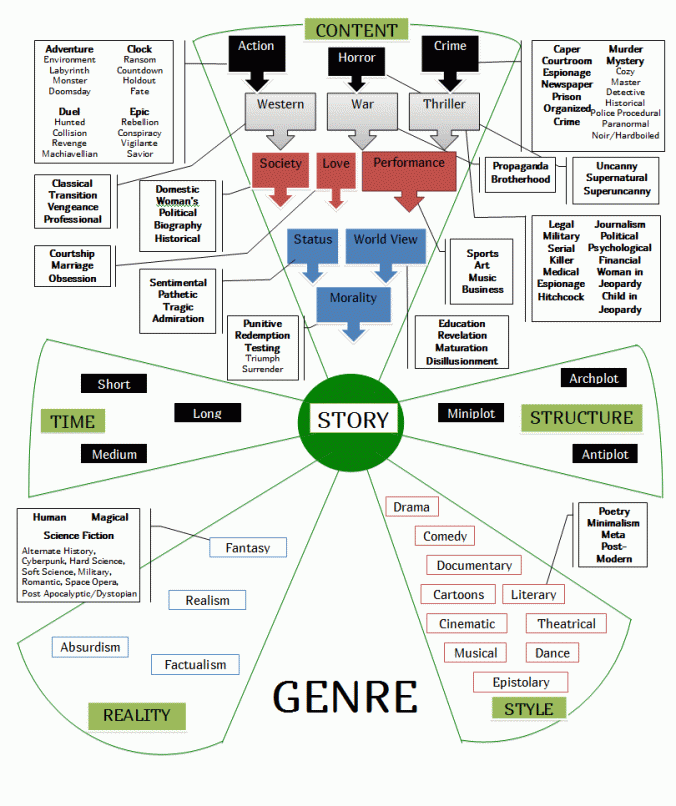
Society Genre stories tend to be idea stories, and there’s a lot of interplay between them and dystopian stories. They’re often used to present an argument for or against a political argument, they tend to be of the “let’s follow your logic to its conclusion” slippery-slope thought process.
These tend to focus on multiple POV’s to get a better look at how the issue impacts others, but that’s not a requirement. Some of the most famous examples only follow one character.
These absolutely require a sub-genra, so the specific beats are going to be dependent on which sub-genre you go with. The Handmaid’s Tale is absolutely an idea story and a society story and a woman vs. society story and a horror story and so on.
Some sub-genres within this sub-genre include, Domestic Society. This focuses on the family dynamic. The core value tends to be the well being of the individual vs. the family unit. The core event tends to be a showdown where what’s good for one clashes with what’s good for all.
Women’s Society tends to concern the struggle of the individual woman versus the patriarchy. The core event of the story is the rebellion or submission of the female protagonist (think Handmaid’s Tale).
Political Society (I would argue all of these are to some degree political, especially women’s society) deals with the struggle for power. The core value is power vs. impotency, and the core event tends to be a revolution. This Les’ Mis, though that also falls squarely under…
Historical Society where any one of the above approaches is used but in a hind-sight being 20/20 kind of way. For this genre to be successful, it needs to be applicable to the modern day. Like how The Crucible, a story about the Salem Witch Trials, was also about McCarthyism. Coyne goes on to say that “using historical details enables the writer to comment on a particular taboo or highly charged moment in contemporary life through the prism of the past.”
Coyne also lists biographical stories within this genre, but I think biographies are something unto themselves. It just depends on how the person telling the story decides to frame it.
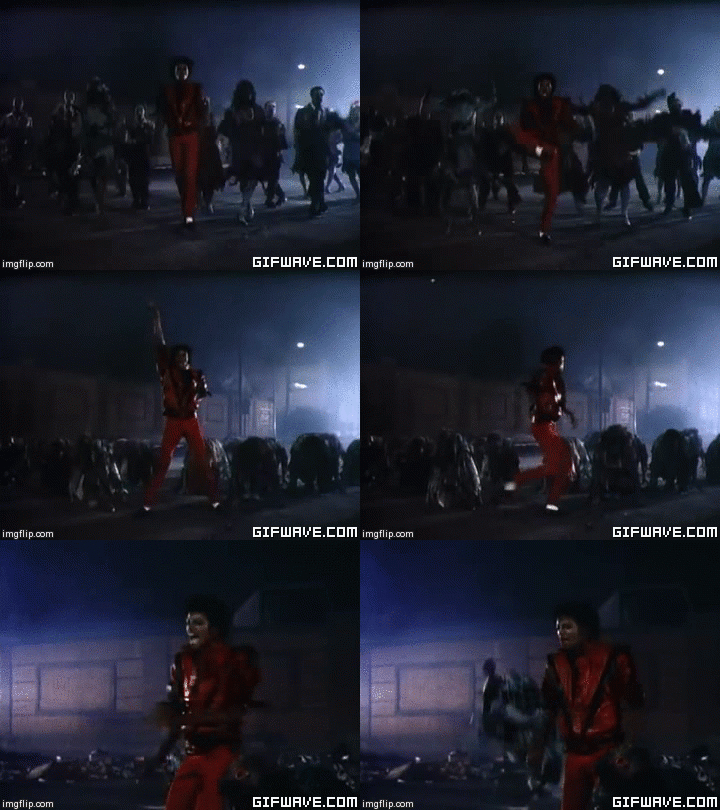 The thriller genre is a mashup of horror, action, and crime. Writing Excuses described the difference between a mystery and a thriller as whether or not the reader knows who the bad guy is and what they’re up to. In a mystery the driving force to turn the page is curiosity. In a thriller, it’s dread. You know what’s coming, the protagonist doesn’t. Like horror, thrillers often go beyond life and death to fates worse than. But a thriller also tends to be a bit more grounded than horror. The villains a bit less like Voldemort and more like Umbridge. He’s out of this world horrifying, she’s the evil you know. Thrillers tend to be more character driven than an action novel because when the stakes are personal (i.e not a bus full of screaming children) and worse than death, you have to care whether the protagonist lives or dies.
 Action stories tend to have big stakes and often (but not always) include explosions. That the protagonist’s life is on the line is a given. Generally so are the lives of other people and monuments. The mind-hack, as Howard Taylor would say, that you are trying to achieve in an action story is an adrenaline rush. A sense of breathlessness that keeps you turning the page. There are tons of great YA action stories. James Dashner, James Patterson, and Scott Westerfeld in particular have done very, very well in YA action.
 Kaitlin Bevis