Why doesn’t anyone bat an eye at all the strange names in the otherwise modern day Persephone universe? Find out below:
Month: September 2016
Juggling Multiple Viewpoints

In season four of writing excuses, my favorite episode was one that focused on juggling multiple viewpoints. I primarily write in first person single narrative, however every now and then, my story leads to a place where I *have* to have another viewpoint character or two.
In Iron Queen, I had to add in Hades and Aphrodite because Persephone wasn’t where the action was. The story from her POV wouldn’t have explained how the gods found her, what was happening on their end, or the struggles they went through. If I’d only done her and Hades or her and Aphrodite, I would have been missing places where the three characters diverged,because plot wise it made no sense for Aphrodite and Hades to stick together during the entire search for Persephone given the fact that Aphrodite was a liability. Hades’s POV was needed to show Zeus going after the gods. Aphrodite’s POV was needed to show Zeus going after the demigods. Both were very important threads.
But it’s not always location based. In Love and War and Venus Rising, I had to add Medea because while Aphrodite and Medea are on the same island, Medea knows things Aphrodite can’t and make no sense plot wise for Aphrodite to learn. I needed an insider. I needed someone on the demigod side otherwise it was going to be a very short, very one-sided story.
I write them all in first person for my current series because that’s been the format so far for my series, but writing multiple viewpoints works best in third limited. I got some complaints about the change in format from Iron Queen, and I’m anticipating them for Love and War. But the story demands it, so all I can do is try to jump POV’s better.
Cue writing excuses. Some of their advice was obvious. Make it obvious who your POV character is right off the bat. My chapter names were the character names, I always had someone refer to them by name within the first few chapters or some other major identifying (“watching my wife chase after a human boy was hell” could really only be one character). And by giving them different voices. I worked very hard on those different voices and some readers will say I succeeded, others wills say I failed. So that’s something I still need to work on. It’s doubly hard for Aphrodite and Medea because the entire point of their characters is that they mirror each other. They are super similar characters that are just at different points in their development. They will be each other’s roads not taken. Eventually. And to do that, there needed to be some pretty heavy similarities.
They had a ton of great advice and pitfalls and over all it was a very informative episode of writing excuses. Take a listen here or read he transcript here.
YA Scavenger Hunt Fall 2016 Announcement!

I’ve been selected to join the YA scavenger hunt!
The hunt begins on Oct 4th and ends Oct 9th

All the authors who signed up to participate in this event were put into teams of 20 by color. There are six teams total this round, and I’m team BLUE!
Check out the rest of my team!

Want to see the other six teams? Check them out here!
Be sure to follow along with the scavenger hunt for lots of great prizes. For how to play, visit here. To see all the books (and vote for mine 😉 ) check out this goodreads list.
FAQ Friday: Why doesn’t Persephone recognize references to herself?
If Persephone is learning mythology, why doesn’t she recognize references to herself in the myths she’s learning about in school?
Because Persephone lives in an alternate universe where the myths are still unfolding. There IS no Persephone in mythology yet. She’s THE Persephone. Not a reincarnation, not a cyclical version of herself trapped in a recurring myth. There has never been a Persephone before her that had any mythological relevance and there won’t be one after her. That’s also why she doesn’t recognize Orpheus’s name or many of the other names of famous mythological figures she encounters. She recognizes the name Demeter, but she thought the name of her mother’s flower shop was just a play on the ancient goddess as Demeter doesn’t go by Demeter in the modern day (literally no other character that wasn’t a god ever referred to her by name, so I didn’t have a chance to explain that without it seeming info dumpy until she introduces herself to one of Apollo’s priestesses in book 3).
I tried to show that Persephone is set in a previously Persephone-less world by opening with her teaching talking about THE myth that’s used to explain the origin of Winter. In our society, that myth is the Persephone myth. In this one it’s not. They used a similar (and yes, existing. Boreas and Oreithyia are mythology figures and that is their story even outside the world of my book) myth. That’s the myth that school children everywhere learn instead of the Persephone one. Because there is no Persephone one. It hasn’t happened yet.
The Four Principles of Puppetry
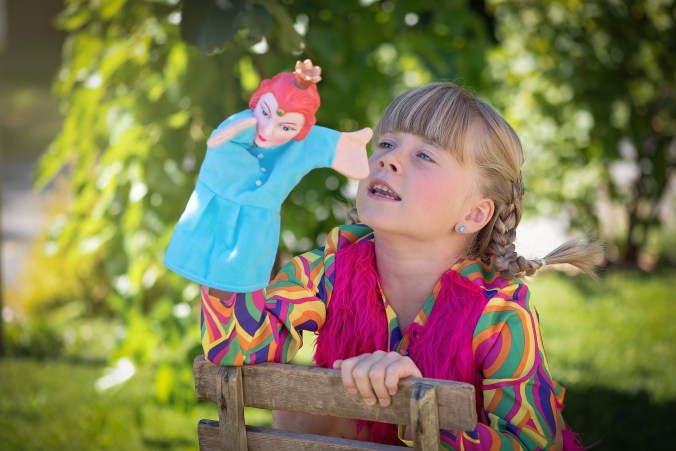
I’m almost caught up with the current episodes, but it’s been several seasons now and my favorite episode hasn’t changed, so I thought I’d share it with you. It’s The Four Principles of Puppetry with Mary Robinette Kowal. Mary explains what the four principles of puppetry are and how they relate to writing in general, and her insight is amazing. It completely changed the way I looked at character action. You can listen for free here or read the transcription here.
Talk Like a Pirate Day!

Today is talk like a pirate day! My daughter has a ton of fun with this. If she dresses head to tail like a pirate, then she gets a free donut from Krispy Kreme. The donuts even look like pirates :D.
There’s all kinds of fun deals on talk like a pirate day. Go check them out.
FAQ Friday: Why Does Persephone Go by Kora?

In Persephone, and certain parts of Daughter of Earth and Sky, Persephone goes by her middle name, Kora instead of Persephone. This is actually a nod to the original myth. Before Persephone’s abduction to the Underworld, she was only referred to in mythology as Kore or Kora, which translates to girl or maiden.
In other words, in the myth she didn’t get a name until she became someone important.
Names mattered a lot in Greek Mythology. The gods had entirely different names or titles for different roles they played. So it only made sense to make sure that names mattered a lot in my series.Every book title is one of Persephone’s titles, and there’s a lot of character development that goes into Persephone choosing to abandon her more “normal” sounding nickname, and embracing the name Persephone. At first she lets people call her Persephone in the Underworld because she figures she won’t be there long enough, and the people there don’t matter to her enough, to bother correcting them. But over time, the people there and her time there come to matter so much, than in book two when she’s returned to the living realm, it feels strange when people call her Kora. By book three, when she’s completely given up clinging to both her idealized version of her human and the parts of her divine life she likes, and embraced her actual life, the name Kora is never uttered again because she became Persephone.
Using different names for different roles, particularly related to age, isn’t unique to Greek culture. Childhood nicknames are common. When I was really little, my nickname was Katie, and it’s telling who still calls me that. Older family members. Because to them, that’s who I’ll always be. When I hit my teenage years, I decided to go by Kat, which I loved. But as I grew up, introducing myself as Kat started feeling strange. So everyone in my adult life calls me Kaitlin except for a few friends from high school, because to them that’s who I’ll always be. I was a different person entirely in high school, and THAT was a different person from the little kid known as Katie.
Outside of age, the names I go by today show a lot about my relationship with the person using them. People who call me Ms. Bevis for instance don’t know me at all. But the person who calls me Mommy knows me on an entirely different level than all my friends that call me Kaitlin. And that’s a whole different relationship than the man who calls me hon. Names matter.
What names do YOU go by? What do they say about you? What do they say about the people using them?
Writing Excuses: Endings

As you all know, I’ve struggled with my endings. Ending a book is hard. But my favorite episode in Writing Excuses season 2 focused on endings. How to write them, what to do, what not to do. The most useful tidbit that I got out of this is how Howard approaches his endings. He waits until he’s about ¾ of the way through an arc, then goes through the story with his writers group and asks “what promises have I made to the reader?”
Honestly, that’s genius. If I did that in my writer’s group, I’d instantly have 9 different opinions on how the book should end. People would make connections I hadn’t thought of in ways I hadn’t thought of it. It’s a great exercise, and one I intend to use going forward.
But not with a series, because 1. I can’t ask my writers group to go back and read the last 6 books. And 2. Series introduce their own ending problem.
When I wrote Venus Rising, my ending kept falling flat. I went through the book and asked myself what promises I made to the reader, and realized I was meeting all of those. So I went through the trilogy, what promises was I making? Well, I’d met all those, so what was the problem?
The problem was that this book, standing alone by itself didn’t make the promises I’d made to the reader in books 1 and 2 matter. If I’d ended the series at book 2, the ending I’d written would have resonated perfectly. But because book 3 was written without including more than a scene or two referencing some of the sub plots that were wrapped up in book 3 (because I didn’t have a POV character in the place where all the sub plot stuff was happening) the ending lost all its power. So identifying, yes, I’m keeping these promises is important, but identifying, well, I am keeping this promise but I didn’t make this promise this book, is also important. In the case of Venus Rising, it’s going to take some restructuring, possibly the addition of another POV character, at minimum more scenes with this specific group of characters to make those aspects of the ending feel like they matter.
You can listen to this episode of Writing Excuses here or read the transcript here.
Guest Blog by Eva Pohler: Noble Monsters
Noble Monsters
Thanks so much for having me on your blog, Kaitlin. You asked me to talk about one of my favorite myths, and it just so happens to be one of the most popular: the Persephone story.
The Persephone myth was my introduction to Greek mythology. I was in the seventh or eighth grade and found it in my English teacher’s library. From that moment on I was hooked.
As I became older, I wondered how a story about an innocent girl being tricked into marrying the god of the most repulsive realm could possibly have appealed to me. I was a feminist, wasn’t I? This was absurd.
But you know what? Beauty and the Beast became my favorite Disney story, and we all know which Greek myth inspired it. So why would a girl, and, later, a woman, who considered herself to be an advocate for women’s rights, adore a story about a girl being held in captivity until she fell in love with her captor?
After years of therapy–just kidding! After years of self-analysis, I came to this conclusion: It wasn’t Persephone’s (or Belle’s) captivity that allured me; it was the unloved, misunderstood monster who needed the opportunity to be redeemed.
And now when I look back on my young adult novels based on Greek mythology, I see that I tend to take up for those innocent monsters: Medusa, the Minotaur, and even, to some extent, Scylla. But the monster I have come to defend most in my writing is Hades, because, really, if you study the classic myths, he was the most noble of all the gods despite the lot her drew that condemned him to rule the Underworld.
Back then, girls and women were viewed as property, spoils of war, and the caretakers and nurturers for the people with real power. So when Hades asked Zeus if he could have his brother’s daughter for his wife, and Zeus agreed, there was no obligation for Persephone’s wishes to be consulted. The male deities had an agreement, and unlike the one between Tevye and the butcher in Fiddler on the Roof, even a dream about a dead relative couldn’t get Persephone out of it.
My novel, The Gatekeeper’s Bride, set during and after The Trojan War, tells their story as I believe it really happened. In my series, Hades has a saying: “Life isn’t fair, but death is.” My series shows his true nobility–unlike the way Disney portrayed him in the animated film Hercules, in which the lord of the Underworld is conflated with the Satan of hell.


PERSONAL LINKS
- http://www.evapohler.com
- Eva Pohler’s Book Page on Facebook
- Eva Pohler on Pinterest
- Bookbub
- Goodreads
VERIFIED SERVICES
View Full Profile →s Blo
FAQ Friday: Roman VS Latin Names

Why is a Professor teaching a group of high school students, and shouldn’t he be using using the Roman names since it’s a Latin class?
Professor Homer is modeled after two of my high school teachers, a certain professor (and that title was a matter of pride to him, so we did use it despite being a high school) and my Latin teacher. My Latin teacher was the sweetest old man you’d ever meet, and he felt it was important to distinguish between Roman and Greek deities. Minerva is not just Athena with a different name. She’s an entirely different god. There’s tons of similarities between them in the same way there’s a ton of similarities between Samhain and Halloween. There are enough differences distinguish between the two holidays just like there are enough differences to distinguish between the two gods.
**I do need to add that while they are different gods, even within their own specific culture they could be worshiped for different roles by making slight variations on the name. So the blending of the gods worked very well because both cultures believed that there were many different aspects to each god. Add that to the oral tradition and the far flung reach of each deities worshipers, and you get some major variations in personality and sequence/existence of events.**
Anyway, I decided to take the same approach my Latin teacher did with my stories by sticking with the spellings of the version of the myth that inspired me most. Professor Homer only tells one myth in the entire series, and that’s the abduction of Oreithyia. The earliest myth of Boreas and Oreithyia I could find was from one of the Simonides fragments (534 to be specific) and it features an Athenian Princess, so to me it made sense for him to stick with the Greek names.
However, if it makes you feel better about him as an educator, he did go over the proper Roman names and roles at the beginning of class. The story just picks up after that classroom lecture.
 Kaitlin Bevis