Writing on Wednesday: The Snowflake Step 5

ice-crystal-1065155_1920

Step five of the snowflake method is to write a character synopsis for each character in the book. Major characters get one page, minor get half a page. This builds on step three. To get the most out of this part of the snowflake, I suggest writing each one from the character’s point of view, as if they were recapping events. This help builds the character’s voice and tells you really useful things like what minor characters were doing while they were off screen for major chunks of the book. This step right here was probably the most useful step in drafting Aphrodite 3–Untitled, because I had so many characters to keep track of and their different interpretation on events impacted the plot in a big way.

Here’s an example of a character synopsis from a fairly minor character in Aphrodite 3– Untitled. I’m only including the first two paragraphs to avoid spoilers, but this should give you an idea.

Now, this is not my best writing ever, or particularly good. This drafting was purely for my benefit, so it hasn’t been polished or made pretty.

~@~

I have nothing against Persephone as a person, but I don’t trust her as a leader. I advise her, push her, and outright bully her to take a more extreme stance against the demigods, sensing her hesitation to do anything that could endanger Hades or make her responsible for lost lives. I thought she was being weak.

When I meet up with Aphrodite and Medea in the dreamscape, I give Aphrodite advice and am pleased to see how far she’s come, though she still has Persephone up on a pedestal. Even Poseidon seems to worship the very ground Persephone walks on. I also get a feel for Medea and realize she’s a very broken, very unstable young girl. But I think we can help her. Furthermore, I think we should……


Mythology Monday: The Argonauts Returned Home

streamer-1194567_1920

**Spoiler warning for anyone who has not read Aphrodite. Also, very rough draft from Love and War**

“SURPRISE!” A wave of voices burst from a sea of golden people crammed into the tiny space.

Ares’s hand steadied me when I jerked back in surprise. “I swore I wouldn’t spoil the surprise,” he murmured in apology.

“Look at her face,” Medea beamed. “She had no idea.”

“Uh, this is…Wow!” I glanced around the room, speechless. A tacky banner hung over the floor to ceiling windows on the back wall proclaimed “Welcome Home Elise!” “Thank you.”

Jason walked to the front of the crowd, a broad smile on his face. “We figured you deserved a hero’s welcome. This is Otrera,” he beckoned to a slim, golden girl. “And Glauce,” he motioned another girl forward.

“So nice to finally meet you,” Glauce gushed, shaking my hand.

“Hi,” Otrera said with an awkward smile.

A lanky boy whose golden features were the only thing going for him shouldered his way up to the front of the crowd. “I’m Deucalion.”

“Nestor,” another interrupted.

“Idas!”

The names just kept coming in an overwhelming cacophony of noise until one smooth voice interjected with a “We’ve met.”

“Narcissus.” My heart stuttered in my chest, skin going cold despite the pleasant temperature of the room. He ran Adonis’s modeling agency, but not Elise’s. The demigod, apparently one of the leaders of DAMNED, had been on the cruise, we’d even had dinner together.

“I’m glad to see you two here.” He clasped Ares’s hand in a firm shake.

“Glad to see you,” a familiar voice echoed from behind him. Narcissus’s assistant was never far from him.

“Where were you?” Ares demanded. “We tried to find—”

“Tantalus teleported me to the island. He was convinced there were gods on board trying to take my place using glamours.” Narcissus shrugged, batting a balloon away from his face. “I never saw hide nor hair of anyone other than the redhead, and she was in no shape to do any harm. But better safe than sorry.”

“So you just left us behind?” I crossed my arms.

Suddenly the party guests became very interested in the snack table set up on the other side of the room.

Narcissus had the grace to look ashamed. “I assumed he’d get you two next.”

“Well, you weren’t wrong.” I forced a smile to my face.

“I had no idea he would hurt you,” Narcissus said softly. “I am sorry about that.” He glanced around as if hoping someone would come to his rescue. “Enjoy your party.”

~@~

When the Argonauts returned home, there was a huge celebration, but Jason’s father, Aeson, was too old to come out and see his son, much less dance and drink the night away. So Jason asked Medea a favor. Could she take some years off his life and give them to his father?

Touched, Medea agreed, but at no cost to Jason’s life force. She withdrew the blood from Aeson’s body, added some herbs, then returned the blood back to his veins. (How?! You may ask. I have absolutely no idea. But holy cow!) The old man became energized and youthful again. Elias’s (the evil uncle that sent Jason on the quest to begin with) daughters saw this miracle and wanted the same service for their father, and might have gotten it, had not Pelias been a two-faced liar that refused to give Jason the throne. Instead, Pelias drove Jason and Medea into exile.

The two settled in Corinth and had two children. Medea, remembering the girl’s interest reached out to them and offered to teach them the secret of restoring vitality out of the “goodness of her heart.” All they had to do was chop their father into pieces then boil them in a caldron of water and herbs. She even demonstrated by turning an old goat into a lamb. Elated, the girls ran home and chopped their father into bits. But the herbs Medea gave them had no magic so Pelias did not come back to life.

Pelius’s son became King and eventually Jason and son attacked, took over the Kingdom, and they all lived happily ever after.

Not! Remember, this is a Greek myth. Tragedy ahead. Tune in next week, for Medea.

B-Fest Appearence

I’m going to be at B-Fest tonight at 7:30 in the Athens Store. If you’re in the area, come on over and check it out.

Event description below:

CjqHUF_WEAAqWDv

Friday at 7:30 PM B-A DAUGHTER OF ZEUS: Meet local author Kaitlin Bevis and get introduced to Persephone, star of her teen fantasy series. Persephone is just an average Athens teenager– goes to Athens Academy, plans to attend UGA when she graduates, hangs out with her friends in Five Points– until she discovers that she is actually the REAL Persephone, a Greek goddess inescapably entwined with Hades, god of the Underworld. If you loved Percy Jackson and are ready for a teen version of life with the gods, this is the series for you. Perfect for fans of The Goddess Test Series by Aimee Carter. All four books of the series will be available for sale and signing by the author. Wear your toga!

Writing on Wednesday: One Page Summary

ice-crystal-1065155_1920

The fourth step of the snowflake method is to turn your one paragraph summary into a one page summary and it’s ridiculously easy.

See, if you’re anything like me, you felt like your one paragraph summary didn’t capture enough of the story and you’ve been itching to fix it. Well now’s your chance.

To do this step, take each sentence in your one paragraph summary and expand it into a paragraph.

Here was my one paragraph summary for Persephone:

Persephone thought she was just a typical, modern day teenager until she realized she was being stalked by a season.When Boreas, the god of Winter, attempts to whisk her away to a not so winter wonderland, she’s rescued by Hades and offered refuge in the Underworld.
Unable to physically reach Persephone in the Underworld, Boreas begins going after her through her dreams. When Persephone learns to defend her mind from the deranged ice god, he kidnaps Persephone’s best friend and threatens to kill her unless Persephone agrees to take her place. In a desperate bid to save her friend, Persephone embraces her power as a goddess and succeeds in killing the god of winter, only to learn an even larger danger is lurking closer to home than she had ever imagined.

Now break it down by sentence.

Sentence 1: Persephone thought she was just a typical, modern day teenager until she realized she was being stalked by a season.

Paragraph 1: Persephone thought she was just a typical, modern day teenager until strange things started happening around her. Girls are snarky with jealousy, water turns to ice whenever she’s around, her best friend is acting like she’s hiding something from her, and her car was nearly blown off the road by a freak ice storm in the middle of Atlanta. But it isn’t until a guy tries to drag her out of her mother’s flower shop, screaming that she’s a daughter of Zeus that her mother finally fesses up.

Persephone’s a goddess.

Sentence 2: When Boreas, the god of Winter, attempts to whisk her away to a not so winter wonderland, she’s rescued by Hades and offered refuge in the Underworld.

Paragraph 2: Persephone thinks her mom has lost her mind. She runs away to her friends house only to discover that her best friend is also in on the secret. Before Persephone can process that they might actually be telling the truth, she’s attacked by a season. Boreas, the god of winter, has his eye on Persephone and now he wants to whisk her away to a not so winter wonderland. She’s rescued from the serial rapist by Hades, Lord of the Underworld, and offered refuge in the Underworld until the end of winter. The catch? He has to marry her to take her there.

Sentence 3: Unable to physically reach Persephone in the Underworld, Boreas begins going after her through her dreams.

Paragraph 3: But marriage doesn’t mean much among the gods, and Hades doesn’t seem interested in the profoundly younger goddess. Persephone gets to know the residents of the Underworld and discovers the place isn’t the epicenter of doom and gloom that she’d been imagining. And Hades isn’t so bad himself. She’s just starting to get the hang of the whole Underworld Queen thing when Boreas attacks her in her dreams.

Sentence 4: When Persephone learns to defend her mind from the deranged ice god, he kidnaps Persephone’s best friend and threatens to kill her unless Persephone agrees to take her place.

Paragraph 4: Hades realizes the younger goddess has no clue how to protect herself or use her powers, so he takes it upon himself to teach her. The more she learns, the closer they grow. Meanwhile, Boreas is rapidly running out of winter, so in a last ditch effort to get his hands on Persephone, he kidnaps Persephone’s best friend, threatening to kill her unless Persephone turns herself over to the deranged ice god.

Sentence 5: In a desperate bid to save her friend, Persephone embraces her power as a goddess and succeeds in killing the god of winter, only to learn an even larger danger is lurking closer to home than she had ever imagined.

Paragraph 5: Despite Hades’s protests, Persephone leaves the safety of the Underworld and faces down the god of winter, determined to save her friend and find out why he’s so obsessed with getting his hands on her. She discovers Boreas is working for Zeus, her father. Persephone succeeds in destroying the ice god, but at great cost. Her best friend is killed in the cross fire. Persephone makes a deal with a Reaper to restore her friends soul and inadvertently locks herself into a promise to keep his shady dealings from Hades. Since gods can’t lie, her promise is binding, and it isn’t until after she makes the deal that she discovers the reaper is working for Zeus and the Underworld is in more danger than she ever could have imagined.

Put it all together and that’s a pretty decent one page summary of Persephone. Is it the greatest summary ever written? No.But it’s considerably more comprehensive then what I sent out in my query letters. If Persephone weren’t already out in the world, I’d spend many more hours polishing this summary into a better reflection of the book. (I’m really proud of my book 6 one page summary, but alas, spoilers). But as an example of how a single paragraph might expand into a page, this works.

Even if you don’t use the snowflake method to outline, this has changed the way I look at my one paragraph and one page summaries for query letters. It’s worth it for that alone. And I haven’t even gotten to the good parts yet.

More on Characters next week.

Mythology Monday: A Wedding and a Sandbar

maldives-698501_1920

He stayed with me while I cried. He let me cry. Not once did he tell me to shut up, or stop over reacting. There was no trying to pretend like nothing was wrong or making me feel stupid or emotional or anything else. The man just sat beside me, offered me his shoulder, and wrapped an arm around me until I finished.

No one had ever done that for me before. Not that I could remember. It was the most I’d connected with another human being for over a decade. I fell in love with him right then. Amazing how powerful something as simple as touch and sympathy can be.

I cried until I was exhausted. And then, only once he was sure my tears were spent, absolutely sure I was on somewhat stable ground, he told me how much trouble we were in.

Turns out my mom had an army.

~@~

Next on their journey, the Argonauts stopped at a place called Drepane, which was ruled by a virtuous king named Alcinous. You may recognize his name from The Odyssey (the happy home where Odysseus tells the stories of his wanderings). Unfortunately, the Colchian fleet (the army from the kingdom where Jason took the fleece, and Medea, and killed the king’s son) arrived shortly after and demanded the return of their princess. Alcinous mediated between the two sides, and in an offhand comment informed his wife, Arete, that if Medea was still a virgin/unmarried, he would return her to her people.

You know, cause women are property and stuff.

Arete wanted Medea to be able to make her own choice, so she told the Jason and Medea what she’d learned from her husband. Medea and Jason married right away…and consummated their marriage on the Golden Fleece (possibly the best f-you in all of mythology).

Thrilled with the marriage, the Argonauts set off for home and were immediately driven off course by another gust of wind. Their ship was beached on a huge sandbank (the Syrtes) near Libya. In true, over dramatic manly fashion, the Argonauts all resigned themselves to death and part ways to die heroic, individual, lonely deaths. Medea hangs out with her maids on the beach and talked about how much it sucked that after all they’ve been through, they’re beached.

Meanwhile, Jason was visited by three nymphs who gave him step by step instructions to get out of his mess. All they had to do was carry the boat across the desert.

Twelve days later, and two Argonauts short (Mopsus to a snake bite and Canthus to a Shepherd fight) they arrived at Lake Triton and the Hesperides garden where they just missed Hercules. Triton Lake opened up into the sea so the Argonauts made their way toward home. Again. Only this time, they made it. But more on that next week.

Ice Cream Social and Author Talk

I’ll be at the Oconee County Library this Sunday to sign books and answer questions. Drop on by and say hello.

I SCREAM FOR LOCAL AUTHORS

Writing on Wednesday: Snowflake, step 3

ice-crystal-1065155_1920

The third step in the snowflake method has to do with characters. The snowflake website says to do this step for each of the main characters, but I do it for all of the named characters in my book who have more than two or three lines of dialogue.

For each character take an hour and write the following:

  • The character’s name
  • A one-sentence summary of the character’s storyline
  • The character’s motivation (what does he/she want abstractly?)
  • The character’s goal (what does he/she want concretely?)
  • The character’s conflict (what prevents him/her from reaching this goal?)
  • The character’s epiphany (what will he/she learn, how will he/she change?
  • A one-paragraph summary of the character’s storyline

This step, particularly the one paragraph summary of the character’s storyline is really helpful to me, because I have so many moving pieces that it’s important that I know what each character has been doing in the background during all the events of the story. Even if they don’t appear “on screen,” knowing what they’ve been up to, why they’ve been up to it, and what conflicts they’re facing helps flesh them out.

Here’s what step 3 looks like for me in scrivener.

Screen Shot 2016-04-26 at 11.11.44 AM

Last Day of School

Today is a very special day. My daughter’s last day of school in the primary classroom at her school.

Bella goes to a Montessori School, so instead of having traditional grades (she’s in Kindergarten), they have age bands. Bella has been with her class since she was three years old, and today is her very last day as an all-important third year. Next year she’ll be moving on to the 1-3rd grade lower elementary classroom.

So, I’m offline today, celebrating this very important milestone to my child. Enjoy your summer everyone :).


Writing on Wednesday: Book Review

For today’s Writing on Wednesday, I’m taking a break from the snowflake method to review the lovely Molly Ringle’s Underworld’s Daughter.

Molly was the guest author on this blog Monday, and many of you will remember the review I did on her first book, Persephone’s Orchard. 

So without further ado…

perf5.000x8.000.inddMolly Ringle does an amazing job balancing multiple story lines spread across time and multiple characters. She also does an amazing job managing the impact those multiple sets of memories and roles would have on modern day characters. I see glimmers of the past within each of the modern characters but they are still very much their own people.

I was a little hesitant when new POV characters were introduced, but before long, I fell in love with each and every one of them. Molly describes this book’s take on the myths more of “Greek mythology fan fiction” as opposed to retellings, but to me that made it more fun. I’ve read the Greek myths. I’ve read a thousand retellings, I’ve written my own. But done right, a retelling should be original to the author, and if it’s original to the author, it’s going to eventually leave the myth behind to tell the rest of the story.

The ending of this particular story was both heart wrenching and shocking. It immediately had me reaching for book three. I can’t wait to see how it ends.

Molly Ringle’s Take on Adonis

Today I’m pleased to present a very special guest blog from one of my favorite mythology re-writers, Molly Ringle. If you haven’t checked out the Crysomelia Series yet, you’re missing out. But don’t worry, you can fix it. The first book is only .99 cents today on kindle, so if you were ever going to start the series, now is a great time.

Molly is here today to talk about a character featured in each of our books. Adonis. So without further ado, let me turn things over to her.
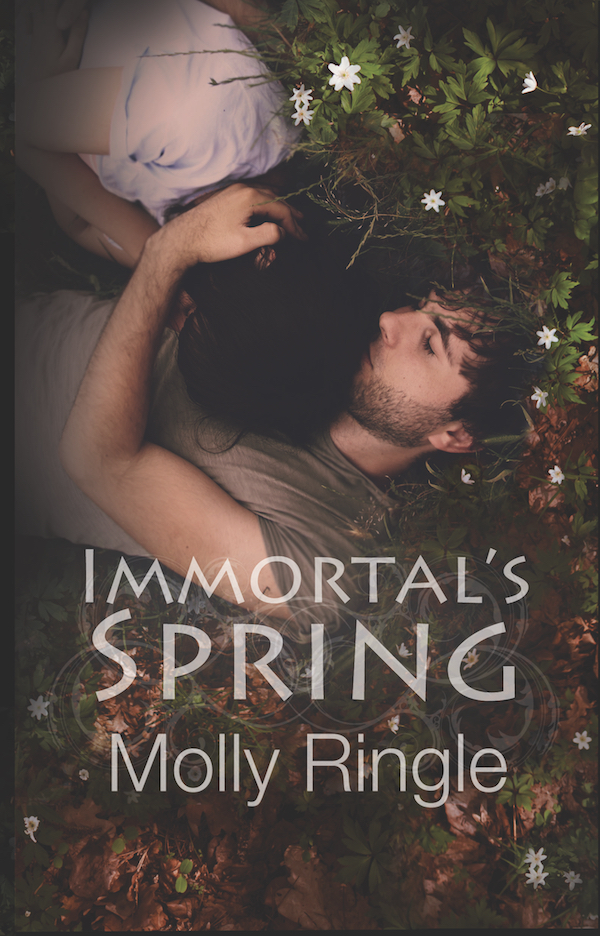
Immortal's Spring cover high res 600 x 900

Hi everyone! I’m Molly Ringle, a fan of Kaitlin Bevis’ and a writer of my own trilogy of Greek-myth-based novels, which starts with Persephone’s Orchard. This week we’re exchanging guest posts on one of the characters we’ve both featured fondly: Adonis.

People usually know what it means to be called “an Adonis:” namely, the person in question is a beautiful, desirable male. Such figures are much adored by legions of women; in the modern world they’re often celebrities known for their good looks. (I ran a search on “Adonis” on Pinterest just now, and got several photos of Harry Styles, among others.)

In mythology, Adonis was a youth so beautiful that even the goddess of love herself, Aphrodite, could not resist him. The pair became legendary lovers, but their relationship was plagued by complications and tragedies, as is typical in Greek mythology. At one point—sources usually say it was in Adonis’ infancy—Aphrodite, already charmed with him, sent him to the Underworld for safe keeping in Persephone’s care. But Persephone became entranced with Adonis as well, and refused to give him back. Zeus had to settle the case: Adonis was to spend four months of every year henceforth with Persephone, four with Aphrodite, and four in whatever way he chose. (People usually say he chose to be with Aphrodite for those.)

That arrangement is curiously like Persephone’s own: part of the year in the Underworld, part of the year in the upper world. Adonis’ ties to the land of the dead end up manifesting in another way too. In mythology, he dies young, usually said to be killed by a boar sent by a jealous rival. Ares, god of war and intimately involved with Aphrodite himself, is often named as the culprit. The heartbroken Aphrodite brings Adonis to new life, in a sense, by transforming his blood into the red anemone flower. And some versions of the myth claim that, like Persephone, Adonis still gets to spend half the year above ground with his lover, even after his death.

Thus he belongs to the class of resurrection deities, or dying-and-rising gods, a group in world religions that also includes figures such as Osiris, Attis, Dionysos, and Jesus. In Ancient Greece there were cults and festivals dedicated to Adonis, in which celebrants (most often women) lamented the yearly death of the lovely young man, and honored the new life that would arise from his sacrifice—a representation, most say, of the cycle of agriculture, in which plants must fall at harvest time but will sprout again in spring.

MY VERSION

In my series, we first meet Adonis briefly in Persephone’s Orchard as a handsome young mortal, a favorite of Aphrodite’s. In the second book, Underworld’s Daughter, we get a closer look at his unhappy childhood, and his disappointment at remaining mortal while his beloved entertains so many enviably immortal men and refuses to be fully faithful to Adonis. After an emotional breakup with her, Adonis ill-advisedly picks a fight with Ares, and takes a lethal knife wound to the belly. Hermes and Aphrodite rush him to the Underworld, hoping for some miracle from Persephone or Hekate, which they get…and that’s where my version really starts to diverge from tradition.

The Underworld magic makes Adonis immortal, but he is still estranged from Aphrodite (who leaves after making sure his life is saved), so he decides to roam the Mediterranean a while and take on a new identity to go with his new immortality. Hearing legends about a dying-and-rising god called Dionysos (who doesn’t truly exist in my version; he’s just a myth), and finding Dionysos’ legends similar to his own story, Adonis drops his old name and takes on that one. Henceforth he will be Dionysos, god of wine, revels, madness, and death-and-resurrection festivals.

Nowhere in mythology does anyone claim that Adonis and Dionysos are one and the same, by the way. I am aware of this. But it struck me that they shared many similarities, and not just because they’re both resurrection deities. Both are also fairly peaceable and non-warlike compared to most of the male gods (although look out for their followers, who might rip you apart). Both have cults that are primarily made up of women. Apparently the rites were often similar in both types of cults, too. So, in my self-appointed task of writing crazy fan-fiction about Greek mythology, I decided I could make a case for this unusual move.

Then, more remarkable still, in reading Kaitlin’s latest installments of the Daughters of Zeus series, I discovered she’s made a similar transformation with Adonis! She wraps his identity up with that of another god too (SPOILERS!)—Eros, in her case; which makes sense, given Eros also has a close link to Aphrodite in the myths, and Adonis surely inspires passion in the world just about as much as Eros does. Kaitlin and I had no idea we were both writing the same type of plot detail for this character (though plenty of our other details differ), which makes it especially interesting: is there something inherent about the archetype of Adonis that suggests transformation? His death-and-resurrection-ness? His being passionately worshipped yet wrapped in mystery? His blend of good fortune and victimhood?

Probably all of that. Adonis may be known these days as merely a pretty face, but like all the Greek gods, he represents so much more than that, and it turns out Kaitlin and I, along with a lot of other people, can come up with quite a bit to say about him. If our new retellings give people a fresh and interesting way to think about the myths, then they were worth writing!

5173tsKIxpL._UX250_


Molly Ringle became fascinated with the colorful weirdness of the Greek myths when she was a kid, and after writing several other novels of love and the paranormal, she finally wrote the Persephone-and-Hades story that had been evolving in her head all those years. It turned into a three-book series, much to her own surprise. She lives in the Pacific Northwest with her husband and sons, and she honestly loves the rainy climate there.