Mythology Monday: Tantalus and the Cursed House of Atreus

Tantal

“You know, if I had a gorgeous goddess following me, I’d slow down.”

I turned, following the deep voice to its owner. Another demigod stood beside the silver set of double doors that led to the auditorium. He looked taller than Adonis, but about as muscular. If Adonis got into heavy steroids. Seriously, I couldn’t decide if I felt impressed or frightened. It’s a thin line.

“Tantalus.” He offered his hand, then shifted, grabbing me before I walked into the “Private Function” sign mounted on a gold pole. “Watch out.”

Letting out an embarrassed laugh, I stumbled into Tantalus. I shouldn’t be so hard on myself; I’ve only been walking for three years. It takes practice. “Thanks.”

“Here for the convention?” He kept his hands on my shoulders and didn’t move away from me or out of the way of the door. Ignoring the people streaming around him, he looked me over. Clearly, he liked what he saw.

Finally! Some appreciation. I could do with a little more reverence and a little less attitude. Especially if it came from someone who looked like this.

Tantalus noticed me noticing him and puffed up with pride. My interest wavered. “Um…actually…” I didn’t want to get into my whole investigation in this crowd. One on one, I could always charm him into not telling anyone what I’d shared and charm him into reporting to me if he saw anything suspicious. But in a room like this, there was no telling how far even a whisper could carry. I’d rather not waste the energy charming an entire convention into silence. I searched for another reason for being here, but drew a blank. “I’ve always wanted to go on a cruise?”

Stopping at the edge of the auditorium, I leaned against the back wall, soundproofing fuzzies tickling my bare arms. Adonis stood out like a golden beacon in the crowd, somehow managing to almost glow despite the dim light.

I scoped out the rest of the room, taking a moment to get my bearings. Booths, set up in semicircles so everyone seated could see the stage, spread to either side of the auditorium. The walls and tables were accented with silver swirls that glittered against the black. No one sat. The atmosphere in the room felt rushed and impatient. Sitting would indicate a time commitment no one seemed to want to fill.

Tantalus smirked and leaned against the wall beside me, hand planted right next to my head. “I’d buy that, if I ran into you on deck.”

What difference would that make? I cocked my head. “What is this anyway?”

“Orientation.”

Ah, for the convention. That made sense. “Maybe I’m just enjoying the view.”

He beamed. Gods, men were so easy to flatter. Tantalus stepped in front of me, holding out his hands as if he were the gods gift to man. Which technically speaking…. “Well look no further, sweetheart.”

A violent shudder wrenched through me at the term of endearment. I wrapped my arms around myself as if I’d shivered.

“Cold?” His eyes flickered over me. “If you want, we can ditch this and go someplace warmer.” His tone made the request behind his offer crystal clear.

I kept my eyes on Adonis, considering Tantalus’ proposition. Well, not considering that angle of his proposition. I prefer men who worship me, not themselves.

Adonis stood in the center of the crowd, deep in conversation with a short, brunette woman. I did double take. She was one of the Plain Janes. The rest of the trio stood close by, chatting up another model. They were here for the modeling convention? Huh. Adonis nodded at something she said, not once looking away to search for me in the crowd.

No. I wasn’t going to do this. Goddesses didn’t follow guys around and stare at them across rooms hoping to catch them trying to steal a glance. A goddess did not pine. And as much as I wanted to convince myself that my only motivation to keep an eye on Adonis was my investigation, I knew that wasn’t true.

But Tantalus? Tantalus wouldn’t question me following him around. He’d actually welcome my attention. And I wouldn’t be heartbroken if something happened to him. That made him good bait.

~@~

Tantalus was a demigod, the son of Zeus and a nymph. He was invited to a dinner on Olympus by Zeus, and while there stole ambrosia and nectar and the gods secrets. He also might have had a part in stealing Rhea’s dog, but that’s debatable.

Following what I believe to be a pattern of Ambrosia driving demigods crazy (it is deadly to mortals, but demigods had it on occasion, often before doing incredibly stupid things with very little motive given) Tantalus made misguided effort to appease the gods by killing his son, Pelops, by boiling him alive, slicing him up, and serving him to the gods at dinner.

The gods caught on pretty quick to the human flavored feast before them and most of them did not partake. Demeter, distracted by her worry for her missing daughter, took a chunk out of the kids shoulder before realizing she’d consumed human flesh.

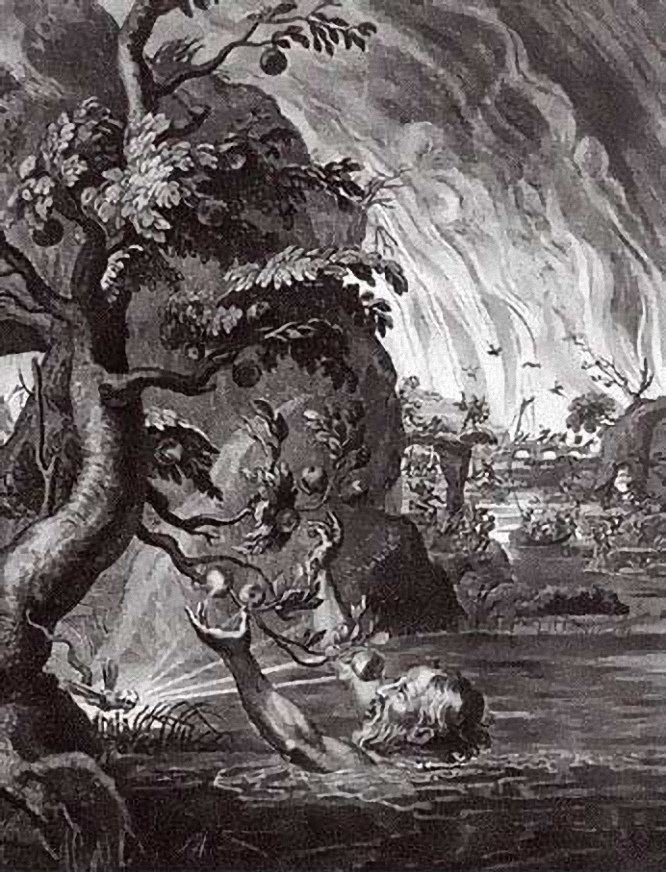
Tantalus was killed and sent to the depths of Tartarus for his crimes. His punishment was to stand ankle deep in water and look up at a cluster of grapes hung just out of reach as he starved and thirsted to death for all eternity. His location is a bit precarious as the giant boulder that another resident of Tartarus has to push up the hill everyday looms above him, precariously perched.

Meanwhile, the Fates gathered the body parts of poor Pelops, and Hephaestus made the kid a new shoulder out of ivory, marking him and his descendants, and he was brought back to life. Poseidon took the kid under his wing and taught him to race chariots until Zeus randomly decided Tantalus’ entire family line needed to suffer. Tantalus’ descendants became known as the cursed house of Atreus.

Pelops went on to win a chariot race for the hand of a woman named Hippodamia. But he won by cheating and sabotaging her father’s chariot which crashed and killed him, but not before Hippodamia’s dad managed to curse Pelops’ house (descendants) with his dying breath.

Pelops and Hippodamia had two sons. Atreus and Thyestes. Pelops dies at some point and Hippodamia gets remarried. Her sons kill their new step brother and get exiled, Hippodamia hung herself in shame.

Somehow Atreus became king of the land they were banished to, Mycenae, and he was going to sacrifice his best golden lamb to Artemis, but decided to give it to his wife instead, who in turn gave it to his brother because she was sleeping with him. His brother convinced Atreus to say whoever possessed the golden lamb should rule, since Atreus thought the lamb was safely at his home he agreed, his brother produced the lamb and took over, saying his brother could take back over once the sun moved backward in the sky.

Atreus and Hermes convinced Zeus to make that happen, and Atreus became king again. Angered by his brother’s betrayal (sleeping with his wife and taking over his kingdom is pretty underhanded) Atreus exiled Thyestes, but not before he killed Thysestes kids by boiling them and slicing them up for dinner, and forced Thyestes to eat them. He kept the kids hands and feet as trophies and taunted Thyestes with the dismembered bits of his children.

Isn’t Greek mythology fun 😀

As his revenge, Thyestes slept with his niece, Atreus’ daughter Pelopia. She had a son, Aegisthus, and abandoned him in the local sheep pen. A shepherd found the boy and presented him to Atreus who raised him as his own out of charity. Meanwhile, Atreus had two sons, Menelaus and Agamemnon. Thyestes came back on the scene, told Aegisthus his backstory, and sat back and watched while his son murdered Atreus.

Agamemnon married Clytemnestra, and Menelaus married Helen of Troy. When Paris took Helen to Troy, all hell broke loose, and Menelaus asked his brother for help. Agamemnon set sale right away, sacrificing his daughter Iphigenia to the gods so he could make better time. In some versions of the myth, Iphegenia was saved by Artemis (unbeknownst to anyone else) and sent to be a priestess.

Clytemnestra, furious that her firstborn daughter was killed, had an affair with Aegisthus (remember him? He killed Atreus, who was also his granddad and uncle) and the two plotted to kill Agamemnon when he returned home from the war. They succeeded, killing him in the bath tub with a net/funeral shroud, and then her other two children, Orestes and Electra, plotted to kill her to avenge their father.

Orestes was torn, and prayed to Apollo who advised him to kill his mother. He did, and Orestes was plagued by furies until Athena stepped in and a fair trial was held. Orestes was forgiven, and the gods stopped doing the whole punishing descendants for something their parents did thing. Thus ended the curse on the house of Atreus.

For Real Friday: Unrequited Love

sad-468923_1280

On Wednesday I talked about how unrequited love is a great plot line when handled what is, in my opinion, right. Today, let’s talk about it handled wrong.

There’s this pervasive problem in the media today with love. And a major part of that issue is entitlement. Everyone loves a good underdog gets the girl/love hate/friend to lovers plot line, but the plot line becomes problematic when it’s so common people start to perceive it as the norm. Consequently, person A will like person B who does not like person A. Rather than taking a hint, person A gets frustrated that person B isn’t following the correct social script. They’re supposed to love them back. The hate is supposed to transform into love. If person A just does enough, says enough, changes enough, offers enough, surely person B will see their real value and love them back.

That’s a horrible place to be in for Person A. Believe me, as someone who has been person A in a friendship where I really, really, really, liked the guy and he just never saw me that way, it sucks. It’s a major blow to the self esteem, you find yourself wondering why you’re not good enough. You obsess, you over focus, and eventually, it can destroy what was a great friendship if you don’t get ahold of yourself and move the frick on.

But I’ve been person B too, and while being person A was devastating on an emotional level, being person B is terrifying because we are taught, above all things, to be nice. There’s not a nice way to tell someone you’re not interested when they aren’t listening and are super sure they can change your mind if they just do xyz.  Meanwhile, you’re living in fear that person A’s frustration will turn into outright resentment. People literally die because they didn’t like someone back. Stalking is a thing, largely due to this misconception that showing enough devotion will = Person B waking up one day and realizing they really did love person A all along. Friendships are ruined and people are left feeling used because of this pervasive myth in our media. Heck, as person B you start to doubt yourself because of that media. Shouldn’t you give person A a chance? Are you being mean or cold hearted by not going against the way you feel and just going with it? It’s a mind– you know what, I’m a YA author, so I’ll watch the language.

Anyway, the best thing person A and B can do for themselves is to remember that stories are the ultimate form of wish fulfillment. They reflect not just the way the world is but the way we want it to be. Of course in a perfect world, the person you love always figures out they love you back. But in the real world, loving someone does not equal them loving you. And that’s okay. They don’t have to. And the sooner both sides of the equation realize that, the happier all parties involved will be.

Way Back Wednesday: Unrequited Love

In the myth, Venus and Adonis, Aphrodite, the literal goddess of love, can have anyone she wants. She picks Adonis (I never said exclusively), who in some versions of the myth doesn’t reciprocate her feelings. Unrequited love is a major trope in all media and it’s one of my favorites when done right. It’s not love/hate (which I also like). When unrequited love is played as love/hate is problematic for a lot of reasons, because it tends to evolve into stalker syndrome and as a viewer it’s hard to get behind. The reason love/hate works is that both players in the trope eventually realize they’re compatible. If one realizes it and the other keeps hating, it tips the balance into a really unhealthy portrayal of a crush.

It works best when the two are friends who you can almost see working. And it works absolutely best when the friendship isn’t resented with  friend zone nonsense. When both characters involved really value the friendship but one of them wants more, it works. And the best example of this I’ve ever seen is in Doctor Who.

“I spent a lot of time with you thinking I was second best, but you know what? I am good… Right then. Bye.  Because the thing is, it’s like my friend Vicky. She lived with this bloke—student housing, five of them all packed in. And this bloke was called Sean. And she loved him. She did. She completely adored him. Spent all day long talking about him… He never looked at her twice. I mean he liked her. That was it. And she wasted years pining after him. Years of her life. ‘Cause while he was around she never looked at anyone else. And I told her, I always said to her, time and time again, I said, ‘Get out.’ So this is me, getting out.”

This is one of the best versions of unrequited love I’ve seen done because it, at least in the end, showed so much respect to both characters involved. I still really wish they hadn’t pursued this plot line with Martha, because it just wasn’t fair. Viewers were going to hate the new companion immediately, no matter who she was because the Doctor and Rose had such an epic thing going for so long. To then give her a crush on him instead of say, jumping straight to Donna and THEN doing Martha, was a disservice to the character because it fueled fan hate. But out of context, if you watch these episodes after a period of grieving for Rose, this was handled amazingly well.

Martha really had a thing for the Doctor and he didn’t think of her as more than a friend. Maybe it was timing (he’d just lost Rose), but more likely through no fault of Martha at all, he wouldn’t have ever felt this way about her and it was okay. He didn’t have to like her like that for their relationship to have value. She managed without him reciprocating, it was never central to the plot and she had her own life and identity outside of the doomed crush.

Can you think of any other times the media handled unrequited love exceptionally well?

Mythology Monday: Adonis

Audiobook Cover

Audiobook Cover

Looking at him set my heart racing. He was perfect. His golden features shone like the sun. A rakish grin lit up his face, and his unbuttoned shirt billowed in the wind, revealing an impressive six-pack.

“Thank you, wind,” Melissa whispered beside me.

Bobbing my head up and down in agreement, I admired the model. Wow! Wait a minute, what in the hell was I doing gawking at a demigod like a deranged nymph? I snapped out of it and straightened up, tossed my hair behind my shoulder, and turned on my charm full blast before striding across the beach.

I felt the weight of everyone’s eyes on me and reveled in the reverence of their slack-jawed expressions. This was more like it.

“Come with me.” I didn’t wait for Adonis to acknowledge the order, but turned on my heel, confident he would follow.

He didn’t.

I turned, pouring more charm into my gaze. “Come. With. Me.”

“Why?” he asked, completely unaffected by my charm.

“Because I said so,” I sputtered, bewildered by his indifference.

He raised an eyebrow. “You seem to have a rather high opinion of yourself, so I’ll try to break this to you gently.” Leaning toward me, he put a hand on my shoulder and stage whispered, “You aren’t as impressive as you think you are.”

Melissa giggled. Adonis looked up as if noticing her for the first time, easy grin faltering. “Can I give you some advice, or are you so brainwashed by this thing you can’t understand me?”

Melissa giggled again. “I’m not charmed, if that’s what you’re asking.” She blinked and looked around at the other models and photographers. They stared back at her, expressions blank.

“They won’t remember this conversation,” I assured her.

Adonis narrowed his eyes. “Stop charming them.”

“It’s for their own good,” Melissa murmured. “If they tell anyone about this or mention the gods—”

“They aren’t stupid!” Adonis snapped. “Unlike you, hanging around these creatures willingly. If you were smart you’d stay away because whatever they’ve promised you isn’t worth it.”

“Excuse me?” I demanded.

Melissa grinned at Adonis as if she’d discovered the one person in the whole of creation who felt the same way she did. “I don’t like them either, but you may want to listen to this one. She’s trying to save your life.”

“Come along, Melissa. He’s not worth the effort.”

“Save me from what?”

I smirked at Adonis and opened my mouth to tell him off, but Melissa spoke first.

“Zeus is killing off all his kids, including demigods.”

“What makes you so sure Zeus is my father?”

“You have charm,” I interrupted. “Not controlled of course, but charm only comes from Zeus.”

“Is that why he’s immune to you?” Melissa asked in an undertone.

I shook my head. “That happens every now and then, random fluke of the fates. The gods can’t touch him.”

Melissa’s eyebrows shot up. She started to say something, but I cut her off with a glare.

The look on Adonis’ face told me his parentage was news to him. That wasn’t uncommon. Most demigods knew they were demigods. It was obvious to anyone in the know thanks to their distinctive physical features, but few knew which god spawned them. Gods were fond of disguises.

“I thought Zeus was dead.”

“Not yet.” I gave him a dark smile. “But I’m sure he’ll be around to explain soon enough. Bye now.”

I flounced off, dragging Melissa behind me.

“Wait!” he called.

I turned, feigning indifference. “Yes?”

He hesitated and looked at Melissa. “Can I trust you?”

“Me?” She drew back in surprise.

He smiled at her. “Well, I know I can’t trust her.”

~@~

Okay, so remember in Iron Queen when I said Adonis was inbred to the extreme? There’s actually mythological basis for that. Adonis’ family tree is a bit messed up. His line starts with Galatia (as in Pygmalion’s statue) and continues to his mother Myrrha, who managed to piss Aphrodite off by not worshiping her enough. Aphrodite cursed Mryrrha by giving Myrrha the hots for her father. Myrrha tricked her father and seduced him with the help of her nanny (seriously, don’t ask for details).

Her dad freaked out, and tried to have her killed, but Myrrha fled and was turned into a Myrrh tree by some sympathetic gods. Why the gods were so convinced life as a tree was preferable to death is a mystery for another day. Anyway, nine months later, Adonis popped up beneath the tree either by way of an arrow, boars tusks, or tree labor with helpful nymphs. Aphrodite immediately fell for the infant, possibly thanks to Cupid. She handed Adonis off to Persephone for safe keeping, but Persephone ended up falling in love with him too. The women went to Zeus so he could settle the dispute, and Zeus declared that Adonis spend four months wherever he want, four months with Aphrodite, and four months with Persephone every year.

Most myths agree that Adonis spent eight months with Aphrodite, but some (mostly Shakespeare) contend that he was ambivalent to her attentions, preferring the joy of hunting and killing things to the company of the goddess who got his mother turned into a tree.

One day, while hunting, he was gutted by a wild boar that was possibly sent by Ares out of jealously, or by Artemis for revenge for Aphrodite getting one of her worshipers killed, or by Apollo for sheer randomness. Aphrodite cradled Adonis in her lap as he died and flowers (anemone to be precise) sprang up where his body rested. His blood is also believed to turn the Adonis river red every year.

For Real Friday: War and Fiction

War is often a glorified concept. That’s not unique to our culture. As long as there have been stories there have been tales of battlefield heroes. The stories make the battles sound exciting and paint clear heroes and villains. Those stories are used to gain support and of course to recruit more men.

peace-152788_1280

The problem is that war isn’t that simple. Nothing is black and white and the cost of that battlefield excitement is high. Soldiers come home traumatized if they come back at all. The causes fought for have more to do with politics than honor, and the people with the loudest voices on the subject never have to see the front lines.

But of course I’m coming from a very privileged position on the topic. I’ve never been in a situation where a war needed to be fought to stop horrible things from happening to me. The wars in my lifetime have been wars on concepts or fought far away amongst other people. I don’t see the price on either side, I hear about it. I hear about the soldiers coming home with PTSD, every now and then I catch horrible images on the news, but for the most part, I go about my life blissfully unaware of the horrors in the world around me. My glimpses behind the curtain are limited to documentaries, the news, and fiction.

Books like the Hunger Games or pretty much anything by Walter Dean Myers paint pictures without the rose colored glasses of glorification. It’s amazing and terrifying how much fiction can shape our perception on things we have no experience with. Can you think of ways fiction has been used to paint pictures of war?

Way Back Wednesday: Ares

Ares only popped up in two shows I watched as a child. Hercules and Xena. He was awesome. Enjoy this clip.

Mythology Monday: Ares

submachine-gun-62902_1280

The doorbell rang, and since no one else moved to get it, I turned and pulled the door open. A man wearing a black leather jacket stood on the porch.

Not just any man. Tall. Dark. Handsome. And a god. Nice. I stood speechless, captivated by his fiery eyes. He seemed equally stunned and let out a low whistle.

“Got to say,” he murmured in a voice almost too low to hear. “I’m liking the newer models.”

“And just who the hell are you?”

He shot me a rakish grin. “Ares.”

God of war. Bloodshed, screams, battle cries. People dying by the thousands. A wooden horse. Fire. Blackened bodies. Sick and wounded soldiers with melting faces. The images came too fast. Too overwhelming. I tore my gaze away from him and stepped back, stumbling in my haste. He stepped forward and grabbed my arm, steadying me.

“That was stupid of me, I’m sorry.” He sounded like he meant it. “It’s been a long time since I’ve met a new deity. I should have let you guess.”

“Everything all right here?” Adonis’ voice came from somewhere over my left shoulder.

“And if it wasn’t? What would you do about it, half breed?” When Adonis didn’t reply, Ares smirked. “Yeah, I thought so.”

He moved past me and stalked into the room. Everyone fell silent. I stood, staring at the open door, too stunned to turn and investigate the silence behind me. All those dying people . . .

Adonis moved between me and the door, breaking my gaze. He studied my face. “Hey, what happened?”

Behind me, Ares and Athena started arguing. I couldn’t focus on the words. I just kept seeing the bodies, the blood, and the death.

“Aphrodite?”

I shook my head to clear it. What was I doing standing here in shock over the death of a few . . . million . . . humans? Humans died, it happened. War was great for gods. There’s no beating wartime worship. Fear and desperation gave it a potency that was hard to replicate in the day to day goings on of the typical human life.

But their faces . . .

“Aphrodite?” Adonis touched my shoulder. “Are you okay?”

I pulled away from him, temper flaring. “What do you care?”

Spinning on my heel, I stalked off. Stupid humans and their stupid wars and their stupid lies and fake concern. And stupid me, for giving a damn about any of them.

~@~

I’m moving on from the mythology I researched for the Persephone trilogy for just a bit because I’ve been doing a ton of research for the next trilogy and I’m just so excited about everything I’m learning that I can’t wait to share it.

So in my writing, Ares just made his first appearance in Aphrodite’s trilogy and I got stuck. I had a firm grip on him when I wrote his character in the third Persephone book, but Aphrodite’s books are full of cocky, arrogant, pretty boys with hearts of gold, and I needed something to keep Ares from blending in.

So I re-read the scenes with him in Iron Queen, and looked over all my research to see if I could find his character again. At some point, I really need to do a short story about the road trip Aphrodite, Ares, and Hephaestus went on at the end of book three.

Anyway, when it comes to mythology, there is surprisingly little on Ares. He’s mentioned in a ton of myths, but he doesn’t star in many. He’s just always there, on the periphery, throwing a temper tantrum.

Ares is one of the few children born to Zeus AND Hera. Well, actually Ovid said he was conceived when Hera touched a flower, but he’s largely ignored on that point. He’s the god of war, but he’s not the ONLY god of War. His sister, Athena is a goddess of war, but she’s more about wisdom and battle strategy. His other sister, Eris invokes war, calls it into being, and Zeus was actually a god of war to the extent that he directed it’s course. Ares wasn’t THE god of war, he was the god of the love of war. The brutality of battle, the primal rage that fuels the fire. He’s never cared who was fighting who, and rarely took sides. He’d go back and forth for fun.

He loves the fight.

But when it comes to actually fighting, he kind of sucks. There’s very few myths that actually feature him winning. During the Gigantomachy, Ares was imprisoned in an bronze jar for thirteen months by the giants Otis and Ephialtes. Hermes found out and told Artemis who pulled off the earliest version of the “hey boys, look at me,” trick, and distracted the giants by offering herself to one of the brothers. The other got jealous, and the two fought and killed each other while Artemis helped Ares escape.

He fought with Athena, a lot. And lost. A lot. She wounded him with a spear during the Trojan War, then threw a boulder at him, then struck him with a sword later just for kicks.

Zeus hated him, but in my book that’s a badge of honor. Zeus seriously insulted him in the Iliad, saying:
“Then looking at him darkly Zeus who gathers the clouds spoke to him:
‘Do not sit beside me and whine, you double-faced liar.
To me you are the most hateful of all gods who hold Olympos.
Forever quarrelling is dear to your heart, wars and battles.”

Ares slept around, a lot, but there’s no accounts (I can find) that he was violent about it. His Roman equivalent possibly raped Rhea Silvus as she slept, impregnating her with the founders of Rome, Romulus and Remus. But according to Livy she was raped by an unknown man, but “declared Mars to be the father of her illegitimate offspring, either because she really imagined it to be the case, or because it was less discreditable to have committed such an offense with a god.” The reason I’m inclined to agree with Livy, is because it is so out of character for Ares to rape. He killed rapists. When one of Poseidon’s sons attempted to rape one of Ares’ daughters, Ares killed him. Violently.

He loved Aphrodite, and by all accounts, actually loved her, not just…well, you know. He and Aphrodite get a bad rep for their affair, but here’s the thing. Ares and Aphrodite were already an item when Aphrodite was given to Hephaestus as a prize/blackmail reward. But more on that later. Once, while Ares and Aphrodite were having sex in one of Hephaestus’ temples, they were spotted by the sun god, Helios and ratted them out. Hephaestus trapped the two in a net, and the two naked gods were put on display for the rest of the gods to see. The two were super embarrassed, and Ares’ son who was supposed to be playing look-out got turned into a rooster. Cause you know, roosters always announce the sun’s arrival. Haha.

He’s been a very fun character to write.

For Real Fridays: Be Careful What You Consume

Sometimes the fears that make their way into our stories aren’t all that subtle. Take the magical food or drinks that make the consumers feel wonderful but have severe consequences trope. There’s not a lot of hidden meaning there, it’s pretty much out in the open. Poison is a thing. It’s been used to kill people, but the trope is never about murder. The people don’t die. Not at first.

It’s about losing yourself. Trapping yourself. Becoming addicted. Finding yourself somehow changed by this thing you unknowingly or naively consumed. There are more than a few substances in this world that can produce euphoria upon consumption and regret the next day. Be careful taking them. It’s not worth falling down that rabbit hole.

And should you find yourself at a strange revelry, banquet, or you know, just a regular old party, watch your drinks. Be careful what you take or what you eat. Just be careful out there. There’s truth in stories. And sometimes that kernel of truth is a lot scarier than fiction.

Way Back Wednesday: Magical Foods and Drinks

“We must not look at goblin men,
We must not buy their fruits:
Who knows upon what soil they fed
Their hungry thirsty roots?”

Foods with magical properties is hardly unique to Greek mythology. Most mythologies have some kind of forbidden food that has a less than desirable impact on humans. Here’s a few examples from my childhood.

The Moorchild by Eloise McGraw

This book was the first time I’d heard of fairy food, magical food that trapped humans within the fairy realm (very Persephone) or caused them to starve to death by making all human food forever taste like dust. The Moorchild was an amazing book. Everyone should read it.

Tithe by Holly Black

And because I literally cannot think about the Moorchild without marveling at the wonderful job Holly Black did modernizing the concept of Changelings for the YA set, Tithe comes next in this list. Fairy Food in Tithe is either a trick or something that makes humans very very sick. Magical properties vary.

The Chronicles of Narnia by C.S Lewis

I mention the Moorchild as the first time I’d heard of magical food because while I read Narnia first, the concept didn’t click. I thought the witch just cast a spell, not that the Turkish Delights were actually magic, which, I mean, I wasn’t far off. Magical food also comes up later in the series with the forbidden fruit.

Spirited Away

This really plays the trope more on the Persephone level (eating the food can trap you in the spirit realm) but later in the movie when Chihiro is offered the food instead of taking it, it helps her. So with that food the intent matters as much as the consumption.

Lord of the Rings

Elf Bread. It’s filling and super helpful. It’s basically ambrosia without terrible side effects.

Food has an interesting place in our stories. It’s a basic necessity to live but most of the time if we include food or drink in a story, there’s a very specific reason. Nine times out of ten, it’s not a good one. Can you think of any magical food I may have missed?

The Island Cover reveal

The Island cover art

“Exploring a remote island can sometimes get you into trouble.

Especially when you stumble upon a cave and awaken two demons.”

I’m excited to be among the first to post the cover for the paranormal horror novel, The Island by Clarissa Johal. About THE ISLAND:

Emma Keller’s estranged grandmother has been missing for seven years. Emma journeys to her grandmother’s private island with the task of readying it for sale. Local rumors say it’s cursed, but she dismisses them as superstition. While there, she unearths a hidden cave, and is visited by two men soon after. Itu is well-spoken, though he hides his face in shadow. The other is more of a worry; with skin of alabaster, Thim’s feral presence sets her on edge. Emma discovers the island has a dark past. The two men aren’t human, but awakened demons…and they have their sights set on her.

Excerpt from THE ISLAND:

She was jarred awake by a cry. The vestiges of her nightmare dissipated as she orientated herself. Nightmare. Emma let out a sigh of relief. The cry sounded again. A distant sound, high and wailing. A baby’s cry. Her heart quickened. Good god, surely that can’t be a baby?

The fire in the stove had burned down, its embers lending a glow to the living room. Emma looked out the front window. The yard was still. She unlocked the door and opened it a crack. The cry drifted in with the breeze, faint but unmistakable. She ran through her mind what possible bird or animal could make the sound and came up with nothing. Characteristically, the island was blanketed with silence, almost like a vacuum. She stood, uncertain. After several minutes, the sound started again—the unmistakable high wail of a baby. She slipped on her boots and parka.

Fog trailed like cobwebs in her wake. The mournful cry threaded through the trees and came from the direction of the house ruins. In spite of a growing anxiety at what she’d find, she quickened her pace. If that is a baby, it’s still alive, and I need to get to it. If it’s not a baby… She blocked out the possibilities of what else it could be.

She approached the ruins and the sound stopped. Her heart raced. I know it was coming from here. The area held an unnatural heaviness. A branch cracked behind her and she turned with a start. Something dark darted through the trees.

“Hello?” Her voice sounded muffled in the fog. Emma’s attention snapped to the left. The dark figure ducked out of sight. She took one step backward, and fled.

Heavy footsteps echoed from behind as she plunged through the trees. They were catching up with her. Emma pushed herself to run faster, terrified she’d lose her footing on the uneven ground. The cabin loomed large, a haven in the thick fog. Stumbling across the cabin’s porch, she hurdled through the door and slammed it shut, locking it.

Emma rooted her feet to keep from running around in circles. Straining to hear, she was greeted with eerie silence. Several moments passed before the baby’s cry started again. And this time, it sounded from right outside the door.

***

THE ISLAND Buy Links:

Amazon

Barnes and Noble

 About the Author:

Untitled

Clarissa Johal is the author of paranormal novels, THE ISLAND, VOICES, STRUCK, and BETWEEN. When she’s not listening to the ghosts in her head, she’s dancing, taking pictures of gargoyles, or swinging from a trapeze. She shares her life with her husband, two daughters, and every stray animal that darkens their doorstep.

Find Clarissa Online:

 Author Website       Blog

Facebook   Twitter      Goodreads

Amazon Author Page    Pinterest