Thursday Review: The Airhead Series by Meg Cabot

20140205-171756.jpg

Blurb from the first book: EMMA WATTS IS GONE.
Emerson Watts didn’t even want to go to the new SoHo Stark Megastore grand opening. But someone needed to look out for her sister, Frida, whose crush, British heartthrob Gabriel Luna, would be singing and signing autographs there along with the newly appointed Face of Stark, teen supermodel sensation Nikki Howard.
How was Em to know that disaster would strike, changing her and life as she’d known it forever? One bizarre accident later, and Em Watts, always the tomboy, never the party princess, is no longer herself. Literally.
Now getting her best friend, Christopher, to notice that she’s actually a girl is the least of Em’s problems.
But what Em’s pretty sure she’ll never be able to accept might just turn out to be the one thing that’s going to make her dream come true
NIKKI HOWARD IS HERE TO STAY.

My Thoughts: I found this series to be surprisingly good. The concept was great, the characters flawed in great ways, and the moral questions raised by this story were really interesting. This was like the most macabre version of Freaky Friday ever and I loved it. Cabot handles a character going through an impossible to imagine situation in a way that felt natural, realistic, and funny. The premise goes from funny to sad to downright creepy in a Dollhouse way by book three and the progression was very well done. I can’t go into much with this book series without giving anything away, but you should absolutely read it.

Mythology Monday: Circe

20140114-161752.jpg

Circe was a sorceress/nymph/goddess of minor magic whose abilities shifted in each myth she was featured in, along with her lineage and species. She was a skilled herbalist and had a magic wand that could change people into animals. Most myths say she is a daughter of Helios and either the Oceanid, Perse, or Hecate, goddess of magic. She has many famous half-siblings, including Aeetes, King of Colchis, father of Medea, and Pasiphae, the unfortunate wife of Minos. She lives in a mansion in the middle of dense woods on the island Aeaea (wow there is not a single consonant in that name). In one version of the myth, she was exiled to the island after killing her husband, the prince of Colchis. In some others she was there by choice, but either way, the island was a magical place. The island is full docile lions, wolves, and other predators that may or may not be her prior lovers transformed into animals.

Those are the lucky ones, the monster Scylla wasn’t always a monster. She used to be a woman that a man named Glaucus loved. He asked Circe to help him win Scylla’s heart, but Circe fell in love with him and turned her rival into a monster. Picus, a Latin King, was turned into a woodpecker when he turned Circe’s advances down out of loyalty to his wife. Circe also has one son by Poseidon named Faunus.

In one version of the myth, she was exiled to the island of Aeaea (wow, there is not a single consonant in that name) after killing her husband, the prince of Colchis. In some others she was there by choice, but either way, the island was a magical place.

Circe helped out the Argonauts by cleansing the Argo and the murderous couple from the murder and send them on their way with much less drama than she gave Odysseus’ men. (It’s worth noting that in the Aeneid, Aeneas is smart enough to go around this particular island). Those she welcomed on to the island and fed drugged cheese and wine that turned the men into pigs. One man, Eurylocus, didn’t eat because he didn’t trust the enchantress, so he was able to warn Odysseus (he’d stayed behind on the ships). Odysseus left immediately to confront the witch goddess, but was intercepted by Hermes who gave him the herb moly to immunize Odysseus against Circe’s magic. He told Odysseus to draw his sword and threaten Circe, which he did, to which the nymph had a bizarre reaction. She changed the men back then invited Odysseus to her bed. Odysseus agreed, so long as she swore not to harm his manhood.

Odysseus stuck around for a year. A year. Let’s not talk about how much this infuriates me on Penelope’s behalf, or the double standards of Homer to use this as a “cool” example of Odysseus’ manliness while his wife is upheld as an ideal woman for abstaining from sex/marriage with the suiters.

Anyhow, Odysseus left a year later, armed with the advice Circe gave him to complete his journey. She eventually left, and possibly destroyed the island of Aeaea, and moved to Cape Circeo, Italy. Little known fact, Odysseus and Circe had three children. One of which, tracked Odysseus down decades later and stabbed him with a poisoned spear, then brought Penelope and Telemachus back to Circe’s island to bury Odysseus. Circe granted them all immortality and brought Odysseus back to life. Odysseus was so grateful, he allowed Telemachus to mary one of Circe’s daughters. Unfortunately, Circe had a disagreement with her son in law that resulted in her murder, which then resulted in his murder once his wife found out, which caused Odysseus to die of grief. Great family, huh? But bright side, Penelope didn’t get murdered so maybe she got to live forever. 🙂

Book Review: The Shadow of the Wind by Carlos Ruiz Zafon

20140205-170104.jpg

Barcelona, 1945: A city slowly heals in the aftermath of the Spanish Civil War, and Daniel, an antiquarian book dealer’s son who mourns the loss of his mother, finds solace in a mysterious book entitled The Shadow of the Wind, by one Julián Carax. But when he sets out to find the author’s other works, he makes a shocking discovery: someone has been systematically destroying every copy of every book Carax has written. In fact, Daniel may have the last of Carax’s books in existence. Soon Daniel’s seemingly innocent quest opens a door into one of Barcelona’s darkest secrets–an epic story of murder, madness, and doomed love.

My Thoughts: It took me a minute to get into this book, but in a good way. Like the plot was simmering in my head just waiting to boil over. Once it did, I couldn’t put it down. The twists and turns in the plot were fascinating, every single character was amazing and the descriptions were a thing of beauty and oh my gosh the symbolism! The motifs! Last week I reviewed the Orchid House and while that book had an excellent duel storyline going, this is how to do duel story lines right. The way the two tales intertwined was nothing short of amazing. And despite all the heavy coincidence that had to happen to make this plot occur, I never for a second doubted the events in the book. Seriously, given the insanely heavy coincidences that had to happen to make the plot possible, that’s saying a lot about the author. I have nothing to add because there’s nothing more to add. Read the book. It’s incredible.

Thursday Review: The Orchid House by Lucinda Riley

20140205-165826.jpg

As a child Julia Forrester spent many idyllic hours in the hothouse of Wharton Park, the great house where her grandfather tended exotic orchids. Years later, while struggling with overwhelming grief over the death of her husband and young child, she returns to the tranquility of the estate. There she reunites with Kit Crawford, heir to the estate and her possible salvation.
When they discover an old diary, Julia seeks out her grandmother to learn the truth behind a love affair that almost destroyed Wharton Park. Their search takes them back to the 1930s when a former heir to Wharton Park married his young society bride on the eve of World War II. When the two lovers are cruelly separated, the impact will be felt on generations to come.

Lucinda Riley skillfully sweeps her readers between the magical world of Wharton Park and Thailand during World War II with irresistible and atmospheric storytelling. Filled with twists and turns, passions and lies, and ultimately redemption, The Orchid House is a romantic, poignant novel that became an instant bestseller in the UK and Germany.

I literally just finished the last page of this book, making this the freshest book review I’ve ever written. The book was interesting, had a lot of historical goodness going for it, and had a plot that wove such a complex tapestry that no summary could do it justice.

But it did have some problems. I love stories that have parallel stories going from the past to the present, so the two stories weren’t the problem. The problem was the person telling the story could not have possibly known the details she gave. The book was third person limited, yet the story in the past was being told to the protagonist orally. See the problem? I don’t mind that the story wasn’t told as dialogue, but the only person we should have been able to see internal thoughts from is Elsie. Elsie could not, no matter how well described the events may have been to her, have known what was happening in Olivia’s head, Harry’s head, or Bill’s head. The only person whose innermost thoughts she could know are her own. And she was the tiniest player in the back story so oddly we were only third person limited in her head twice in the whole book. As a writer and as an English teacher I just couldn’t get over the framing of the story. It’s a nitpick and it’s my issue but it kept pulling me right out of the story.

However, both of the stories featured complex, wounded characters and the author did a fantastic job managing a large diverse cast of characters all of whom had entirely different motivations and all managed to sound completely different. Every character was fully developed and they were all interesting. Even the two characters I absolutely loathed (I was supposed to, that’s not a knock on the author) had complex reasons for doing the things I hated and were three dimensional.

The descriptions were gorgeous, but they needed to be integrated into the dialogue more because the story had a lot of floating head syndrome where the characters just spoke to one another for a page or more with no details to ground you into where they were or what they were doing. But then there would be amazing paragraphs of description that were so well done that I got a crystal clear picture only to move on to the next scene with dialogue that was groundless. Seriously though, gorgeous imagery. Loved it.

The plot was intense and kept me reading though it did spin out of control a bit near the end with an event that I kind of hated with a fiery passion. But what came after that event was interesting and wrapped everything up in almost a nice neat bow. There were some mysteries left unsolved, which is good, stories that wrap absolutely everything up feel artificial.

Overall a decent read if you can ignore the nitpicks.

Thursday Review: Violet on the Runway by Melissa Walker

20140131-160256.jpg

The blurb: A wallflower in the spotlight can do one of two things: wilt, or blossom…

Violet Greenfield’s life changes forever when a lady in giant Chanel shades tells her she could be IT, the next Kate Moss-but taller, and without the PR problems. That’s how Violet winds up with a business card in the front pocket of her jeans on her first day as a senior in high school. Angela Blythe from Tryst Models in New York City wants to put Violet on a plane and whisk her into the world of high-heeled boots and oversized sunglasses. Tall, skinny Violet, who’s been P-L-A-I-N practically forever.

And guess what? She’s going.

The review: This is not my typical read, but I’m having to do some research about models for my next book, and I’m curious what other authors do with the same information. Descriptions can be tricky. This book reminded me a lot of The Devil Wears Prada, for a younger audience. I had a difficult time relating to some of the side characters (everyone’s reactions to news they didn’t like tended to be polite silence, which seemed odd) and there were a lot of times I didn’t get Violet’s logic. I had an issue with the ending (I had an issue with the ending of DWP too) because

(SPOILER) it seemed to imply that a person couldn’t exist in that world without being corrupted and the only way around that was to get out of it. I could respect it if that was the answer for that character, if it was simply that she didn’t have the strength of will to exist in that world without becoming someone she didn’t want to be….except then she went back? And to be fair, there was one model in the story who didn’t seem to go completely off the rails, but she vanished midway through.

That just doesn’t seem to be a realistic portrayal. There are women in the modeling industry, strong, successful women with a secure sense of self, and it’s a shame this book didn’t take the opportunity to focus on one of them or to show Violet become one of them. But maybe all of that will change in the next book

The dialogue worked well, I was always very grounded in my setting, and overall the story was well written. If you like books about models, this one is worth a look. If you’ve read any other great books about models, please recommend them to me. I need to do some more reading.

Mythology Monday: The Argonauts meet the Amazons


After the Argonauts got through the clashing rocks, they entered the Black Sea and discovered the island Thynias. As they approached the island, they saw Apollo flying overhead in his sun chariot to visit a mythical people called the Hyperboreans, descendants of Boreas’ daughter, Khione. The island shook when he passed so the argonauts decided to build Apollo an altar and shrine, just to avoid offending other gods. Based on every other Greek myth I’ve ever read, that was a super good call.

Their next stop was the river Acheron, which flows into Hades and here they met King Lycus. The king was friendly and offered to let them rest as his place, but tragedy struck when their prophet was killed by a wild boar, and a minor Argonaut is killed by an illness. They build a memorial and with heavy heart they sailed on.

As they sailed away from the Acheron, they notice Sthenelus, a deceased comrade of Hercules who was left behind after Hercules completed his labor to steal Hippolytas’ girdle, and three living humans who were stranded at the island of Sinope. The Argonauts help the ghost Sthenelus find peace and welcome the three living guys on board. To collect them, the Argonauts have to make a brief stop on an island of Amazon influence, but skedaddled before the women could organize and attack them.

That’s right, the Amazon’s were so epic the Argonauts ran away.


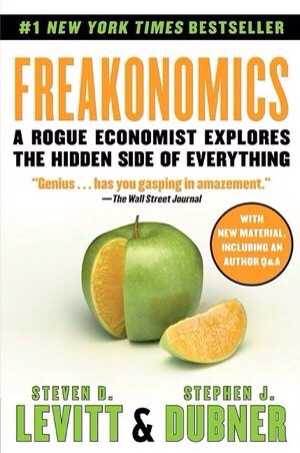
Thursday Review: Freakonomics by Levitt and Dubnet

20140131-154437.jpg

The Blurb:
Which is more dangerous, a gun or a swimming pool? What do schoolteachers and sumo wrestlers have in common? Why do drug dealers still live with their moms? How much do parents really matter? How did the legalization of abortion affect the rate of violent crime?

These may not sound like typical questions for an economist to ask. But Steven D. Levitt is not a typical economist. He is a much-heralded scholar who studies the riddles of everyday life—from cheating and crime to sports and child-rearing—and whose conclusions turn conventional wisdom on its head.

Freakonomics is a groundbreaking collaboration between Levitt and Stephen J. Dubner, an award-winning author and journalist. They usually begin with a mountain of data and a simple question. Some of these questions concern life-and-death issues; others have an admittedly freakish quality. Thus the new field of study contained in this book: freakonomics.

Through forceful storytelling and wry insight, Levitt and Dubner show that economics is, at root, the study of incentives—how people get what they want, or need, especially when other people want or need the same thing. In Freakonomics, they explore the hidden side of . . . well, everything. The inner workings of a crack gang. The truth about real-estate agents. The myths of campaign finance. The telltale marks of a cheating schoolteacher. The secrets of the Klu Klux Klan.

What unites all these stories is a belief that the modern world, despite a great deal of complexity and downright deceit, is not impenetrable, is not unknowable, and—if the right questions are asked—is even more intriguing than we think. All it takes is a new way of looking.

Freakonomics establishes this unconventional premise: If morality represents how we would like the world to work, then economics represents how it actually does work. It is true that readers of this book will be armed with enough riddles and stories to last a thousand cocktail parties. But Freakonomics can provide more than that. It will literally redefine the way we view the modern world.

My thoughts:

This is not my typical read, so I’m going to refrain from going very in depth with this review because I don’t know enough about economics or the type of research that went into this book to make a recommendation on that level. As a read though, it was entertaining, sometimes funny, and above all else, interesting. Definitely a different way of looking at things. As a parent, I’m not sure I always liked or agreed with the points that were made because the arguments he made seemed difficult to quantify if only because it relied on data and numbers when there is so much more to being a well-adjusted, successful human being than that.

All the same, I’d give this one a read. Interesting points were made and the bit about the KKK was hysterical (not a sentence I ever thought I would write.)

Mythology Monday: The Argonauts Encounter Hungry Harpies

20131217-105112.jpg

Jason and crew’s next stop was still in the gulf of Propontis, only this stop landed them in hot water (what a change!) when a hothead of a king named Amycus demanded a boxing match with their strongest fighter. Pollux steps up and wins the fight. The King’s people attack and the Argonauts fight them off, escaping with a random surplus of sheep.

The Argonauts destination was an island called Colchis, but they found their way blocked by clashing rocks called the Symplegades. Unable to find a way around, they stopped in Thrace where they met a king named Phineus. Phineus was a prophet who gave away the gods secrets. (Percy Jackson fans will recognize this myth.) As punishment, Phineus had been cursed by Zeus to be old, frail, blind, and followed by Harpies that would steal his food before he could get it in his mouth. Phineus was thrilled to see the Argonauts because his foresight told him they were going to release him from his curse. The Argonauts hesitated, unwilling to anger the gods, but Phineus assured them their fate was already written. He’d seen them help, so they were going to help, otherwise they’d never get past the rocks. Jason either killed the Harpies, or two of his Argonauts (Phineus’ brother in laws in fact, and children of Boreas) chased them away. Either way it happened, the trap is the same. Phineus sits down to eat a meal and the Harpies swooped down to get the food. When they swooped down, the Argonauts sprang and either chased them away or cut them down.

As a thank you, Phineus told them how they could get through the clashing rocks and get to Colchis. Kind of. In the same way I could walk up to some random pregnant woman on the street and tell her she’s having a girl. There’s a good chance I’d be right. And just as much of one that I’m not. Phineas told Jason to release a dove when they approached the clashing rocks and if the dove made it through, to row with all their might. If the dove was crushed, he was doomed to fail.

Lucky for the dove it made it through, losing only a few tail feathers. So they rowed fast and The Argo made it through with minimal damage. The clashing rocks got stuck together and now everyone can get by them.

Thursday Review: Timebound by Rysa Walker

20140128-153453.jpg

The Blurb: When Kate Pierce-Keller’s grandmother gives her a strange blue medallion and speaks of time travel, sixteen-year-old Kate assumes the old woman is delusional. But it all becomes horrifyingly real when a murder in the past destroys the foundation of Kate’s present-day life. Suddenly, that medallion is the only thing protecting Kate from blinking out of existence.

Kate learns that the 1893 killing is part of something much more sinister, and Kate’s genetic ability to time-travel makes her the only one who can stop him. Risking everything, she travels to the Chicago World’s Fair to try to prevent the killing and the chain of events that follows.

Changing the timeline comes with a personal cost, however—if Kate succeeds, the boy she loves will have no memory of her existence. And regardless of her motives, does she have the right to manipulate the fate of the entire world?

My review: I found this book on amazon or .99 cents and was impressed by how good it was. I can’t summarize much of it because I don’t want to give anything away. The plot unfolds kind of like Orphan Black, it’s much more fun to watch/read with no clue what you’re going into. I can say the world building was excellent, the plot thoroughly thought through, and the moral dilemmas that came up about whether or not people should or shouldn’t exist and which timeline was correct were very interesting. I loved the main character. The only thing I didn’t care for was the insta-love (at least every character involved was likable) and there’s a bit of info dumping followed by demonstration which could have been cut since we’re immediately shown what we were just told. But neither was done over the top, so neither bothered me much. And the info dumping was realistic. When you’re getting taught how to do something new, you get told how to do it a lot and then you get to try it. So it’s hard to get that balance quite right.

This was a great book, reminded me a lot of Ruby Red. You should read it.

Mythology Monday: Meet an Argonaut: Glaucous


After leaving the island of women and sex, the Argonauts travel through a straight called Hellespontos, searched the islands found there. They make friends with a king named Cyzicus of the island Propontis. Cyzicus was a friendly newly wed and close to Jason in age, so the two hit it off immediately. Cyzicus suggested that the Argonauts search an area beyond Bear Mountain for the Golden Fleece, but the fact that the region was inhabited by six-armed giants somehow slipped his mind. The giants raided the ship. Hercules and a few others managed to fend them off, but many of the supplies were ransacked.

The Argonauts needed more supplies, so they set about searching the forests for food, water, and wood for repairs. Hercules sent his current romantic interest or son depending on what source you’re reading, a young man named Hylas, to get water. Hylas somehow managed to get himself drowned by water nymphs or kidnapped and married to a water nymph, but his body wasn’t found, so Hercules ended up staying behind to search for Hylas while the Argonauts continued their quest. The timing of this bit varies. I think it makes the most sense here, but many sources list this happening after the events of the next paragraph.

The Argonauts headed back to King Cyzicus, but got lost along the way. They arrived near Cyzicus’ home when it was dark, and Cyzicus’ people, the Doliones, mistook the Argonauts for enemies and attacked. A bloody battle ensued, many died, including Cyzicus. Both sides realized their mistake when the sun rose, and an epic funeral was held and Cyzicus’ wife committed suicide. Bad weather keeps the Argonauts on the Propontis shore for several days until a local seer starts a new cult to appease the gods.

Some of the Argonauts are unhappy with Jason’s decision to leave Hercules behind. Or rather Jason’s decision to respect Hercules’ request to stay behind. Mutiny looked likely, but in classic Deus Ex Machine, Glaucus, a random sea god and prophet pops up to reassure the crew that Herc leaving was meant to be.

Let’s talk about Glaucus for a minute. Glaucus was born a mortal fisherman. He discovered a special herb that brought the fish he caught back to life and decided to try it for himself. The herb made him immortal and a prophet, but it also turned him into a fishman. Think of the least attractive variation of merman you can imagine and you’re close. Oh, and he may have been immortal, but he still aged. Some sources say he built the Argo, though Argus is typically credited with building the ship. Glaucus watched over sailors and such. He stuck around the Argo as well, helping it out of storms and unmoving seas and chatting with the crew and throwing random prophesies at them. Glaucus was probably kind of bored. He used to be human, so human interaction was a must. It also helped that he was a huge fan of Orpheus.

Glaucus fell in love with the sea nymph Scylla, but she was turned off by his fish man vibe, so she rebuffed his affections. Desperate and devastated, Glaucus begged Circe for a potion that would make Scylla love him. Circe fell in love with him instead, and begged him to choose her. Glaucus refused saying he would never stop loving Scylla, so Circe turned Scylla into a monster. He later moved on to seduce Ariadne, the maze-solver, but lost her to Dionysus later. Glaucus went on to love many other men and women, depending on the myth.

Anyhow, appeased that the missing crew members (Hylas, Herc, and Polyphemus (he stayed with Herc to search) were part of a divine plan, the crew go on their merry way and continue the quest for the Golden Fleece.