Thursday Review: Soulless by Gail Carriger

20140124-162233.jpg

The Blurb: First, she has no soul. Second, she’s a spinster whose father is both Italian and dead. Third, she was rudely attacked by a vampire, breaking all standards of social etiquette.

Where to go from there? From bad to worse apparently, for Alexia accidentally kills the vampire – and then the appalling Lord Maccon (loud, messy, gorgeous, and werewolf) is sent by Queen Victoria to investigate.

With unexpected vampires appearing and expected vampires disappearing, everyone seems to believe Alexia responsible. Can she figure out what is actually happening to London’s high society? Will her soulless ability to negate supernatural powers prove useful or just plain embarrassing? Finally, who is the real enemy, and do they have treacle tart?

My thoughts:

If any family members have ever just…wanted to buy me something (hint, hint husband, there is a holiday coming up), you could gift this entire series to my kindle and I’ll jump up and down squealing like the little girl. I love this book. It’s such a fun world, such a fun character, and such a fun plot. Did I mention this book was fun? I’ve been looking for another writer like this for a long time. I’ll probably go read everything she ever wrote now. :D.

In all honesty, I can’t adequately summarize everything I liked about this book and I don’t have anything to nitpick. It was just a fun and unique concept and if you liked the Clockwork Angel/Prince/Princess series by Cassandra Clair (which please remember, I really enjoyed) this will blow you away. All the fun of the world, far less of the angst. You won’t be crying your heart out over sick and dying characters (which I love to do, but sometimes, I just want to read something FUN), but you’ll laugh a lot more.

Seriously, go read this book.
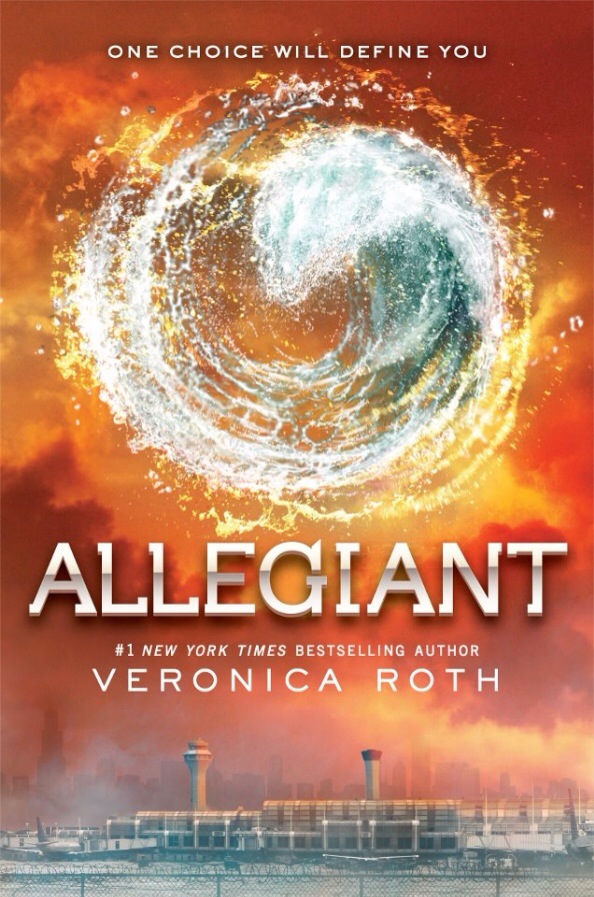
Thursday Review: Allegiant

20140123-151416.jpg

The Blurb: The faction-based society that Tris Prior once believed in is shattered—fractured by violence and power struggles and scarred by loss and betrayal. So when offered a chance to explore the world past the limits she’s known, Tris is ready. Perhaps beyond the fence, she and Tobias will find a simple new life together, free from complicated lies, tangled loyalties, and painful memories.

But Tris’s new reality is even more alarming than the one she left behind. Old discoveries are quickly rendered meaningless. Explosive new truths change the hearts of those she loves. And once again, Tris must battle to comprehend the complexities of human nature—and of herself—while facing impossible choices about courage, allegiance, sacrifice, and love.

Told from a riveting dual perspective, Allegiant, by #1 New York Times best-selling author Veronica Roth, brings the Divergent series to a powerful conclusion while revealing the secrets of the dystopian world that has captivated millions of readers in Divergent and Insurgent.

My thoughts:

I can’t complain about this book because I didn’t put it down. Do I wish the ending was different, yes. But very few series end exactly how I want them to, and endings were hard. I was happy to get Four’s POV, and while I’ve heard a lot of other reviewers say they couldn’t differentiate between the two voices, I had no trouble. Then again, people have said the same thing about my third book, so maybe it’s not a good sign I didn’t have a problem? :S

I appreciated how much all of the character’s changed from book one. And I enjoyed reading this book. My only complaint is one I’ve said since book one of the series. There was too much story for too little book. The first book should have (in my opinion) ended with Tris’ initiation/winning thing with Dauntless and the nagging feeling something isn’t right. Because that was the end of that story’s arc. The second book should have started with that huge thing that happened at the end of book one, and that entire thing, Tris’ reactions to her mom and dad, all of that, should have taken up a *huge* chunk of book two. I don’t remember much of book two, but I can tell you between all the new characters and reveals in book three, there should have either been more books, or a much longer book to allow me to fully feel the impact of everything that happened. So *much* happened. And the second you learned one thing, it was replaced with another that made the first thing irrelevant. I think with enough build up and slower pacing, the ending would have been perfect.

It’s not a knock on the author that I wanted more of her story. Entire books more even. It just means I got so invested in the world I want to spend more time with it. Who knows, she might have short stories in the works to flesh out. If so, I look forward to reading them.

Mythology Monday: Meet an Argonaut: Euphemus

20131215-234156.jpg

Euphemus was the son of Poseidon and is sometimes portrayed as the son of Europe. Europe was the daughter of the giant Tityos. Tityos was the son of a mortal princess named Elara and Zeus. He was not a good guy and got sent to Tartarus and sentenced to the Prometheus treatment during his stay.

Anyway, Euphemus was maybe married to Hercules’ sister, Laonome. His marriage to her changes depending on the source. He could walk on water and was pretty much perfect. He is not, I repeat, is not, the same Euphemus that was killed in the Iliad.

Euphemus isn’t known for much, except winning a chariot race at the funeral games of Pelias and starting the civilization of Cyrene in Libya. He met up with his half brother (on Poseidon’s side) and was given a dirt clod as a gift of hospitality (the Greeks were really odd about Hospitality). He was supposed to drop the clod in front of the Underworld, but it got washed overboard and through some really odd, kinky dreams about sleeping with one of Triton’s daughters while crying about it and nursing her, he gave birth to a civilization. The clod grew into an island called Thera, and Euphemus’ descendants ruled there.

The Greeks were fricken weird sometimes.

Mythology Monday: Meet an Argonaut: Atalanta

20131212-110917.jpg

Atalanta is my favorite Argonaut, which is a shame because not all sources agree that she was one, but lets pretend, shall we? Atalanta was born to King Iasus, and possibly an Arcadian princess, but her mother is never really talked about in mythology. The king wanted a son, not a daughter, so he left her on the mountaintop to die. She was found and raised by a bear, so she grew up hunting like a bear would. She was a fierce huntress, and unsurprisingly, worshipped Artemis.

Artemis’ name/honor was left out of a major sacrifice by Oiuneus. Artemis took issue with being left out so she sent a wild, man-eating boar to wreak all kinds of havoc. This boar became known as the Calydonian Boar. A guy named Meleager (also an Argonaut) hosted a hunt for the boar, and Atalanta and a crap-ton of Argonauts and other famous heroes joined forces to hunt down the boar.

A brief side note about Meleager. When he was born, the fates predicted his life would only last as long as a specific piece of firewood hanging above the mantle. So his mother, Althea, doused the firewood and hid it, so no harm would come to her child. He grew up a hero, married Cleopatra (Not that one) and developed a *huge* crush on Atalanta. But she was a sworn virgin for Artemis and he was married. Fate can be so cruel.

Anyway, back to the hunt, the boar killed a lot of men, and two centaurs took advantage of the chaos to try to rape Atalanta, but Meleager came to her rescue. She wounded the boar, and Meleager killed it. Because she had drawn first blood, Meleager awarded her the boar’s head or hide or both which pissed off his brothers, who didn’t think a woman deserved the prize. Meleager killed his brothers for insulting Atalanta. When his mother heard he had killed her other sons, she tossed the firewood on the fire and Meleager died in a blaze of flame.

It’s worth noting that she knew Meleager well before the hunt. The two had been Argonauts together. Some sources say she joined out of love for Meleager, that she wouldn’t consummate because an Oracle had warned her losing her virginity would be disasterous for her.

Meleager continued to have adventures in the Underworld. When Hercules visited to find Cerberus, he took the opportunity to play matchmaker, and convinced Herc to marry his younger sister, Deianira.

Anyway, after the hunt, Atalanta’s father remembered he had a daughter and tried to arrange her marriage. She made a deal that she would only marry a man who could beat her in a footrace. Many men died in the attempt to outrun her until Hippomenes came along and asked Aphrodite for help. The goddess gave him three irresistible, shiny, golden apples. As they raced, Hippomenes would throw the apples and Atalanta would veer off course to collect and eat them. He won, they got married, had a son named Parthenopaios (more on him when we cover the seven against Thebes). They either failed to honor Aphrodite, or managed to piss off either Zeus, Hera, or Rhea, and got turned into lions.

At the time, by the way, the Greeks believed that lions only mated with leopards, so the two could never actually have sex again. She lived the remainder of her life alone as a lion. Poor girl.

Mythology Monday: Meet an Argonaut: Castor and Pollux

20131211-203323.jpg

The Gemini twins. I wanted to be a Gemini so badly when I was younger. Depending on the magazine, I’m either a Libra or a Scorpio. I also *really* wanted to be a twin. Alas, I am still neither.

Anyhow, Castor and Pollux were Helen of Troy and Clytemnestra’s half brothers. Pollux was the son of Leda and Zeus, and Castor was the son of Leda and Tydareus (Icarus’ brother and Penelope’s uncle). Apparently Zeus seduced/raped Leda in the guise of a swan while she was pregnant? OR Zeus was both of their parent’s and that’s just the way the genetics broke down. It depends on the myth. Tydareus was a father figure to all four of the children though. Anyway, Pollux was a full-blooded deity somehow and Castor was a complete human.

The two rescued Helen when Theseus kidnapped young Helen, but you’ll have to read her Mythology Monday for more details about that ;). The twins also took part in the hunt for the Calydonian Boar, Pollux won a boxing match against King Amycus, and both were present for the attack on the city Iolcus. But we’ll get to Argonaut adventures on another week.

The twins wanted to marry the sisters Phoebe and Hilaeria, but they were already engaged to the twin’s cousins, Lyceus and Idas. Lyceus and Idas had special powers. Idas was gigantic and Lyceus had night vision. Both were also Argonauts. So they did the logical thing and kidnapped the women and took them to Sparta, where they both had one son. This caused a major family feud. They fought over everything and stole one another’s cattle, and it was just a huge mess. At one family gathering, Castor and Pollux attempted to steal back their herd of cattle, their cousins realized what they were up to and followed them. The cousins ambushed the twins and managed to kill Castor just after he shouted a warning to Pollux. The four were so busy fighting that they neglected to notice Paris sneaking away with Helen, which sparked the Trojan War.

When Castor was killed, Pollux asked Zeus if he could give up his mortality or share it with his brother so they would never have to be apart. Zeus transformed them into the constellation Gemini.

Isn’t it crazy how everything in Greek Mythology connects?

Mythology Monday: Meet the Argonauts: Telamon

20131206-200331.jpg

Telamon was brother a son of Aeacus, brother of Peleus, and friend of Hercules.

After he and Peleus killed their brother Phocus, Telamon went to Salamis, and married the kings daughter Periboea. They went on to have a son, Ajax the Great.

Telamon was the first to breach the wall of Troy when Hercules sacked the city (pre-Trojan war). Hercules wanted that honor for himself, so he very nearly killed Telamon in the fit of rage. The only thing that stopped him was that Telamon dropped everything and built an alter to Hercules to appease his “friend.” As a reward, Hercules gave Telamon a woman named Hesione to marry. Not sure what happened to Periboea, but he had another son by Hesione, who was named Teucer, an archer and another prominent figure in the Trojan War.

Thursday Review: Graceling

20131022-191352.jpg

The Blurb:
In the Seven Kingdoms, people born with an extreme skill, “Grace”, are feared and exploited. Katsa herself despises hers, killing. Her uncle Randa, King of the Middluns, commands her to punish and torture his enemies. Prince Po, with combat skills, becomes her friend, and she learns terrible truths about her Grace and a secret hidden far away that could destroy the realm.

My Review: I really enjoyed the world building and the concept behind Graceling. The idea of Graces (essentially super powers) and their limits was interesting. There was plenty of action, but never so much that violence didn’t have time to have consequences. There were major character arcs for Po and Katsa, their characters develop so much that they almost aren’t recognizable at the end. That’s not a bad thing. Kristin Cashore had a firm grip on who her characters were, and she wasn’t afraid to take risks to get them to change that much realistically. I really enjoyed this book and checked out the next two at my library as soon as I finished it.

That being said, I still felt a bit of a disconnect in this book. I liked the characters, I liked the world, but I never really felt connected to either. There was something about the pacing. So much happened in this book on so many different levels, and despite that it seemed to drag in places. It was still incredible writing, and I enjoyed it, I just wonder if maybe there was actually more than one book (or novella even) in this story. I could see the entire overarching plot of this one book being an entire trilogy without taking away a single thing that made it great.

Mythology Monday: New Years

20130910-150615.jpg

Did you know the New Year’s baby is an Ancient Greek thing? At the festival of Dionysus/Bacchus, a baby would be paraded around in a basket as a symbol of rebirth. There was lots of partying, plenty of drinking, and an overall good time to be had.

New Years hasn’t changed much. People forget, I think, that mythology can be a very modern thing. It’s still happening. Take New Year’s Eve as an example. It’s a ritual. A really fun, very positive, happy ritual. 😀 Now a days ini Greece, families turn off all the lights and reopen them to “enter the year with a new light”. After the fireworks show, they cut serve a New Year’s cake that has one coin baked into it that symbolizes luck to whoever gets it.

On New Year’s many people….

1) Go to parties
2) Make a wish at midnight.
3) Drink champaign
4) Believe that when the clock strikes twelve you get a clean slate
5) Set a goal for your future
6) Make a list of everything bad that happened in the last year and burn it
7) Count down and watch a giant ball, peach, or other large object drop or fireworks
8) Kiss that special someone
9) Believe that whatever you are doing at midnight is what you will be doing all year
10) Eat twelve grapes
11) Sing “Auld Lang Syne”
12) Reflect on the last year

What’s your mythology? Comment below with your New Year tradition 🙂

Thursday Review: Rot and Ruin series

20131212-210033.jpg

Blurb: In the zombie-infested, post-apocalyptic America where Benny Imura lives, every teenager must find a job by the time they turn fifteen or get their rations cut in half. Benny doesn’t want to apprentice as a zombie hunter with his boring older brother Tom, but he has no choice. He expects a tedious job whacking zoms for cash, but what he gets is a vocation that will teach him what it means to be human

I picked up the first Rot and Ruin book from a friend in my cohort a year ago. The book seemed standalone, and was pretty good, so when I saw the next two novels in the library, I grabbed them.

This series gets super dark. The world building is very similar to Walking Dead. Everyone comes back as a zombie when they die, but bites speed up the infection. And as in most post-apocalyptic zombie scenarios, the people are almost worse than the undead. Everyone lives in these secure settlements, but every now and then children go missing. Our protagonists discover theres a place called Game Land where children are given weapons and thrown at zombies for entertainment. Really, humanity just goes down hill from there.

These books were scary, and not just because of the zombies, but because the descent into the dark side of humanity, and the rage and fear that lives there, was realistic. If you like zombies, this series is a must read.

Mythology Monday: Brumalia

20130102-103006.jpg

Originally, Brumalia was a holiday intended to honor Cronus, Demeter, and Bacchus. Bacchus by some beliefs was another facet of Hades’ personality so I chose to use it in my book. It was typically held in November, which makes no sense because it was intended to celebrate the Winter Solstice. Some sources indicate that the festival lasted for weeks, so that may explain the date discrepancy.

Brumalia was full of prophesied, visions, and not surprisingly, copious drinking. It really sounds like a surprisingly typical holiday party. There was even kissing under mistletoe and holly themed decorations.

So why did I use it in my book? I felt like the Underworld wouldn’t celebrate mainstream holidays like Christmas, but they would celebrate something around the same time. Hades is pretty considerate when it comes to encouraging the souls to keep their customs. Choosing an ancient holiday makes sense because he’s ancient. The celebration is kept open enough to where the souls could interpret it however they want. The palace had a ritzy party, but Brumalia was celebrated all across the Underworld in different ways.