Mythology Monday: Hercules labors 4-6

20130611-143923.jpg

Hercules’ next labor was to capture the Erymanthian Boar. The boar was a huge, violent creature that roamed the mountains and depending on the myth was responsible for the death of Adonis. Hercules traveled to the mountains, and on the way got a group of centaurs drunk. Things got out of hand, as drunken parties so often do, and Hercules ended up having to kill them all with his poisoned arrows.

One centaur, Chiron, could’t die because he was immortal. But the poisoned arrows still hurt, so in exchange for the pain of the arrows, he took Prometheus’ place as snack for the golden eagle. Herc killed the eagle with his arrows, so Chiron told him to trap the boar in a snow drift. It worked, and the boars tusks were put on display at a shrine of Apollo.

The next labor was simpler. Clean the Augean Stables in a day. Augeas was the King of Eliis, and he had more cattle than anyone in the whole word, but had NEVER cleaned his stables (30 years old, over 1,000 cattle, gross). That was bad, because in addition to being numerous, the cattle were also divinely heathy so they created a lot of manure. Herc was promised ten percent of the cattle if he succeeded.

Her rerouted two rivers and blasted the stables clean. Augeas didn’t deliver 10% of the cattle, so Herc killed him. But because the rivers did the work, and because he was paid, this labor was thrown out, which is part of the reason ten labors became 12.

Instead, Herc was sent to defeat the Stymphalian birds. These were man-eating birds with bronze beaks and sharp metallic feathers. They were also Ares’ pets. Even their poop was highly toxic. They had recently moved to a swamp in Arcadia to escape a pack of wolves, and were troubling a nearby town.

But the birds lived in a swamp. How could Herc get to them without sinking? Athena gave him a noisemaker he shook to frighten all the birds into the air, where they were shot at with…. you guessed it, poisoned arrows. They flew far away and became Jason’s problem, but that’s another story.

Mythology Monday: Hercules’ labors 1-3

20130604-135308.jpg

Mad with grief, Hercules took the Oracle of Delphi’s advice to perform 10 impossible tasks for King Eurysteus. He was tricked into doing the last two. In return for completing the labors, his sins would be forgiven and he would be granted immortality.

*side note: most of the monsters in these myths were the children of the Titans Typhon and Echidna)

The first task (order varies depending on who writes the myth) was to slay the Nemean Lion. It had golden super-fur/body armor that could not be cut with any weapon. It also had claws sharp enough to shred metal. Sometimes the lion could shape shift into a beautiful woman and would feign injury, drawing in the would be heroes and then shifting into a lion and killing them.

Hercules blocked the exit of the lion’s cave and then either strangled the lion, or shot it with in an arrow in its mouth. He ran into a problem when he tried to skin the lion because nothing could cut its fur. Finally, Athena took pity on him and pointed out the lions claws were rather sharp, so Hercules used them to skin the lion.

This skin became his cloak/armor.

Next, Hercules sent to kill the hydra. You guys know this one, it had nine (or three, or a thousand) heads and every time you chopped off one, three (or two) more grew in its place. Remember, myths varied by who told them (hence the parenthesis). The hydra’s breath and blood were poisonous and the reptilian creature lived in a lake that sat above an entrance to the Underworld.

Hercules shot flaming arrows at the creature, but that just pissed it off. He may or may not have beat it with his club, stabbed it with his sword, or cut off several heads with a sickle. Whatever weapon he used, it soon became apparent that more heads grew every time he chopped one off. Unfortunately, the hydra couldn’t die so long as it had one head.

Hercules may have asked Iolaus or Athena for aid, and came up with the brilliant idea of cauterizing the wounds before more heads could grow. He either used fire or the creatures own blood dipped on his sword to cauterize the wound. Then he used the creatures blood to turn all his cool weapons into cool poisonous weapons.

Sadly, in killing the hydra, Hercules rendered that river uninhabitable. All the fish died and the nearby villagers either starved or moved.

The last labor I’m covering today was for Hercules to obtain a doe belonging to Artemis. It had golden antlers and bronze and brass hooves. It could outrun even the swiftest of arrows. Hercules chased it across Greece for a full year. Eventually he trapped it a. while it was sleeping, b. with a net, or c. with an arrow shot between its legs, tripping it. He apologized to Artemis and promised to return the doe once he showed it to the King. Artemis didn’t hold a grudge, ruining Hera’s plot to anger the goddess.

When Hercules showed the deer to the King, he wanted to add it to his collection of woodland creatures, but he was unable to keep up with the deer, so it escaped and returned to Artemis.

Over the next few weeks we’ll cover the rest of Hercules’ labors and other tasks. I promise we will get back to general mythology soon.

Mythology Monday: Young Hercules

20130528-211844.jpg

Hercules wasn’t originally named Hercules. His original name was Alcides. Once his adoptive parents realized Hera wanted to kill him, they renamed him Heracles (Greek version of Hercules, the original) to try to appease her.

It didn’t work.

Young Hercules was a jerk. He had a music teacher, Linus, brother to Orpheus and son of Apollo and the muse Calliope, who created basic musical concepts like melody, and rhythm. Unfortunately, he made mistake of correcting his student.

So Hercules took Linus’ lyre and bashed his head in, ending the life of a brilliant musician in one petulant tantrum. Seeing Hercules was a budding psychopath, his foster father-uncle sent him to the fields where the only things he could hurt were sheep.

Hercules was then visited by two nymphs. Pleasure and Virtue, they offered him a choice between an easy life full of pleasure, or a hard life full of glory. In a rapid character 180, Hercules, the kid who just killed someone for correcting his music, you know, making him work harder to be better, decided that the hard life would pay off.

Hercules traveled to Thebes where he slew an entire army single-handed. He was rewarded by being given King Creon’s oldest daughter, Megara. The two lived a happy life, and had two children before Hera drove Hercules nuts and made him kill his children, and in some versions his wife. In other versions of the myth, Megara was given to Iolas. Hercules’ nephew, and then they had a kid.

Sane again, then driven newly mad with guilt, Hercules fled to the Oracle of Delphi and begged for atonement. She (working for Hera) sent him on a quest that would involve twelve labors. We’ll cover those in the next mythology Monday.

Mythology Monday: Hercules

20130513-190907.jpg

Hercules/Heracles (Greek name) is bar none the most famous demigod. He’s had Disney movies, television shows, and look, there’s Kevin Sorbo and my daughter at Dragon Con 🙂
The Greek myths surrounding this legend are numerous, so I’ll be dedicating a few Mythology Monday’s to him. Let’s start with his birth.

Hercules, the Greek version (technically Heracles) was the son of Zeus and Alcmene, granddaughter to Perseus and Andromeda which means that Hercules was descended from Zeus twice.

She was happily married to Amphitryon, so Zeus disguised himself as her husband while he was away and they conceived Hercules. Tireseas the prophet told her husband what happened and by some accounts she was exiled. (Interesting note, her second husband was Rhadamanthus who later became one of Hades’ judges). Another version of the myth has her coming home the same night Zeus left, and conceiving two children that night, Hercules with Zeus, and Iphocles with her husband.

Hera tried to prevent Hercules from being born by having the goddess of childbirth hold up the delivery, but Galanthis, a maid, stopped her and got turned into a weasel. The delay cheated Hercules out of a kingdom as the gods had promised the next-born descendent of Perseus would be king. While Eileithyia (goddess of childbirth) was delaying the delivery with Alcmene, Hera caused another descended of Perseus to be born two months premature and he was crowned King instead

In some versions of the myth, Alcmene abandoned Hercules to the elements because she feared Hera’s wrath. Athena, protectress of divine children scooped him up and brought him to Hera. Hera, not realizing the child was Hercules nursed him so he wouldn’t die. There was a breastfeeding mishap, and the spilled milk formed to milky way. The milk gave him extra super powers, and he was returned to his mother.

When he was eight months old, Hera sent snakes to kill him, but Hercules strangled the snakes.

Alceme later died in Megara (yes you read that right) and Hercules, born Alcaeus, was adopted by Amphitryon, Perseus’ other grandson.

Tune in next week for even more about Hercules!

Mythology Monday: Creation

Most of you know all about the Olympians, and may even have a bit of knowledge about the Titans, but Greek mythology doesn’t start there. It starts one generation back with the primordial gods, or the elementals. The first of the Greek gods was Chaos. Nothing else existed but Chaos. All of creation was just an empty void.

Chaos created love which allowed for order to begin. From love came the day and the night. Eros, which was the god of Love; Tartarus, the god of the Underworld; Erebus, the god of darkness; and Gaea, the earth appeared. Now remember, these aren’t humanoid gods like the Olympians. Gaea was the goddess of the earth, but she WAS the earth. Erebus WAS darkness, Tartarus WAS the region of the Underworld known as Tartarus. They didn’t look like people.

Gaea gave birth to Uranus who then became her mate. They had three sets of children. The giants, the Cyclopes, and the Titans. The titans were more humanoid. But Uranus was a terrible father. He tried to take the children from Gaea and imprison them. So she plotted with the Titans against Uranus. Gaea gave Cronus, the youngest of the Titans, a flint and a sickle to use against his father. Cronus fought Uranus and castrated him. His nether bits fell into the ocean and from their blood sprang the furies, from the foam came Aphrodite.

Cronus became the next ruler. He threw the giants and the Cyclopes into Tartarus and married his sister Rhea. Together, they had six children, but Cronus was afraid that one day his children would rise up against him like he rose up against his father, so he ate every single one of the children except for the youngest. Rhea tricked him and gave him a stone instead.

That child was Zeus.

Because Cronus ruled the earth and the sky, Zeus had to be suspended from the ground by a rope so he was never fully in either realm. He grew up this way and when the time was right, went against his father to avenge his siblings.

He managed to trick Cronus into drinking a potion that made him vomit up Zeus’ siblings. These children were Hera, Poseidon, Hades, Hestia, and Demeter. Zeus also freed the giants and the Cyclopes. Together, they fought Cronus and most of the remaining Titans and won and Zeus became god of Olympus.

The titans were sent to Tartarus except for atlas who was given the world on his shoulders as punishment.

Mythology Monday: Christmas

20121218-222130.jpg

He sees you when you’re sleeping,
he knows when you’re awake,
he knows if you’ve been bad or good
so be good….

Or Else

For over a century this menace to society has been breaking into homes at night, and apparently watching you sleep. Even mice are paralyzed in fear by his presence.

No it’s not Edward Culllen, it’s Santa Claus. Nowadays we are not bought off by his gifts, and our children know better than to take candy from strange men.

What can you do to protect yourself from this holiday horror? Follow the simple instructions below and you can enjoy a silent night.

1) Write a letter pleading for your life. Explain what makes you valuable to society and why you should be passed over. Better yet, have your kid do it. Santa may have a soft spot for children. It worked on the Grinch. You can send Santa and email, call him, post to his Facebook page, or twitter.

2) Be on the look out for his misunderstood twin brother Krampus. Every year on the fifth of December this deformed creature roams the Alps ringing bells and dragging rusty chains as a harbinger of Santa’s arrival. (Go on, google it).

3) Know his whereabouts. Modern science allows us to track Santas movements. Simply type Santa into google maps or google earth to find up to the minute details on his location.

4) Deck the halls with boughs of holly: M Night Shamalan taught us that the beasts do not care for the color red. Red of course is the most proven way to deter Mr. Claus, but science has proven any bright color will do. Pay special attention to your roofs as strings of lights sometimes have the unintentional benefit of getting tangled in his sled.

5) Light the fire and hang your old socks. The heat and the smell may be enough to frighten Santa away from your abode.

6) Leave milk and cookies. If it doesn’t slow him down it may eventually lead to diabetes, protecting future generation from this night of terror.

Good luck! And have a safe and Happy Holiday Season!

Mythology Monday: Halloween

When people talk about mythology, they act like it’s something ancient. Something that already happened. We are constantly creating myths in our own culture today. Some elements occur over and over and over again, like the myth of Superman. It’s kind of similar to Hercules, Gilgamesh, Odysseus, take your pick. That’s all myths are, stories. There may be some basis in truth, but for the most part, they’re just fun to tell.

Halloween has a mythology all of its own. Every ghost story, campfire tale, and urban legend is better when it’s told in the dark of the night on Halloween. So let’s tell some scary stories, shall we? Leave your scary story in the comments, and the creepiest one will get a spooky surprise.

Here’s the scariest story I ever heard: (note: I didn’t come up with this, I heard it as a kid)

So there’s this girl, and she’s home alone. She lives in a big house and it has one of those glass sliding door. As she’s passing through the living room, she catches a glimpse of someone in her back yard. It’s a creepy looking man holding a butcher knife. She freaks and runs up stairs, locks her door, and calls the police. The come, but the man is long gone.

“You’re very lucky miss,” the policeman tells her. “The man you described is an escaped killer. Now, where did you say you saw him again?”

She stands in front of the sliding glass door and points to where she saw him in the back yard.

The policeman exchanges a look with his partner. “See, here’s the thing, the soil out there is still wet from this afternoons downpour, and there’s no foot prints.”

The girl gets defensive, “you don’t believe me?” she asks.

“Oh we believe you saw him, just not there.”

“Where was he then.”

The officer motions for her to look out into the back yard again, and shifts positions. Suddenly his reflection is visible in the sliding glass door.

“Right behind you.”

Mythology Monday: Homer

20121013-153334.jpg

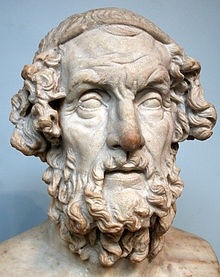
So this isn’t exactly a myth, but Homer is alluded to in Persephone,so to me it makes sense to include him in a Mythology Monday. Homer is the alleged author of both The Iliad and The Odyssey. I say alleged because there is some dispute over the matter. There’s this whole Homeric question over when he lived and what he might have written, but for simplicities sake, let’s assume he wrote both. Homer was possibly blind, and may have lived in a few different time periods or not at all, but again, let’s keep it simple.

The Iliad tells the story of the Trojan War. It starts ten years into the war, and mostly follows Achilles, a demigod by the goddess Thetis, who is angry because his…. erm, war prize girlfriend, Briseis, was taken from him. He refuses to fight, so Patroclus his cousin/friend wears his armor and is killed. Then Achilles gets really mad, and starts fighting again. He kills the Trojan prince Hector, and disrespects his body. There’s a massive battle, then everyone takes some time off to bury the dead. A ton of other stuff happens in the story, Hector seems really nice and there’s this really cute scene with his infant son, so it’s really sad that he dies, but it’s an epic. A paragraph summary is bound to leave something out. Odysseus (called Ulysses by the Romans) is also in this book on the Greek side with Achilles.

The Odyssey starts ten years AFTER the Trojan war and follows Odysseus’s ten year journey home. (Home likes the number 10). Penelope, Odysseus’ wife is being pestered by suiters, but she hasn’t given up hope that Odysseus is alive. Given that she hasn’t seen her husband in over twenty years, that’s a lot of faith. She also has a son, Telemachus, by Odysseus whom he has never met. Sadness. Odysseus journeys home through all kinds of adventures, and then kills all of his wife’s suitors. They all live happily ever after (if you ignore that poem by Alfred Lord Tennyson).

Homer wrote a few other books and poems about the Trojan war, but these are the important two. They are important because every writer for hundreds of years tried to make their own version of these epics. Virgil wrote the Aeneid based on these books, Dante was influenced by them, Alexander Pope, and more recently James Joyce. There are still books and movies and all kinds of media dedicated to the stories from Homer’s epics. Including mine.

Granted, Persephone is only briefly mentioned in The Iliad, and is not mentioned in a terribly complimentary way when Odysseus travels to the Underworld (she’s referred to as Proud Persephone and sends the souls of women to torment Odysseus as he journeys through the Underworld) but she’s there. So is Hades, Helen of Troy, Cassandra, and many many more characters of my world.