I’ll be at the Oconee County Library this Sunday to sign books and answer questions. Drop on by and say hello.
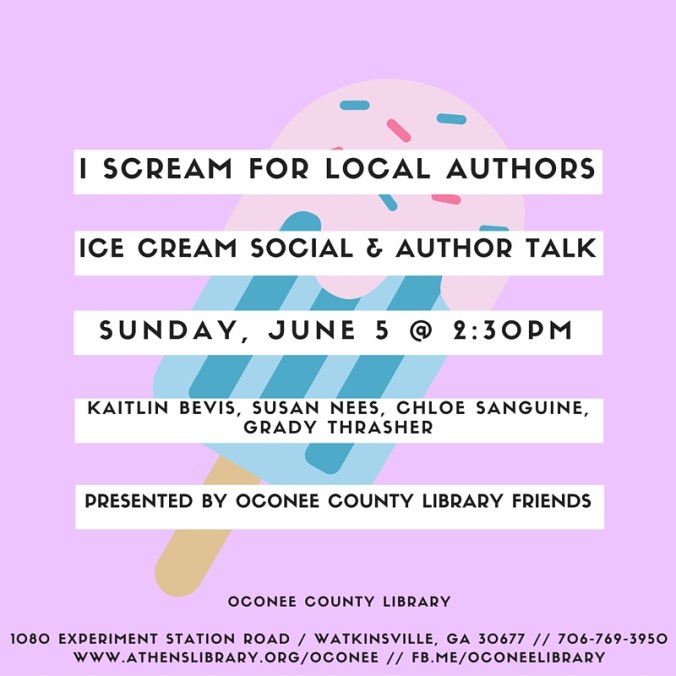
I’ll be at the Oconee County Library this Sunday to sign books and answer questions. Drop on by and say hello.

The third step in the snowflake method has to do with characters. The snowflake website says to do this step for each of the main characters, but I do it for all of the named characters in my book who have more than two or three lines of dialogue.
For each character take an hour and write the following:
This step, particularly the one paragraph summary of the character’s storyline is really helpful to me, because I have so many moving pieces that it’s important that I know what each character has been doing in the background during all the events of the story. Even if they don’t appear “on screen,” knowing what they’ve been up to, why they’ve been up to it, and what conflicts they’re facing helps flesh them out.
Here’s what step 3 looks like for me in scrivener.

For today’s Writing on Wednesday, I’m taking a break from the snowflake method to review the lovely Molly Ringle’s Underworld’s Daughter.
Molly was the guest author on this blog Monday, and many of you will remember the review I did on her first book, Persephone’s Orchard.
So without further ado…
 Molly Ringle does an amazing job balancing multiple story lines spread across time and multiple characters. She also does an amazing job managing the impact those multiple sets of memories and roles would have on modern day characters. I see glimmers of the past within each of the modern characters but they are still very much their own people.
I was a little hesitant when new POV characters were introduced, but before long, I fell in love with each and every one of them. Molly describes this book’s take on the myths more of “Greek mythology fan fiction” as opposed to retellings, but to me that made it more fun. I’ve read the Greek myths. I’ve read a thousand retellings, I’ve written my own. But done right, a retelling should be original to the author, and if it’s original to the author, it’s going to eventually leave the myth behind to tell the rest of the story.
The ending of this particular story was both heart wrenching and shocking. It immediately had me reaching for book three. I can’t wait to see how it ends.
Last week, I introduced the snowflake method and explained I’d be taking a week to outline and give an example of each step. This week, we’re moving on to step two.
The second step of the snowflake method is to expand your one sentence summary into a one paragraph summary. This is not the back cover copy. This paragraph summarizes the entire book, including the ending. This is pretty easy if you have a vague idea what your book is going to be about, especially if you follow the three disasters and an ending format.
Sentence one should be the backdrop.
Sentence two through four should each be a disaster.
And sentence five should be the ending.
I was going to do an example from Aphrodite, but since it’s four books into a series, it’s not a great example of what could ultimately be used as a querying tool if done right. So I’m making an example of Persephone instead.
Sentence one: Backdrop
Persephone thought she was just a typical, modern day teenager until she realized she was being stalked by a season.
Sentence two: Disaster One
When Boreas, the god of Winter, attempts to whisk her away to a not so winter wonderland, she’s rescued by Hades and offered refuge in the Underworld.
Sentence three: Disaster Two
Unable to physically reach Persephone in the Underworld, Boreas begins going after her through her dreams.
Sentence four: Disaster Three
When Persephone learns to defend her mind from the deranged ice god, he kidnaps Persephone’s best friend and threatens to kill her unless Persephone agrees to take her place.
Sentence five: Ending
In a desperate bid to save her friend, Persephone embraces her power as a goddess and succeeds in killing the god of winter, only to learn an even larger danger is lurking closer to home than she had ever imagined.
Put it all together.
Persephone thought she was just a typical, modern day teenager until she realized she was being stalked by a season.When Boreas, the god of Winter, attempts to whisk her away to a not so winter wonderland, she’s rescued by Hades and offered refuge in the Underworld.
Unable to physically reach Persephone in the Underworld, Boreas begins going after her through her dreams. When Persephone learns to defend her mind from the deranged ice god, he kidnaps Persephone’s best friend and threatens to kill her unless Persephone agrees to take her place. In a desperate bid to save her friend, Persephone embraces her power as a goddess and succeeds in killing the god of winter, only to learn an even larger danger is lurking closer to home than she had ever imagined.
Is this a perfect summary? Heck no. It leaves out almost everything important. The relationship with Hades, Thanatos, Persephone’s entire arc. But this does serve as a great framework, because these are the three disasters that set the rest of the plot into motion. This paragraph isn’t the place for character development or interpersonal drama. This is incredibly broad strokes. The next step fleshes out the characters. But more on that next week.
I’m a pantser, not a plotter. I do a kind of vague outline for the series as a whole and the individual books. I’ve got a ton of tools, notecards, and a dry erase board that I use when I’m brainstorming the story, but for the most part, once I start writing, I just plow through until I’m finished, then go back in revisions and fix all the inconsistencies. I know the major plot points going in, but not much between.
But when I started writing Aphrodite Book 3 (I really need to come up with a name for it), I knew I needed to do something different. When I revised Aphrodite, most of her character arc that I had planned for her entire trilogy ended up in the first book. And almost every scene with Ares had dialogue taken directly from book two. Book two was pretty much gutted, and that’s fine. It made Aphrodite a much stronger book. But that meant that I had to completely change book two to suite a character who was in a wildly different place than I’d imagined her starting and a romance that was way further along than I intended it to be.
Revisions for Love and War are still ongoing and since it’s a middle book, any change in the sequence of events or characters is going to equal massive reverberations to book three. So when I turned in Love and War and tried to get started on Book 3, I found myself stuck. I know the major events. Those aren’t going to change. But how the characters get there, that’s in flux. But deadline wise, I can’t just not work on it until Love and War goes through revisions. Plus, it’s a process that goes both ways. While I’m writing I might have a revelation about a character that I want to plant seeds for in book two.
So, I’ve decided to try something new. The Snowflake Method. Click the link there and read all about it, and if you have scrivener, download this template. Trust me, you’ll thank me.
I’ve been using the template since the first of April, and I’ve made some great strides. Part of that is because in writer land, anything new and exciting that gets you writing is a good thing. The rest is the fact that this method rocks. The best thing is, as I’m going through and figuring things out, I’m not just making changes to my outline, I’m making notes to focus on in the revisions of Love and War. So this has really helped me flesh out some of my background characters a lot more and given me a lot of ideas for how the plot can progress while still leaving me a lot of flexibility to make changes without having to gut my entire novel.
I’m going to be talking about this template over the next few weeks.There are ten steps to the snow flake method, so I’m going to go ahead and start with step 1.
Step 1: Take an hour to come up with a one sentence summary of your story. Here’s the guidelines offered on advanced fiction writing.
You’re going to want to take the whole hour to tweak the words and really think it through. I promise you as a frequent writer of query letters, do this before you write the book. It’s so much easier to expand on an idea then it is to shrink one. Even if you don’t use the snowflake method, you’re going to want a ten second summary.
Also, know that this will change as you go through the snowflake method and the actual writing of your book.
Now I’d love to share the one line summary for book three, but since book two isn’t out yet, I’ll refrain.
Aphrodite’s one line summary using the snowflake method would have looked something like this.
When demigods start going missing under mysterious circumstances, a gorgeous goddess investigates with help from the one man immune to her charm. (22)
But that’s too many words. So let’s cut under mysterious circumstances, because if they’re missing, the circumstances are already pretty mysterious. And start is a filter word and I don’t mention the setting, so I’m going to try this.
When demigods go missing, a gorgeous goddess boards a cruise to investigate with the help of the one man immune to her charms.(23)
Still too many words. I know the fifteen word thing isn’t set in stone, but focusing on that word count while trying to get the gist of the story in it is really helpful to my thinking process.
A gorgeous goddess boards a cruise ship to investigate missing demigods with help from the one man immune to her charm. (21)
A goddess boards a cruise to investigate missing demigods with help from the one man immune to her charm. (19)
Still too long and too abrupt. Maybe the cruise isn’t as important.
When demigods go missing, a goddess investigates with the help of the one man immune to her charm. (18)
A goddess investigates missing demigods with help from the one man immune to her charm. (15).
It’s still not perfect, but through this exercise I’d figured out three things that were super important to me in telling this story. Demigods are missing. A goddess is looking for them. She’s joined by a guy she can’t charm. And she’s on a cruise ship. If I take the rest of my hour, I can probably work the cruise in somehow, but that book has already been published, and I think I’ve made my point.
This is a really good exercise to help you think through the most important base components of the story. And playing with the words in a small, unthreatening chunk gets your brain working on the plot.
Plus it’s fun. Can you summarize what you’re working on in a 15 word sentence? If you’re not working on anything, how would YOU summarize Aphrodite in 15 words? What were your biggest takeaways from the novel?

There is so much out there for writers that it can be a little overwhelming. So I’m going to share my top ten writers’ resources (in no particular order), along with how I use them, to demystify all the offerings of this really extensive community we’ve created. For me, most of the tools center around being motivated to write. I love writing, but because it’s been a lifelong hobby, it’s become second nature for me to put it in the backseat to literally anything else happening in my life right then. Connecting with a larger writing community helps keep my thoughts aligned with the whole writing as a career thing.
The key to me with this list is timing. I don’t do everything on this list all the time. Writers’ group is twice a month, nanowrimo quarterly, conference more like once a year, and workshops or classes maybe once every three if there’s an awesome opportunity.
The podcasts, time machine, and tone appropriate books are daily things that keep me motivated or are useful for writing. Books on writing tend to fall in one of the months between nanowrimo. Scrivener I pretty much only use when outlining whereas writing excuses and tone appropriate books are pretty much used daily. The new writing gear is just whenever I notice I’m hitting a slump in motivation. For me it all comes down to motivation. Because once I sit down and start writing, I’m fine. But getting me to stop and sit down is a trick sometimes, so I need an arsenal.

“You were in a hurry for this?” I groaned. At Adonis’ insistence we were packed into one of the clubs on the lower decks with over a hundred other people watching “How to Use a Life Jacket 101” on a row of T.V screens attached to the ceiling.
He gave me a scathing look. “We can’t all teleport if the ship sinks.”
Once Adonis felt confident he knew our emergency rendezvous point and how to work a lifejacket, I insisted we take a tour of the ship. I needed to get a firm grip on where everything and everyone was if my observations were going to be of any use to Poseidon.
We went straight to the only deck above our suite, the sun deck. While Adonis explored the jogging track and the mini golf course, I kept an eye out for other demigods or deities. There were so many people on board, and the ship was so huge. How could I possibly keep an eye on everything?
There wasn’t much to explore on the next deck beyond water slides and kiddie camps, so we went straight down to the Lido deck. We both paused as we caught a whiff of Chinese food coupled with the sizzling sound of burgers on the grill.
“Wanna grab a bite?” I asked Adonis, mindful of his more human needs. Gods don’t technically need to eat, but food tastes too good to forgo completely. Plus with my divine metabolism, the extra calories wouldn’t hurt me a bit.
“Yeah, I could eat.” He grabbed my hand before I could make my way to the front of the line. “Line starts over here.”
Normally I’d say to hell with it and charm my way to the very front, but using charm really seemed to bug Adonis for some reason, so I shrugged and followed him to the end of a long, winding line. A large group of guys with closely shaved heads stood in front of us. The second they noticed me, they waved me in front of them behind a group of bikini-clad girls who instantly noticed Adonis.
We didn’t have to wait long.
The boat jerked, and let out a loud honking sound.
“The ship’s leaving!” Adonis sprang up from the table and dashed to the stairs. By the time I caught up with him, he was already in the suite with a huge grin on his face as he waved to the smattering of people on shore from our balcony. Someone, housekeeping probably, had opened all the taupe shades, allowing an unobstructed view of the port.
Letting out a deep breath, I collapsed onto the couch, kicking off my heels. Oh gods, that felt good. I stretched my feet, curling and uncurling my toes in the cushy carpet. Maybe heels weren’t the most practical choice for running around the entire ship.
“Aphrodite. . . ”
“Yes?” I couldn’t manage more than a whisper.
“Last night. . . ” Something I didn’t recognize flickered in his eyes. “You know it didn’t. . . mean anything. Right?”
If he’d stabbed me, it would have hurt less. Laughing, I twined my arms around his neck, pressing myself against him. “Oh, Adonis,” I breathed. “Don’t flatter yourself. You aren’t nearly as impressive as you think you are.”
“Probably not.” Adonis smirked.
I wondered if he realized I’d just quoted the first thing he’d ever said to me. Did he even remember? Was it pathetic I did?
“Adonis!” The photographer snapped.
“Sorry!” He schooled his expression into a pout. “Anyway, glad we’re on the same page. I didn’t want things to get awkward. I mean don’t get me wrong, you’re—” he leaned back, flashing me an appreciative look—”wow, and last night was a lot of fun. Well.” His fingers tightened on my waist. “Until it wasn’t.”
Yeah, Poseidon showing up kind of ruined everything.
“But you know, you’re still a. . . well a god. And I—”
“Hate gods, yeah I know.” So why did his heart pound so hard against my hand? “Well.” I smiled, trying not to show how hurt I felt. “You’re still a half-breed, so it shouldn’t be any great loss.”
Adonis glanced up at the ceiling. “Are you even aware of how offensive calling me a half-breed is? I mean, really?”
“You hate my entire species,” I reminded him. “Do you really think you’ve got a leg to stand on?”
“I don’t hate you.” He titled his head, capturing my gaze and flashing me a smile that managed to be reassuring and apologetic in equal parts. The photographer shouted a warning and the smile disappeared.
No, you don’t hate me. Just everything that makes me, me. But at least I looked nice and making out with me felt fun. I couldn’t wrap my mind around Adonis. What was with all this polite small talk disguised so thoroughly as friendly banter that I kept losing sight of the line?
“I still think you should get off this boat at the first opportunity.”
“Why worry?” I planted a hand to his hip, holding still for the camera. “You’ve made your opinion of me abundantly clear.”
Adonis snorted. “It really bothers you that I don’t worship the ground you walk on like everyone else, doesn’t it?”
“You’re just jealous because I don’t have to prance around in front of the camera to get attention,” I teased.
Here’s a deleted scene from Aphrodite. Enjoy!
Adonis didn’t take long to get ready. When room service arrived, I grabbed a strawberry and sat opposite Adonis at the table.
“About last night—” I began
.
“I’m sorry about what I said, it was way over the line. I know the Poseidon thing isn’t my business.” He shrugged. “I mean, you’re a goddess, you can take care of yourself, and if you can’t, well it’s out of my league, right?”
“Yeah.” I managed to smile at him. “I mean, I appreciate your concern, but—”
“Poseidon could kill me with a thought and that wouldn’t help you.” He took a bite of a strawberry. “I don’t like it. But I get it. Honestly, that’s part of the reason I hate gods. I don’t like feeling powerless. Well, that, and I’m not much for their moral code.”
Like we only had one. I toyed with my fork, fighting back a wave of irritation at the way he lumped us all together.
The alarm on Adonis’ phone chirped. “Oh crap!” He took another quick bite of eggs and downed the rest of his smoothie. “Come on, we’re going to be late.”
“Kind of seems par for the course with you.” I pointed out, following him to the stairwell.
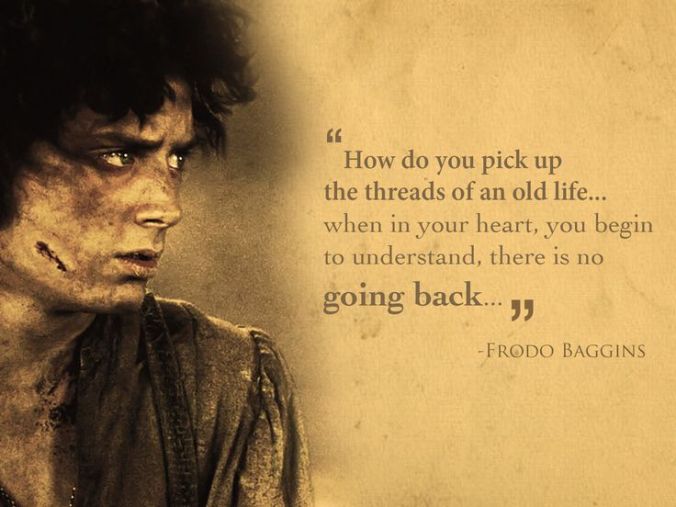
Once the hero has completed their quest, they have to return home. The return trip comes with its own trials and tribulations, notably living with what they’ve done, what they’ve lost, how they’ve changed. Sometimes that journey is bittersweet, the home they’ve been striving to get back to isn’t the same anymore. It’s too small. They’ve mastered both world s yet belong to none. Other times, it’s everything they’ve hoped for. It depends largely on their motivation. If they wanted to leave at the start of the quest, they realize there’s no place like home. If they’ve been torn from home, desperately trying to return, it’s the opposite.

My favorite return is in UP because of Carl’s rejection of paradise falls (basically heaven) with Ellie and his return to the joys of life. It’s a great story about moving on. My least favorite return is in Return of the King because it was super depressing.
The return/crossing the threshhold/master of both worlds/falling action/ending is generally the shortest part of the story. It happens fast, disney tends to cover all the steps in a happy montage song. Here’s a great example from Enchanted.
 Kaitlin Bevis