Last Day of School

Today is a very special day. My daughter’s last day of school in the primary classroom at her school.

Bella goes to a Montessori School, so instead of having traditional grades (she’s in Kindergarten), they have age bands. Bella has been with her class since she was three years old, and today is her very last day as an all-important third year. Next year she’ll be moving on to the 1-3rd grade lower elementary classroom.

So, I’m offline today, celebrating this very important milestone to my child. Enjoy your summer everyone :).


Writing on Wednesday: Book Review

For today’s Writing on Wednesday, I’m taking a break from the snowflake method to review the lovely Molly Ringle’s Underworld’s Daughter.

Molly was the guest author on this blog Monday, and many of you will remember the review I did on her first book, Persephone’s Orchard. 

So without further ado…

perf5.000x8.000.inddMolly Ringle does an amazing job balancing multiple story lines spread across time and multiple characters. She also does an amazing job managing the impact those multiple sets of memories and roles would have on modern day characters. I see glimmers of the past within each of the modern characters but they are still very much their own people.

I was a little hesitant when new POV characters were introduced, but before long, I fell in love with each and every one of them. Molly describes this book’s take on the myths more of “Greek mythology fan fiction” as opposed to retellings, but to me that made it more fun. I’ve read the Greek myths. I’ve read a thousand retellings, I’ve written my own. But done right, a retelling should be original to the author, and if it’s original to the author, it’s going to eventually leave the myth behind to tell the rest of the story.

The ending of this particular story was both heart wrenching and shocking. It immediately had me reaching for book three. I can’t wait to see how it ends.

Molly Ringle’s Take on Adonis

Today I’m pleased to present a very special guest blog from one of my favorite mythology re-writers, Molly Ringle. If you haven’t checked out the Crysomelia Series yet, you’re missing out. But don’t worry, you can fix it. The first book is only .99 cents today on kindle, so if you were ever going to start the series, now is a great time.

Molly is here today to talk about a character featured in each of our books. Adonis. So without further ado, let me turn things over to her.
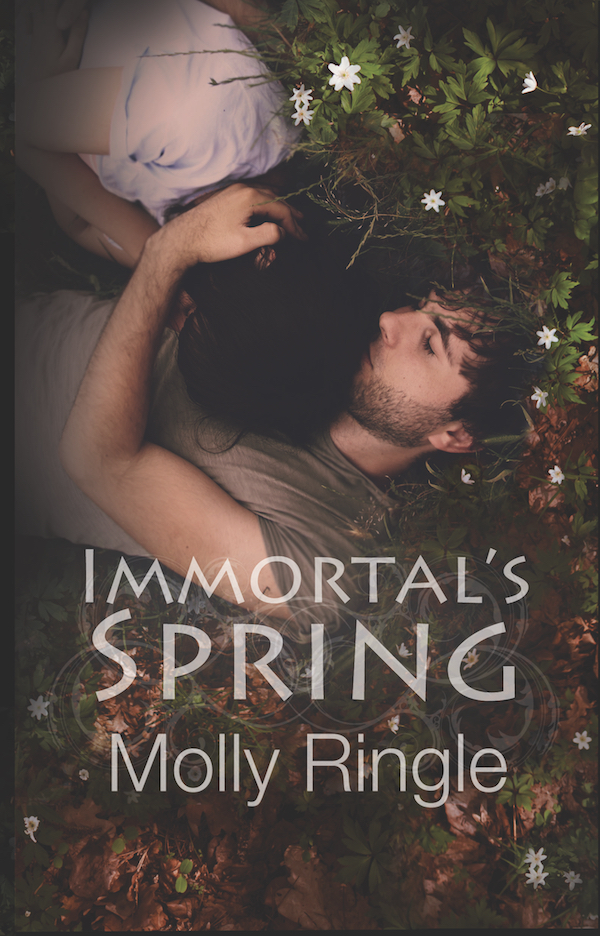
Immortal's Spring cover high res 600 x 900

Hi everyone! I’m Molly Ringle, a fan of Kaitlin Bevis’ and a writer of my own trilogy of Greek-myth-based novels, which starts with Persephone’s Orchard. This week we’re exchanging guest posts on one of the characters we’ve both featured fondly: Adonis.

People usually know what it means to be called “an Adonis:” namely, the person in question is a beautiful, desirable male. Such figures are much adored by legions of women; in the modern world they’re often celebrities known for their good looks. (I ran a search on “Adonis” on Pinterest just now, and got several photos of Harry Styles, among others.)

In mythology, Adonis was a youth so beautiful that even the goddess of love herself, Aphrodite, could not resist him. The pair became legendary lovers, but their relationship was plagued by complications and tragedies, as is typical in Greek mythology. At one point—sources usually say it was in Adonis’ infancy—Aphrodite, already charmed with him, sent him to the Underworld for safe keeping in Persephone’s care. But Persephone became entranced with Adonis as well, and refused to give him back. Zeus had to settle the case: Adonis was to spend four months of every year henceforth with Persephone, four with Aphrodite, and four in whatever way he chose. (People usually say he chose to be with Aphrodite for those.)

That arrangement is curiously like Persephone’s own: part of the year in the Underworld, part of the year in the upper world. Adonis’ ties to the land of the dead end up manifesting in another way too. In mythology, he dies young, usually said to be killed by a boar sent by a jealous rival. Ares, god of war and intimately involved with Aphrodite himself, is often named as the culprit. The heartbroken Aphrodite brings Adonis to new life, in a sense, by transforming his blood into the red anemone flower. And some versions of the myth claim that, like Persephone, Adonis still gets to spend half the year above ground with his lover, even after his death.

Thus he belongs to the class of resurrection deities, or dying-and-rising gods, a group in world religions that also includes figures such as Osiris, Attis, Dionysos, and Jesus. In Ancient Greece there were cults and festivals dedicated to Adonis, in which celebrants (most often women) lamented the yearly death of the lovely young man, and honored the new life that would arise from his sacrifice—a representation, most say, of the cycle of agriculture, in which plants must fall at harvest time but will sprout again in spring.

MY VERSION

In my series, we first meet Adonis briefly in Persephone’s Orchard as a handsome young mortal, a favorite of Aphrodite’s. In the second book, Underworld’s Daughter, we get a closer look at his unhappy childhood, and his disappointment at remaining mortal while his beloved entertains so many enviably immortal men and refuses to be fully faithful to Adonis. After an emotional breakup with her, Adonis ill-advisedly picks a fight with Ares, and takes a lethal knife wound to the belly. Hermes and Aphrodite rush him to the Underworld, hoping for some miracle from Persephone or Hekate, which they get…and that’s where my version really starts to diverge from tradition.

The Underworld magic makes Adonis immortal, but he is still estranged from Aphrodite (who leaves after making sure his life is saved), so he decides to roam the Mediterranean a while and take on a new identity to go with his new immortality. Hearing legends about a dying-and-rising god called Dionysos (who doesn’t truly exist in my version; he’s just a myth), and finding Dionysos’ legends similar to his own story, Adonis drops his old name and takes on that one. Henceforth he will be Dionysos, god of wine, revels, madness, and death-and-resurrection festivals.

Nowhere in mythology does anyone claim that Adonis and Dionysos are one and the same, by the way. I am aware of this. But it struck me that they shared many similarities, and not just because they’re both resurrection deities. Both are also fairly peaceable and non-warlike compared to most of the male gods (although look out for their followers, who might rip you apart). Both have cults that are primarily made up of women. Apparently the rites were often similar in both types of cults, too. So, in my self-appointed task of writing crazy fan-fiction about Greek mythology, I decided I could make a case for this unusual move.

Then, more remarkable still, in reading Kaitlin’s latest installments of the Daughters of Zeus series, I discovered she’s made a similar transformation with Adonis! She wraps his identity up with that of another god too (SPOILERS!)—Eros, in her case; which makes sense, given Eros also has a close link to Aphrodite in the myths, and Adonis surely inspires passion in the world just about as much as Eros does. Kaitlin and I had no idea we were both writing the same type of plot detail for this character (though plenty of our other details differ), which makes it especially interesting: is there something inherent about the archetype of Adonis that suggests transformation? His death-and-resurrection-ness? His being passionately worshipped yet wrapped in mystery? His blend of good fortune and victimhood?

Probably all of that. Adonis may be known these days as merely a pretty face, but like all the Greek gods, he represents so much more than that, and it turns out Kaitlin and I, along with a lot of other people, can come up with quite a bit to say about him. If our new retellings give people a fresh and interesting way to think about the myths, then they were worth writing!

5173tsKIxpL._UX250_


Molly Ringle became fascinated with the colorful weirdness of the Greek myths when she was a kid, and after writing several other novels of love and the paranormal, she finally wrote the Persephone-and-Hades story that had been evolving in her head all those years. It turned into a three-book series, much to her own surprise. She lives in the Pacific Northwest with her husband and sons, and she honestly loves the rainy climate there.

Fave Friday: Litographs

I love these shirts. What they do is they take a story, and create a design using all the words in the book. Well, at least 50,000 of the words in the book.

I want to own them all. I’ve made a deal with myself that every royalty check I can get one (because otherwise I won’t pace myself at all and I’ll have a closet full of more shirts than I could wear). Here are my favorites by design and book. These aren’t a reflection of my favorite books represented on their site. I had to like the book AND the design for it to end up on my list.

Obviously mythology shirts made my list. Not only do I love the content, but it’s basically walking advertising. These shirts start conversations where I can slide in the fact that I write mythology retellings. Plus they look cool. The shirts are Bullfinch’s Mythology, The Odyssey, the Iliad, and the Aeneid.

There are a million different children’s stories I want from the site, but these are my top four. Alice in Wonderland, The Blue Fairy Book, Stories by Hans Christian Anderson, and the Princess Bride.

Miscellaneous. I love the way these look and I’m a huge fan of the actual books the text comes from. I already bought The Last Unicorn, Cinder is next on the list, Poems by Emily Dickinson is awesome on a lot of levels, and The Tempest has a really neat design.

Which one should I get next?

The Snowflake Method: Step 2

ice-crystal-1065155_1920

Last week, I introduced the snowflake method and explained I’d be taking a week to outline and give an example of each step. This week, we’re moving on to step two.

The second step of the snowflake method is to expand your one sentence summary into a one paragraph summary. This is not the back cover copy. This paragraph summarizes the entire book, including the ending. This is pretty easy if you have a vague idea what your book is going to be about, especially if you follow the three disasters and an ending format.

Sentence one should be the backdrop.

Sentence two through four should each be a disaster.

And sentence five should be the ending.

I was going to do an example from Aphrodite, but since it’s four books into a series, it’s not a great example of what could ultimately be used as a querying tool if done right. So I’m making an example of Persephone instead.

Sentence one: Backdrop

Persephone thought she was just a typical, modern day teenager until she realized she was being stalked by a season.


Sentence two: Disaster One

When Boreas, the god of Winter, attempts to whisk her away to a not so winter wonderland, she’s rescued by Hades and offered refuge in the Underworld.

Sentence three: Disaster Two

Unable to physically reach Persephone in the Underworld, Boreas begins going after her through her dreams.

Sentence four: Disaster Three

When Persephone learns to defend her mind from the deranged ice god, he kidnaps Persephone’s best friend and threatens to kill her unless Persephone agrees to take her place.

Sentence five: Ending

In a desperate bid to save her friend, Persephone embraces her power as a goddess and succeeds in killing the god of winter, only to learn an even larger danger is lurking closer to home than she had ever imagined.

Put it all together.

Persephone thought she was just a typical, modern day teenager until she realized she was being stalked by a season.When Boreas, the god of Winter, attempts to whisk her away to a not so winter wonderland, she’s rescued by Hades and offered refuge in the Underworld.
Unable to physically reach Persephone in the Underworld, Boreas begins going after her through her dreams. When Persephone learns to defend her mind from the deranged ice god, he kidnaps Persephone’s best friend and threatens to kill her unless Persephone agrees to take her place. In a desperate bid to save her friend, Persephone embraces her power as a goddess and succeeds in killing the god of winter, only to learn an even larger danger is lurking closer to home than she had ever imagined.

Is this a perfect summary? Heck no. It leaves out almost everything important. The relationship with Hades, Thanatos, Persephone’s entire arc. But this does serve as a great framework, because these are the three disasters that set the rest of the plot into motion. This paragraph isn’t the place for character development or interpersonal drama. This is incredibly broad strokes. The next step fleshes out the characters. But more on that next week.


Mythology Monday: The Argonauts Encounter Sirens

mermaid-1043460_1920

I’ve always hated the ocean. Otrera and the others can just sit out there, on the ocean’s edge for hours sunbathing, and to them, the sound of the surf crashing to the sand is something relaxing. To me it’s downright ominous. Like the water is drawing closer and closer as the tide swallows the sand. The water doesn’t look beautiful to me. It looks mysterious. Anything could be lurking below the surface, and I could never shake the feeling that I didn’t belong there. Or that something else might take offense at my intrusion. I always thought it was a silly fear, my own personal phobia, until I saw the monsters waiting beneath the waves.

I shuddered at the memory of Ren, the first female demigoddess anywhere near my age that I’d met. Blood in the water as she screamed. Slick, grey shapes closing in on her from beneath the waves. She’d never been all that stable, but none of us expected her to jump overboard. The bitter memory clashed with the happy atmosphere of the dining hall, morphing the din of conversation and laughter from the nearby tables into something menacing.

Ren was just a first generation demigoddess and she had no control of her powers. None. Jason told me they found her after her charm drove her step-father to shoot her mother then blow his own head off for making Ren cry. She mostly stayed below decks until that horrible night when she jumped.

“We’re monsters, all,” she’d sobbed before stepping off the edge of the boat.

I didn’t know our charm worked on anything other than humans. But the dolphins were drawn to her. At first we were delighted by the sight of them, but then they started fighting over her.

Talos had jumped in after her, a rope tied around him, before we spotted the pod. But when the dolphins realized he was trying to take her away from them…

Swallowing hard, I pushed my lunch tray across the slick table before returning to my journal. I’ll never be able to listen to that Orpheus song again. Every time it comes on the radio, I see the blood bubbling along the top of the water and hear her screaming. Her screams were the worst because they compelled action. There weren’t enough of us immune to charm to hold back the guys who kept trying to leap off the boat to save her. I ended up turning on the radio to drown her out.

~@~

After their escape from Colchis and a cleansing by Circe,the Argonauts headed home with much nicer weather on the horizon. They ran into a bit of trouble here and there but nothing that most of them couldn’t handle. Like every other Greek hero, the Argonauts encountered Sirens. Beautiful women whose songs tempted sailors to their watery graves.

According to Greek mythology, there were anywhere from two to five Sirens, sometimes referred to as muses of the water world/lower world. They may have been named the following (depending on your source); Thelxiepeia, Molpe, Himerope, Aglaophonos, Pisinoe, Parthenope, Ligeia, Leucosia, Raidne, and Teles. The Romans claimed they lived on an island called Sirenum Scopuli, but most sources place the sirens on random flowery islands surrounded by cliffs and rocks that were conveniently located en route to the hero’s destination. The sirens were either the gods of a muse (which one changes depending on the myth), deminymph, or Chthon (an earth goddess) and a river god named Achelous, or they were daughters of the primordial deity, Phorcys, god of the hidden deeps of the ocean. They were either gorgeous, gross, or bird women depending on the myth you read.

Once upon a time, the Sirens were playmates to Persephone. When Persephone went missing, Demeter gave the women wings to search high and low for her daughter, but when Demeter learned they’d seen her daughter abducted and did nothing to stop it, they were cursed, lost their feathers, and possibly became cannibals, implying they ate the drowned sailors. Though can they really count as cannibals if they’re eating another species? I’m not sure about that. They also may have lost their feathers after they lost a singing competition against the Muses.

When the Argonauts sailed past the Siren Island, Orpheus played his lyre and played a prettier song loud enough to drown out their singing. Only one of the crew, a guy with great hearing named Butes, heard their song and leapt into the sea. But Aphrodite rescued him so all was well.

The Sirens later died when Odysseus sailed past them, tied to a mast so he couldn’t go to them. He’d instructed the crew to plug their ears with wax so they couldn’t hear the sirens and not to under any circumstances allow him to jump into the ocean. Why didn’t Odysseus plug his ears like Circe suggested? He was curious. Since the Sirens were cursed to live on the island until a man passed by that heard their song yet did not respond to it, they threw themselves into the ocean and drowned when Odysseus passed.

Friday the 13th!

friday-the-13th-1042203_1920

There’s only one Friday the 13th in all of 2016 and it’s today. For you superstitious types, that means that one year’s worth of bad luck is going to fall today.

For those that aren’t superstitious, tonight would be great night to watch horror movies. Here’s a few of my favorites. If you can’t tell from the list, I don’t watch a lot of horror. I hate slasher films, and if it doesn’t have a decent plot, I’m gone. Plus I don’t like being scared that often. I have to be in a very specific mood for scary movies. None of the classics are on here because I have no appreciation for the genre. Sorry.

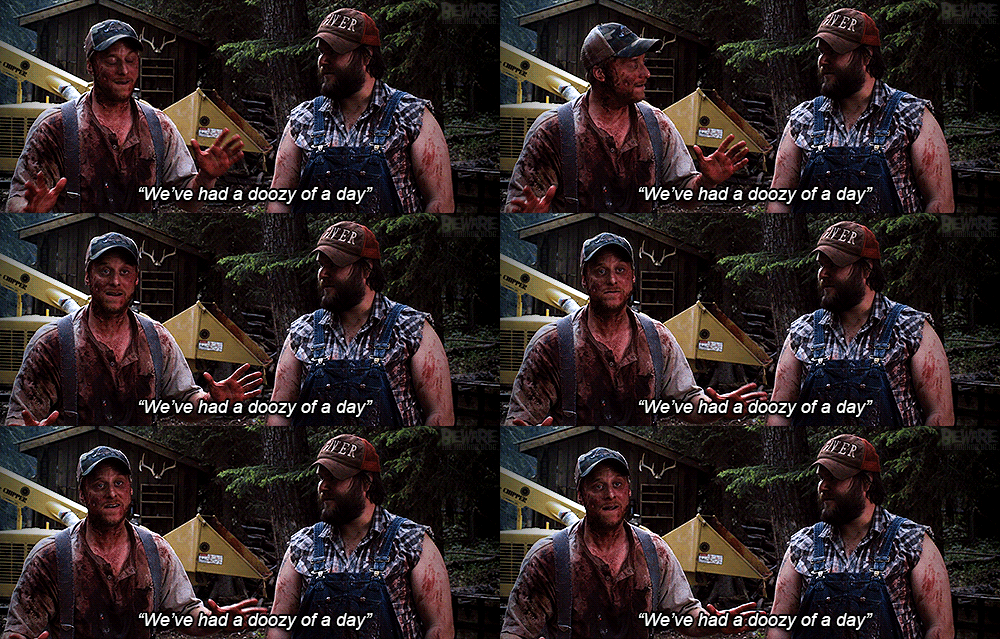
doozy_of_a_day_tucker_dale

Tucker and Dale VS Evil

It’s scary AND funny. Watch it, you won’t regret it.

00aaf9d95ec0515d9ca0612d00ede385

The Ring

I remember watching this one with a friend in high school. We even watched the extra feature, which was the video that’s supposed to kill you. Seconds after the screen went blank, my fricken phone rang! We screamed and hid behind the couch.

identity

Identity

I watched this one with my husband back on one of our first dates. I know the concept isn’t that original, but it was the first like it I’d seen, so it’s in my top five.

200_s


Zombieland

I don’t even know if this counts as horror, but I really love this movie.


paranormal-activity1

Paranormal Activity

Pick one. They’re scary as all get out.

As for tonight, I’ve heard good things about the Babadook. What are you planning to watch tonight? Got any great movies to add to the list?


Writing on Wednesday: The Snowflake Method

ice-crystal-1065155_1920

I’m a pantser, not a plotter. I do a kind of vague outline for the series as a whole and the individual books. I’ve got a ton of tools, notecards, and a dry erase board that I use when I’m brainstorming the story, but for the most part, once I start writing, I just plow through until I’m finished, then go back in revisions and fix all the inconsistencies. I know the major plot points going in, but not much between.

But when I started writing Aphrodite Book 3 (I really need to come up with a name for it), I knew I needed to do something different. When I revised Aphrodite, most of her character arc that I had planned for her entire trilogy ended up in the first book. And almost every scene with Ares had dialogue taken directly from book two. Book two was pretty much gutted, and that’s fine. It made Aphrodite a much stronger book. But that meant that I had to completely change book two to suite a character who was in a wildly different place than I’d imagined her starting and a romance that was way further along than I intended it to be.

Revisions for Love and War are still ongoing and since it’s a middle book, any change in the sequence of events or characters is going to equal massive reverberations to book three. So when I turned in Love and War and tried to get started on Book 3, I found myself stuck. I know the major events. Those aren’t going to change. But how the characters get there, that’s in flux. But deadline wise, I can’t just not work on it until Love and War goes through revisions. Plus, it’s a process that goes both ways. While I’m writing I might have a revelation about a character that I want to plant seeds for in book two.

So, I’ve decided to try something new. The Snowflake Method. Click the link there and read all about it, and if you have scrivener, download this template. Trust me, you’ll thank me.

I’ve been using the template since the first of April, and I’ve made some great strides. Part of that is because in writer land, anything new and exciting that gets you writing is a good thing. The rest is the fact that this method rocks. The best thing is, as I’m going through and figuring things out, I’m not just making changes to my outline, I’m making notes to focus on in the revisions of Love and War. So this has really helped me flesh out some of my background characters a lot more and given me a lot of ideas for how the plot can progress while still leaving me a lot of flexibility to make changes without having to gut my entire novel.

I’m going to be talking about this template over the next few weeks.There are ten steps to the snow flake method, so I’m going to go ahead and start with step 1.

Step 1: Take an hour to come up with a one sentence summary of your story. Here’s the guidelines offered on advanced fiction writing.

  • Shorter is better. Try for fewer than 15 words.
  • No character names, please! Better to say “a handicapped trapeze artist” than “Jane Doe”.
  • Tie together the big picture and the personal picture. Which character has the most to lose in this story? Now tell me what he or she wants to win.
  • Read the one-line blurbs on the New York Times Bestseller list to learn how to do this. Writing a one-sentence description is an art form.

You’re going to want to take the whole hour to tweak the words and really think it through. I promise you as a frequent writer of query letters, do this before you write the book. It’s so much easier to expand on an idea then it is to shrink one. Even if you don’t use the snowflake method, you’re going to want a ten second summary.

Also, know that this will change as you go through the snowflake method and the actual writing of your book.


Now I’d love to share the one line summary for book three, but since book two isn’t out yet, I’ll refrain.

Aphrodite’s one line summary using the snowflake method would have looked something like this.

When demigods start going missing under mysterious circumstances, a gorgeous goddess investigates with help from the one man immune to her charm. (22)

But that’s too many words. So let’s cut under mysterious circumstances, because if they’re missing, the circumstances are already pretty mysterious. And start is a filter word and I don’t mention the setting, so I’m going to try this.

When demigods go missing, a gorgeous goddess boards a cruise to investigate with the help of the one man immune to her charms.(23)

Still too many words. I know the fifteen word thing isn’t set in stone, but focusing on that word count while trying to get the gist of the story in it is really helpful to my thinking process.

A gorgeous goddess boards a cruise ship to investigate missing demigods with help from the one man immune to her charm. (21)

A goddess boards a cruise to investigate missing demigods with help from the one man immune to her charm. (19)

Still too long and too abrupt. Maybe the cruise isn’t as important.

When demigods go missing, a goddess investigates with the help of the one man immune to her charm. (18)

A goddess investigates missing demigods with help from the one man immune to her charm. (15).

It’s still not perfect, but through this exercise I’d figured out three things that were super important to me in telling this story. Demigods are missing. A goddess is looking for them. She’s joined by a guy she can’t charm. And she’s on a cruise ship. If I take the rest of my hour, I can probably work the cruise in somehow, but that book has already been published, and I think I’ve made my point.

This is a really good exercise to help you think through the most important base components of the story. And playing with the words in a small, unthreatening chunk gets your brain working on the plot.

Plus it’s fun. Can you summarize what you’re working on in a 15 word sentence? If you’re not working on anything, how would YOU summarize Aphrodite in 15 words? What were your biggest takeaways from the novel?

Mythology Monday: Escape from Colchis

sea-1175248_1920

Being here brings back memories, I wrote, returning to my journal, shifting positions in the uncomfortable plastic chair. Not that I was here, of course. But underneath the ocean-themed decor, it smells the same and that’s enough to take me back.

I remember lying in a bed like this for what felt like ever. I don’t think my stepdad knew what was going on. Every time he visited, his eyes would glitter with sympathy and he would say meaningless phrases like “Stay strong, kiddo.”

He was so convinced I was sick that I believed him. At first I thought I’d switched places with my step-brother. That I’d misunderstood what my parents had asked me to do. I was convinced they’d given me his cancer so he could be better and I could die. To be fair, I was, like, six. It made sense to me.

I remember being so angry. Screaming into my pillow and crying myself to sleep wondering what I’d done wrong. Why had they picked him over me? But then I’d try to be so good when Mom visited. Like if I was just sweet enough, loving enough, good enough, she’d switch us back.

I drew in a deep breath, antiseptic smell of the hospital stinging my nose. The incessant beeps coming from the machines attached to Elise made it hard to focus. My step-brother never visited. I think they told him I died. He sure was surprised to see me later, though that might have been the gun to his head.

Then I found out the truth. I thought I’d felt angry before. Betrayed. But that feeling didn’t even begin to touch the way I felt the day I realized they were farming me out for parts and selling me to the highest bidder.

“They wanted to call it ‘Hope.’”

That’s one of the last things my mother ever said to me. I wonder what would “they” have said if they’d known “Hope,” their miracle cure, their golden fleece, was a terrified girl that had to be strapped down to the bed, screaming and crying every time the doctor walked into the room, because she knew what his presence meant. That this time, blood wasn’t enough. “They” needed more.

~@~

When we last left off, Jason completed the trials of Colchis, grabbed Medea, and sailed away. But this wouldn’t be a Greek myth if the story ended there. See, first Medea had to go from betraying her father’s pride and helping Jason win to the completely unrelatable zone of killing her brother, cutting him to pieces, and dropping his body in the ocean to distract her father. Her father stopped to gather the dead bits of his son, allowing Jason and the Argonauts to escape.

Yeah.

To be fair, had the King intended to be fair and give Jason the fleece as promised for completing the tasks, Medea wouldn’t have had to resort to such measures. She knew for a fact Aetees intended to cheat Jason out of the reward, possibly through nefarious means because he told her as much. She considered suicide first, but ultimately, the promise of a life with Jason was, in her mind, worth her brother’s life.

One thing I haven’t dwelled on much in this myth is Medea’s magic. Sure, she helps Jason with some potions, but her magic is actually a lot cooler than just brewing herbs. Doors open for her. She can chat with the moon. Her mythical abilities vary by myth, but she’s not a god or a demigoddess. There’s not a lot of just random spell casters in Greek mythology, so Medea as a character is fascinating.

Anyway, Zeus was not thrilled by the gory murder of Medea’s brother, so he decided to make their return trip hell. He sent storm after storm, delaying their trip and endangering the crew. Depending on the myth, the storms either blew the Argo to Circe’s island, or the boat got so sick of the storms that it *asked* Jason to please take it to be cleansed by Circe.

Writing on Wednesday: May the Fourth Be With You!

10272705_10151971738241901_4630730400074100390_o

So today I have to write about Star Wars. I have to. But there’s a problem with that. I’ve already written at length about the hero cycle in previous posts. Star Wars didn’t invent the mono-myth but it used the crap out of it. But there’s another thing the Star Wars movies did really well. And that was the trilogy format.

Trilogies are everywhere, but did you know they follow a formula? For the most part. Here’s how it goes.

Book one can stand alone if it needs to. It begins the story, introduces the world, and contains a complete plot arc. There’s an ending and a resolution, and all seems to be happily ever after except for a few dangling threads that could be shaped into a new book or movie. An exception to this tends to be in YA where it’s almost a given that the book will be a trilogy, so the first book will resolve a story, but there’s more than threads left behind. There’s huge questions that demand huge answers. As more authors are contracted for the trilogy as a whole, you’ll see more of those Divergent style endings, where everything wraps up, then boom.

But back to a traditional structure.

By book/movie two, the writer is confident in the fact that there’s going to be a third. This means books three and four tend to be a lot more entangled in terms of plot lines and arcs. Book two has an arc, but it could never stand alone. It needs the first book and the third. Consequently, book two tends to end in a hopeless, dismal, terrible state of despair. It also tends to start there. And linger there in the middle. The second book is where everything that can possibly go wrong, does.

Book three continues that trend for about the first half the book, then swings in an upward trajectory that wraps everything up and completes the arc.

Star Wars did an interesting twist with the trilogy in Episodes 1-3. They wrote what I consider to be the anti-trilogy. The second movie doesn’t plunge you into darkness and sad stuff, it ends with a wedding. It’s the bright shining happy spot in the series (I realize fans may disagree, but plot wise, they tried very hard to saturate the second movie with happiness). The third movie in a typical arc would have been the second.

I wonder what the next trilogy will bring. My theory is it will follow the formula of 4-6, but at every plot point make a different choice that throw a lot more shades of gray into the story arc than we’ve previously seen with Star Wars.

What do you think is coming next?