
Not the cover.
Page proofs have been approved, and I have a release date AND a preorder link…:D
June 9th!
Not the cover.
Page proofs have been approved, and I have a release date AND a preorder link…:D
June 9th!

I shook my head. “Put Zachary in charge of Reaping. You can trust him. If we can find two, maybe three other souls we can trust on the surface, I think they can handle it.”
“Zachary?” Hades gave me a quizzical look.
“Asclepius’ new persona,” Cassandra explained.
“What makes you think you can trust him?” Charon gave me a surprised look.
“He helped me when the Reapers were attacking me. And he never had to be charmed. He swore fealty on his own. Who’s Asclepius?”
“He swore fealty? To you?” Hades’ eyebrows shot up. “Well . . . okay then. You’ll still have to try to charm him, but if you say he’s trustworthy . . . ”
“Who is he?” I asked again.
“He’s the first Reaper.” Hades was talking fast, indicating we needed to move on from this conversation. “He was a god of healing, and he tried to stop death. That violated the rules of nature We put into place. Rather than changing the nature of the dead, it changed him.”
The way he said “We” emphasized the capital letter, and I understood he was talking about my mother, Zeus, and the rest of the original six. When they created the world, they’d all agreed on its natural laws. Earth and all its inhabitants formed a complex system involving all their powers. To protect their creation, they’d even given up the ability to lie. Words had power; the wrong words could unintentionally change the nature of something. I’d never considered the ramifications of a god intentionally trying to change the rules.
I felt sick. Poor Zachary. He’d tried to stop death and become its first agent.
~@~
Asclepius (to cut open) was the mortal son of Apollo and a princess named Koronis. Unfortunately, his mother died during childbirth (for was murdered for being unfaithful to Apollo, myths vary), so his father had to cut him from her body (hence the name). His mother was placed among the stars (The Crow constellation).
The demigod was then placed into Chiron’s care and taught medicine. Chiron taught him all he knew, but Asclepius also learned medicine from snakes whispering in his ears. Snakes are sacred to medicine to ancient Greeks, so the demigod grew so skilled that he figured out how to stop death and restore the sick back to life. Unfortunately, Zeus was very against the idea of immortal man, so citing fear of overpopulation, he killed Asclepius’s with a lightning bolt. Other myths claim he was killed for bringing back a specific person (Hippolytus).
The gods honored the fallen demigod with the constellation Ophiochus (the serpent holder), and performed apotheosis to turn him into a god so he could continue to be their doctor.
In most vases and paintings, Asclepius looks like an old, bearded man holding the staff with a snake around it that you’ll see in so many hospitals. (He was kind of a big deal in medical circles).
Asclepius participated in the Calydonian Boar Hunt at some point. He also married Epione, the goddess of soothing pain, and had five daughters (Hygieia, the goddess of health; Panacea, the goddess of universal remedy; Aceso, the goddess of recuperation; Iaso, the goddess of healing, and Aglaea, the goddess of beauty) and three sons (Machaon, Podaleirios and Telesphoros). He may have also had a son named Aratus, with a woman named Aristodama. More on them in a minute
In my universe, he wasn’t turned into a god, because let’s face it, that’s uncharacteristically kind of the gods. He was turned into the first reaper. Now instead of healing people, he releases souls. You’ve met him in the Persephone trilogy as the reaper, Zachary.

Moms deserve more than a day. Remember to call your mom this weekend and do something special. If you are a mom, take it easy and make wonderful memories (after you call your mom and do something special).
For those of you missing your mother this mothers day, do something happy that makes you think of her.
Have a great weekend everyone!

I had such a blast at WHOlanta! I’ve done a panel at Jordancon before, but this was my first time going to a convention with guest status. I had a table to sell my books (which I shared with the lovely James Palmer), I was on a lot of panels, and I got to meet Colin Baker, Nicola Bryant, and Camille Coduri from Dr. Who. I was a little nervous about speaking on so many panels, but fortunately authors Lee Martindale and Jana Oliver took me under their wing and talked me through all the tips and tricks of going to cons. I’m sure I still made missteps, but far fewer than I would have without their guidance. I’ve even picked up a few tricks of my own to pass along.
Panels:
Selling Books:
How about you? Any tips or tricks I might have missed?

In honor of Mother’s day next week, I’m dedicating this week to the amazing mom’s in Greek mythology. Ancient cultures may not have had the most respect for women in general, but they respected the role of motherhood. Here’s the top three mommy myths in Greek mythology. By the way, I’m leaving both Hera and Gaia off this list because in my opinion they sucked as mothers.
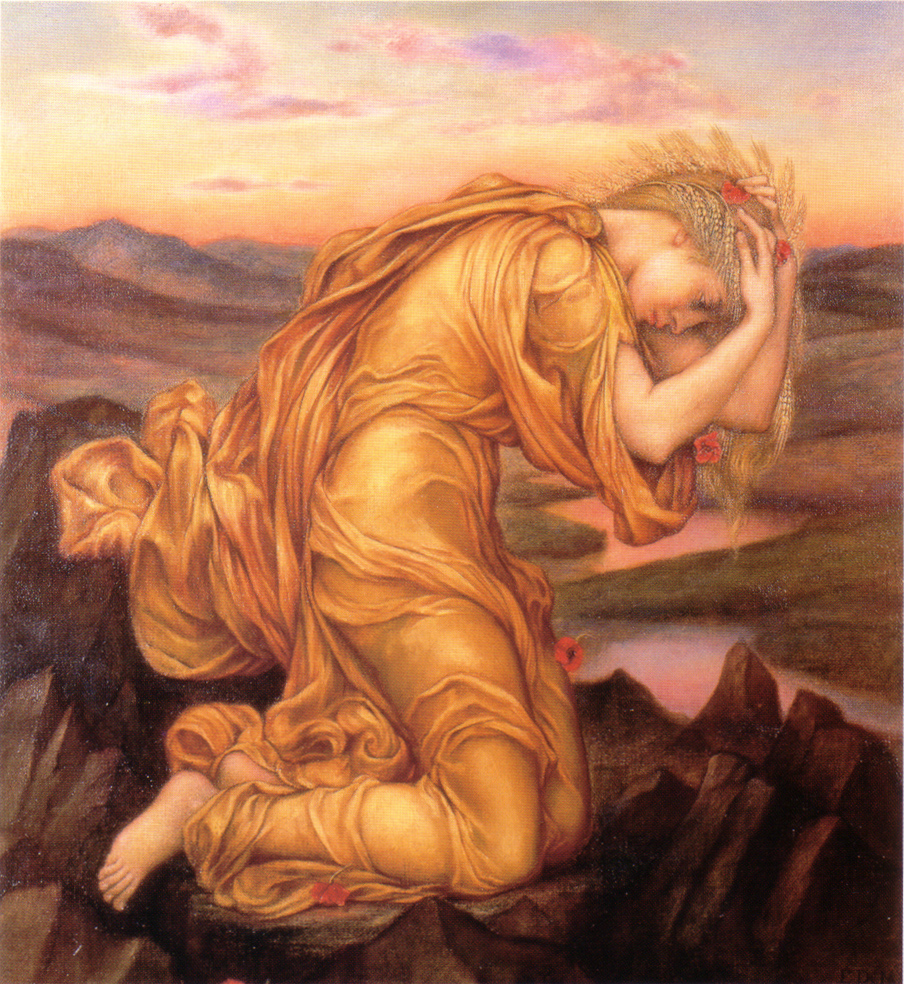
“Demeter mourning Persephone 1906” by Evelyn De Morgan – http://visionsofwhimsy.blogspot.de/2011/04/happy-birthday-mum.html. Licensed under Public Domain via Wikimedia Commons – http://commons.wikimedia.org/wiki/File:Demeter_mourning_Persephone_1906.jpg#/media/File:Demeter_mourning_Persephone_1906.jpg
Demeter
I’ve already went into Demeter’s myth at length several Mythology Mondays ago, but I can’t leave her out of this list.
She was by all accounts, an awesome mom. She took great care of Persephone, protected her, and kept her out of the drama of Olympus, no small feat.
When her daughter went missing, she scoured the earth to find her and didn’t rest until her daughter was returned to her arms.
It’s a pretty epic myth, all things considered and in my opinion the most powerful myth about motherhood in Greek mythology.

Rhea
Rhea was married to a kind of awful guy. And yes, it took him eating a couple of her kids to realize the true depths of his depravity, but eventually that mothering instinct took over and rather than allow Cronus to kill Zeus, she, at great risk to herself, snuck him away and tricked her husband. Later, she gives Zeus the tools he needs to save her other children. This decision cost her a kingdom, a husband, every bit of status she had ever gained. She wasn’t killed with the rest of the Titans but she faded into obscurity.

“For two days and two nights the boat was and hither and thither” by Walter Crane – The story of Greece : told to boys and girls (191-?) by Macgregor, Mary. Licensed under Public Domain via Wikimedia Commons – http://commons.wikimedia.org/wiki/File:For_two_days_and_two_nights_the_boat_was_and_hither_and_thither.jpg#/media/File:For_two_days_and_two_nights_the_boat_was_and_hither_and_thither.jpg
Danae
Danae was a princess whose child was fated to kill her father. Her dad locked her up so no man could reach her, but that didn’t stop Zeus. As punishment for getting knocked up, her father locked her and her baby in a coffin and threw them out to sea so Poseidon would get the blame for killing them, not him. Poseidon didn’t cooperate so mom and son, Perseus, made it to shore, where a king fell in love with her. She wasn’t interested in marriage (no doubt emotionally scarred from her horrible treatment with her father), but the king raised Perseus and agreed not to pursue her for awhile anyway. When Perseus grew up, the king lost patience and tried to marry Danae, but Perseus used Medusa’s head to turn him to stone.
That tells me a few things about Danae. The main one being she’s an awesome mother. Perseus loved her enough to go to great risk and kill a father figure for the love of his mom. That means rather than shutting down or blaming Perseus for all the trouble he brought her, she kept mothering on like a good human being. Given her insane childhood, that’s kind of awesome, so props to Danae.
So there you have it. My top three favorite Mom myths in Greek mythology. What’s your favorite Greek mother?
I’m so excited to be attending WHOLanta this year! Below is my schedule for panels (subject to change), and I will be signing books between panels. Come find me if you’re attending.
Friday:
6:00 Dunwoody 1: Traditional Publishing VS Indie Publishing
Saturday:
10:00 AM: Dunwoody 2: Disney/Pixar
12:00 PM: Dunwoody 1: American YA Lit
5:00 PM: Dunwoody 2: Characters you love to hate and hate to love
6:00 PM: Dunwoody 1: Genre Blending
7:00 PM: Dunwoody 2: 20 Years of Buffy
Sunday:
10:00 AM: Dunwoody 2: Live Action Disney
3:00 PM: Peachtree: Why I Stayed, Sexism in Dr. Who
I am working through my page proofs for Venus Rising. Theoretically, this is the easiest part of the publication process. All I’m supposed to do is read through and make sure there are no formatting glitches. It’s too late to change content, the copy edits are finished, this is just a last look through.
But it’s the last look through! If I miss something now there’s no going back. Everyone will see the mistake in print.
So…I’m procrastinating. It’s amazing the things that feel like they must be done right now when you have work you’re nervous about doing. Here’s the last few things that my brain has demanded must be accomplished now.
Someone send help….

My daughter’s school actually does a whole thing for May Day, so I’m off to go enjoy that. May everyone’s day be festive and fun.

A reader asked if they can start with Daughter of the Earth and Sky.
If you’re like me, you sometimes stumble upon book two in the library or win it in a giveaway, and you just want to know if you should open the book or if you’ll be so hopelessly lost it’s not worth the bother. I recapped well enough in book two for a new reader to be able to pick up in book two. So yes, you can.
However, I suggest finding a copy of book one if you can (it’s free in audio form if you sign up for my newsletter), because while you will get what’s going on thanks to recapping, you aren’t going to appreciate it as much as a reader who was “there.”

In The Story Grid, Shawne Coyne takes a moment to discuss the differences between plot driven and character driven stories. In brief, a plot driven novel focuses on external problems whereas character driven focuses on internal problems. It’s very tempting to divide these into hard and fast categories, like saying all natural disaster movies are plot driven because the conflict is external.
That’s just not true. For example, look no further than zombies.
Zombies are Man VS Nature in its rawest form. Replace zombies with forest fires, earth quakes, tidal waves, giant meteors hitting the earth, or insert natural disaster here, and you’ll feel the same sense of hopeless dread against a force that can’t see reason and cannot be stopped.
Some zombie fiction is almost entirely plot driven, like World War Z. In others, the zombies themselves are almost window dressing to large scale, character driven dramas, like The Walking Dead.
Very, very rarely is a story 100% character or plot driven and successful. A viewer/reader/whatever has to care whether the character lives or dies to willingly follow them through the zombie wasteland. How much they care is a sliding scale. But there has to be something, otherwise the entire plot falls flat. Conversely, stories that exist almost entirely in a protagonists head, a protagonist without some kind of external goal, are incredibly boring. (We’ve all had to read those issue books in schools).
All stories balance character and plot as a driving force to pull the reader through the novel. How much of each is going to depend on audience, genre, and the writers personal preferences. But both sides of the equation have a lot to teach an aspiring writer.
 Kaitlin Bevis

