Shawn Coyne discusses the genre clover from his novel, The Story Grid. To download a version of the genre clover for your own use, click here. 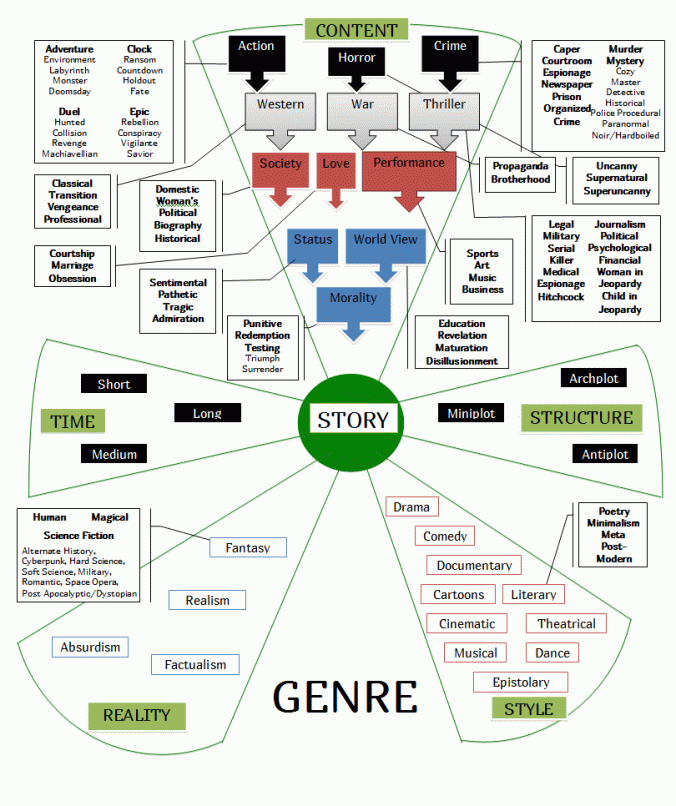
Mythology Monday: Melinoe

“Persephone?” I reached out to caress her cheek.
She flinched. “Don’t.” Her green eyes searched my face. “I should be able to tell.” Her voice broke. Persephone tried to pull back, but I held her fast.
My arms dropped, and I stepped away for good measure. There was no telling what she had gone through, so if she needed space, I was happy to oblige. “Tell what?” I wanted to reach out to her, to demand to know what Zeus had done and how I could fix it, but I didn’t dare. “Persephone.” It was a fight to keep my voice calm. “Tell me where to find you.”
She looked away and I jerked toward her, almost unable to restrain myself from reaching for her. Persephone flinched.
“Hey, it’s okay. Wherever you are, I’m going to find you and bring you home, okay? But I need you to point me in the right direction.”
“Stop.” She took a deep, shuddering breath, sliding her air plant pendant back and forth on the chain of her necklace. “I should be able to tell him from you. If you’re not him, if you’ve taken that from me, if you’ve broken us that badly . . . ” Iron glinted in her eyes, hard and unfeeling. “Then you won’t have to find me. I haven’t come into my powers yet, but I will. I’d be afraid of that day if I were you.”
Comprehension bubbled up within me like bile. I was going to make a way to kill him. Then I’d drag him down to hell and spend the rest of eternity making him suffer.
It wouldn’t be enough. It would never be enough. Zeus looked like me. The bastard had looked like me when he’d hurt her. “It’s me.”
She didn’t look convinced, and I didn’t blame her. I didn’t sound like myself. There was no getting past this. Even if I found a way to get her back, even if everything worked out, she would look at me now and see him.
“Everyone is ‘me.’” Persephone put the word in air quotes. “Be more specific.”
~@~
Melinoe (dark minded) was the moon goddess of ghosts and the bringer of nightmares and madness. Every night she wandered the earth, trailed by a group of wailing ghosts, waiting to strike fear int he hearts of men. One half of her body was black as pitch, the other corpse pale, a testament to her duel nature. She was born on the mouth of the Cocytus River.
Sometimes Melinoe is described as a daughter of Persephone via Zeus pretending to be Hades. When either Hades or Persephone (myths vary, but personality wise post-abduction this sounds more like a Persephone punishment than a Hades one) discovered what happened, and enraged, rent the daughter resulting from the union, discoloring her flesh.
In my books, I split the difference. Zeus does take on Hades’s likeness in Iron Queen as a trick to drive Persephone to the madness Melinoe represents, but I don’t go physical with that because frankly, I didn’t want to write that story. Plus the whole Zeus as Hades thing is tricky because there are interpretations in Greek Mythology that Zeus and Hades were the same god, just different titles. Or Hades and Dionysus, or Melinoe is actually another title for Hekate or Persephone and the whole origin story is moot. When you mix the religions of a bunch of different regions and try to combine them into one Pantheon, things get messy.
**Before you go, I just wanted to remind you that Love and War is still on sale for .99 cents! Click here to buy it today.
FAQ Friday: Where can I buy Persephone?

Q: Where can I buy Persephone in format/language/country/for free.
I get variations on this question a lot and for obvious reasons, I am all too happy to answer.
First, some links: Amazon | Barnes & Noble | Kobo | Audible | Goodreads and many, many more.
Persephone is available in print, all the major electronic formats, and as an audiobook narrated by yours truly. Print wise, you can order it wherever books are sold, but unless you happen to live in Athens, Georgia, the odds of you walking in and seeing it on a shelf are slim, so you will have to special order it.
Internationally, Persephone is available through Amazon and to my knowledge Amazon alone. It is at this point in time only available in English.
Audiobook wise, Persephone is available on audible,itunes, and good ol’ amazon.
Persephone occasionally goes on sale for .99 cents, but my publisher has not yet offered it for free. As far as I know, they have no plans to. If really, really, really want to read my book, but can’t afford it even on sale (trust me, I feel your pain. I have lived in the red) the best suggestion I can offer is your local library. If they don’t have a copy and you request it, chances are they will buy more than one of copy, so not only do you get it free, but it also helps me in terms of sales and exposure. We both win. My books are all available on overdrive, so if your library offers eBooks, there’s a good chance they already have it in an electronic format or can easily obtain it via request. You can even request the audio version. If you’re asking for my recommendation for a good pirate site, let me tell you three quick things.
- While I am truly flattered that you want to read my book enough to commit theft, I’m not J.K Rowling (not that she deserves to be robbed either). I need every penny of my royalties to scrape by.
- I have it on good authority from the many, many, many readers who have emailed me complaining their stolen copy of my book infected their computer, that a good chunk of those pirate sites claiming to have my book are bad news.
- When real copies of my book go up, they are pretty quickly taken down, and they stay down for one very important reason. My publisher takes piracy very, very seriously. When they see their products being stolen, they act on it beyond just sending take down notices.
I have an E.d.S in School Library Media, so accessibility is very important to me. If you cannot obtain a copy of my book for any reason at all, email me using the contact me form on this website. I’ll see what I can do.
Sale: Love and War

Love and War is on sale for .99 cents from now until March 15th! Don’t miss this opportunity to catch up before Venus Rising is released.
Mythology Monday: Lethe

“So that—” Cassandra pointed at one of the beautiful rivers winding its way through the landscape “—is the River Lethe. Don’t drink the water, bathe in it, or even touch it.”
“Why?” I gazed longingly at the translucent water and pressed my hand against the cool glass. I’ve always hated swimming, and all the water I’d ever drank came from a faucet, but something about the sparkling water called to every fiber of my being.
“You’ll forget things. Sometimes when a soul comes here, their death was traumatizing, or maybe their whole life sucked. This river gives them a chance to forget the things that would otherwise haunt them.”
“Like Oreithyia?”
Cassandra hesitated. “She’s an extreme case. There are different levels of memory loss. The Lethe can take away all memories associated with a singular event or person, or wipe away their entire lives, and everything in between. Some memories go deeper than others. Boreas knew she would be coming here so he . . . made it difficult. He doesn’t like to be forgotten.”
I didn’t ask how. I was having a hard enough time dwelling on what could have happened to me. I didn’t need further details.
“We also use it on people who’ve done bad things in life,” Cassandra continued. “We take away all their memories, and they serve in the palace or around the Underworld until their sentence is up.”
That didn’t seem like much of a punishment. “Why?”
“For most people, their circumstances contributed to whatever crime they committed. This gives them a blank slate. When they finish their sentence they can live the rest of their afterlife in peace. Of course it doesn’t work like that for everyone, but between me and Moirae we can usually tell who should go straight to Tartarus.”
~@~
Lethe (the River of Unmindfulness) is both a river in the Underworld and a goddess of oblivion (daughter of Eris and Oceanus). Geographically, if flowed around the caves of Hypnos on the border of Elysium. Souls who drank from her water soon forgot all they knew, so the dead frequently used it to forget their mortal lives. In some versions of the myths, every resident of the Underworld had to drink from the water and were forced to forget their entire lives. In others, drinking from the Lethe was a requirement for reincarnation. Some cults taught souls were given a choice between the Lethe or a twin river called the Mnemosyne that would give memories and even omnipotence.
In my universe, the Lethe doesn’t equal complete forgetfulness unless a soul drinks a lot of it. There are levels and it can be used to forget specific traumas or for souls who committed crimes in their mortal lives to forget both the crimes and the circumstances. The reason for that is two fold (and very inspired by Kelley Armstrong’s Haunted).
FAQ: Can Persephone be read as a standalone novel?
Can Persephone be read as a standalone novel?
I get it. Sometimes the last thing you want to do is get tangled in a long series. Persephone is the first of a series of trilogies set in the Daughters of Zeus universe. There are multiple stopping and starting points within the series provided you don’t mind skipping the last page. There will be unanswered questions, but for the most part, of all the books, Persephone contains the most self-contained plot.
Literary VS Commercial Novels

In chapter five of The Story Grid, Shawn Coyne talks about the differences between literary and commercial works, and it’s pretty common sense, but he did have some insights I wanted so share.
So first, a quick primer.Writing Excuses had the best explanation for literary fiction versus commercial, or genre fiction. In literary fiction the focus is on the craft, the word play, the things being accomplished by the text. Genre fiction is all about the story.
There’s a prevailing attitude that literary fiction is better than genre fiction. And in form that’s likely true. But that’s really not a fair comparison because the two have entirely different goals. If a literary fiction novel doesn’t pull your attention to the clever tricks of the words on the page, it’s failed. If a genre fiction novel pulls your attention off the story long enough to dissect the wordplay, then that’s a problem.
Think of it this way. Two people are making their way down a path. One is racing, determined to get their very best time. They are ultra focused on their form, the way their feet touch the ground when they run, everything matters.
The other person is out for a walk to enjoy the pretty scenery. They are taking the time to look at every plant and flower, smelling the fresh air, basking in the sunshine.
There are similarities between the two. They are both using feet to propel them down the same path. They can learn from each other, use tips and tricks from each other to better meet their goals because the ground rises and falls beneath them identically. But it would be foolish to criticize the racer for not stopping to smell the flowers or the walker for making such terrible time.
The similarities in base form aren’t the only thing that make it tempting to compare the two unfavorably with each other. Literary fiction is what is often taught in the classroom. While literary fiction is still being written, because of the way writing adapts and changes, some genre fiction will become literary fiction as time goes by. Historical context, out of fashion writing styles, and impact of the novel itself has a lot to do with what is viewed as literary. Conversely, a lot of high brow literary stuff was once upon a time looked down upon as over rated genre fiction.
Coyne goes on to explain that within genre fiction, the largest consumers are women. Women’s fiction is historically the best selling fiction genre, followed closely by (and sometimes including) romance. That fact is why pretty much every novel ever written contains a romance regardless of genre. Authors and publishers want to attract the most possible readers. Recently YA has made some massive waves and is changing the market place, so I’m curious to see what conventions change down the road.
Most helpful to me in this chapter was Coyne’s explanation on how he selected which books to acquire for his publisher by focusing on the recent sales of each sub genre within his genre of genre fiction. You should absolutely check it out in The Story Grid.
Mythology Monday: Ascalaphus

Time passed in a blur of color and light. People laughed and danced around us, the spinning arcs of the skirts making me dizzy.
“I can’t dance another step.” I giggled, clinging to Hades so I wouldn’t trip and fall.
“Let’s get some air.” Hades led me out of the ballroom. The party was scattered all across the Underworld, but we found privacy in the grove of trees. The trees stretched into the sky, their branches arching and spilling over, sheltering us from view of any of the other souls wandering the Underworld.
“You’re trying to stop me from making a scene.” I stepped away from him into the center of the clearing. I spun around, holding my arms out. “Whoa.” I stopped mid-spin, waiting for the clearing to do the same.
“You should probably eat something.” Hades caught my hand. “Think of something, anything at all.”
I imagined pomegranate seeds and a plastic baggy full of them appeared in my free hand. I put six seeds in my mouth. An owl hooted in the distance.
Hades laughed. “You’re going to need more than that. What’s your favorite type of bread?”
“I’m a goddess. Do I have to worry about hangovers?”
“Your metabolism will change when you come into your powers. As far as alcohol is concerned, right now you’re a human.” He suppressed a grin. “Ambrosia gets even gods drunk, so you’re in trouble.”
~@~
I had a lot of fun peppering my books with Easter eggs for people as obsessed with Greek mythology as I am. The owl hooting in the distance in the scene above was a reference to the god Ascalaphus.
Ascalaphus (not to be confused with the Argonaut by the same name) was a minor deity/spirit that kept the orchard in the Underworld. He saw Persephone eat the fateful pomegranate seeds and informed Hades and Zeus. Because of those seeds, she was forced to return to the Underworld every year.
Demeter did not take that news well. But she couldn’t lash out at Zeus or Hades to the degree that she’d like to, so she shot the messenger. She buried Ascalaphus under a rock, but that pesky demigod Hercules freed him. Since keeping him trapped didn’t seem to be working, she turned him into a screech owl. Ever since, screech owls have been associated with the Underworld. Spotting one is a bad omen.
There is a version of the myth that credits Persephone with his transformation, which while out of character at the time, wouldn’t be for long as she became known as The Iron Queen.
FAQ Friday: How old is Hades, physically?

How old is Hades, physically?
Simple answer? Let’s call him twenty-five.
Less simple answer? While Persephone said she thinks he’s in his mid-twenties, the answer to that question is going to depend on which part of Hades you’re talking about. The gods are basically frozen in their prime. That moment before cells start degrading and everything is just getting better and better and better. For different parts of your body or brain, that turning point happens at different parts of your life. For instance, your prime years of math learning or foreign language learning are over way before your prime height. But for simplicities sake, human men stop maturing in their mid-twenties, exactly which year/month/day of their mid twenties is going to vary person by person, but mid-twenties is a pretty safe estimate.
Romances
In honor of Valentines, I’m reposting this blog for my writing on Wednesday feature.
Disney handles romance well.
That may be the most controversial sentence I’ve ever written. But when it comes to crafting romances from a plot perspective, they know what they’re doing.
The romantic plot arc is a simple one. That’s why it tends to run as a subplot. That doesn’t make it less important, it just means that the plot points of a romance line up with the plot points of the external conflict.

Like it or not, this is the basic plot structure for every romance ever. “But what about–” you may protest. No, seriously. This is like the monomyth for romance. If a story has a romantic element in it at all, ever, it follows these points, maybe not in this order, but they’re there. Even if the author didn’t do it consciously.
Disney used to get to simplify the attraction stage. Boy sees girl, girl sees boy, boom. Expectations set. Because the early days of Ariel just happening to spot Prince Eric on the boat were done so well, they’ve become cliche. So lately they’ve been poking fun at that expectation with movies like Enchanted or Frozen. Oddly enough in doing so, they created the best example of the initial attraction yet in “Love is an Open Door” simply because they didn’t have the rest of the movie to develop it.
Love is an open door meets all the best requirements for the initial attraction. The characters don’t just connect on a physical level, they see each other. The name of the song has meaning to Anna in that this relationship embodies everything she’s been denied growing up. It’s simultaneously an escape and the thing she’s been missing from her life. Ignoring the whole marriage thing, by the end of the song the audience is rooting for this couple.
The next stage, conflict keeps them apart tends to be where the main plot line rears its ugly head. Ariel is a mermaid not a human, Aladdin is a street rat, not a prince, Anna is already engaged, the spell wears off at midnight, or my favorite, they disagree on fundamentally different levels. Best example of this, the absolute best version of Peter Pan ever made (not disney but included due to awesomeness).
Wendy loves him, she’s pretty sure he loves her, but fear and a fundamentally different outlook on life keep them apart. You’ll notice all my favorite examples come out of movies that did something different with the scenes. Like I said, they can be in different order or be used for a different purpose. Understanding the plot points that are being changed makes those choices stronger.
First kiss is often tied into the resolution of children’s movies and many YA books because true love’s kiss has become a symbol of finding your one true love. Once you’ve established the characters are together, the tension for that subplot is gone. It’s no longer a building romance. But there are some examples of this. However there are no examples of first kiss coming before the discovery/growing closer stage and few in YA for obvious reasons so I’m gonna tie those together. My favorite example is Aladdin. Their initial attraction was when they were both in Aladdin’s hovel. Their initial conflict keeping them apart was a difference in station, resolving that conflict led to another when Aladdin just kept screwing up, and he finally fixed it by finding common ground in their growing closer scene which was the magic carper ride, which ended with their first kiss.

Worsening conflict is Wendy being taken by Pirates, Aladdin almost drowning, Ursula impersonating Ariel, Kokoum getting shot, Anna discovering Hans betrayed her. In the children and YA romance structure, there’s almost no breathing room between worsening conflict and black moment, because one leads to another. Aladdin finds himself helpless, powerless and flung far from Jasmine, Ariel finds herself alone on a dock while she watches her love go off to marry another. Anna is freezing to death behind a locked door, Pocahontas hears her love sentenced to death. Pan falling out of the sky. It’s in these moments the characters find their inner strength or break completely. The dark moment leads straight to the climax because finally the characters have what they need to fight and in romance that strength comes from each other. The movie that handled this the best romance wise is Tangled. You think her darkest moment is when she thinks Flynn betrayed her, but that was just worsening conflict. She finds her inner core of strength “Did I mumble, Mother? Or should I even call you that?” But none of that matters when Flynn is stabbed. She breaks. She sacrifices her newfound backbone, her ability to fight to save him and she does it in a strong way. But what makes this scene great is that it’s not just her moment of strength. It’s his. He arcs. The selfish thief is every bit as willing to sacrifice his life to save hers as she is to save his. And for a romance, that’s pretty awesome.
The happily ever after in most romances is true loves kiss, wedding bells in the future, and a happy resolution on all plot points. But sometimes that’s not the case. Peter Pan has Wendy growing up while Peter stays behind and her knowing a part of her will always be with him. UP’s romance ends with the knowledge that Ellie (symbolically the house) is waiting for Carl in paradise and he’ll always miss her but he still has things to live for. Pocahontas ends with John Smith sailing away. Sometimes the best romances are bittersweet.
The ending is never, should never feel like a given. That’s what makes a great romance.
 Kaitlin Bevis