Mythology Monday: Janus

janus1

“Life isn’t fair! Why should death be any different?”

“Did you ever stop and wonder if maybe that attitude is why the gods are dead?” I asked. “People don’t believe in gods because they can’t wrap their minds around the idea of someone allowing all the terrible things in the world to happen.”

“Reality has teeth and claws. It’s rarely pretty and never fair. Haven’t you figured that out yet?”

I clenched my fists. “Why? I get that no one has the power to interfere now, but when the gods were in power, how could they let things get this bad? You’re here every day! You hear the stories of murder, thievery, and worse. You see the children who starved to death. This isn’t a recent development. Why didn’t you stop it?”

“We gave humans free will—”

“That’s bull!” I exploded. “If you have the power to stop someone from getting killed and don’t, you’re just as guilty as whoever pulled the trigger.”

“Where do you draw that line, Persephone? There are billions of humans, and a handful of us—”

“Who allowed humans to get to the billions? That was greed, plain and simple. More humans equaled more worship. And really, between the God of Mist, and the God of Doorways, and the god of every other useless thing, you couldn’t at least try?”

“You’re angry. I understand. You didn’t see this side of the world back in your flower shop. Your mother kept you sheltered. It’s a bit of a shock at first, but—”

“But what? Over time I’ll get used to it? Used to seeing children in the court of the dead? Used to watching husbands cry over lost wives? Why should I get used to it when I can do something about it?”

“You can’t save everyone. You just don’t have that power.”

“But you did! You each had the power to grant immortality!” I threw my hands in the air. “Why were only some people given the gift? My mother has the power to make things grow anywhere. How come people are still starving? Are you all so full of yourselves that you think you’re any more deserving of these gifts than any one of those humans?”

~@~

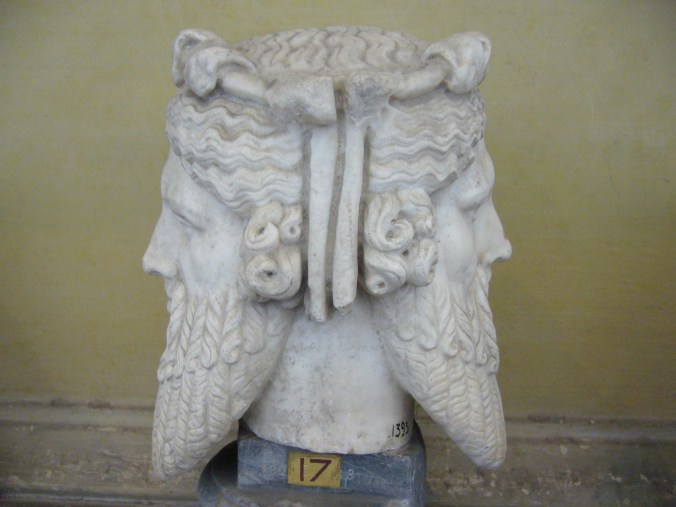
Persephone makes a brief reference to Janus, the Roman God of Doorways. Like the God of Mist and the God of Fog, she’s wrong to write Janus off as a minor deity. Janus/Jana was actually two gods, hence the two heads, and was worshiped as everything from the sun, the moon, to the space between passages, i.e. doorways, beginnings, endings, transitions, war, peace, birth, death, traveling, the list goes on and on because if something has a distinct beginning, end, and transition between the two, Janus presides over it. Thematically, Janus is important in Persephone as a coming of age novel.

For a long, long time they were regarded as the highest of gods and got dibs on all the sacrifices, like Hestia. Janus has two faces, one to look in the future, one the past. In this regard, they are similar to the Greek Fates, but there was no Greek equivalent to Janus in its entirety, though Greek mythologists played around with the idea of Janus in their own stories later.

Janus may have fathered some children, but a lot of those stories are Greek additions to his mythology. He’s an interesting conundrum in Roman mythology as his role touches on/overlaps the roles of so many gods in the Pantheon. Popular theory is that Janus either predates the Roman Pantheon all together or was developed in an isolated bit of the culture and later worked into the mythology.

I’m not even going to try to get into the myths regarding Janus, because there’s a lot of discussion/argument about whether the god playing the role of Janus in any given myth was him, or if his name was stuck in as a replacement or a straight up mistake in translation/assumption. (Janus for instance has nothing to do with the month of January, though for a long time scholars thought that was the case).

In mythology, Janus is complex and fascinating, and I encourage you to read more about him. 
Is Persephone brave?

board-939244_1920

Persephone is called brave twice in the entirety of the Persephone trilogy, and only once by Hades. But it made quite an impression on the goddess (as I’m sure being called brave by the Lord of the Underworld would.) She immediately denies it, thinks about it for two books, and denies it again.

“You’re strong and brave. More than you know. You stood and fought in Tartarus.”

I shook my head. “I’m not brave. I’m just stupid. When something scary or bad happens, my mind shuts off and I act. Believe me, later, when it has time to process, I’m terrified.”

Their difference of opinion here has to do with the definition of brave. To her, it means not being afraid, which some of my readers agree with. Since Persephone quakes in fear and cries after the fact, to them she’s not brave. That’s a matter of opinion, and is open to reader interpretation. Those readers are not why this is a frequently asked question.

To Hades, being brave means moving forward despite your fear. Which means you can’t possibly be brave in the absence of fear.Persephone  was scared of Pirithous and stabbed him with a pencil, when she stood up against Hades in the clearing, when she stood up to Hades in the Underworld, when she learned self-defense, when she opened her mind on purpose to Boreas’s dreamwalking after Melissa was taken. When she faced Pirithous in the Underworld, and finally when she faced Pirithous in the end. She was scared, and while internally she may have quaked, and while she cried, and shivered, and sometimes whined after the fact, she took her fear and pushed it aside moment by moment, often at the risk of her own life. These aren’t always reactive situations either. She makes plans to do something scary from a place of relative safety and implements them in moments of danger throughout the trilogy.

Many readers agree with Hades’s definition. That’s a matter of opinion and is open to reader interpretation. Those readers are not why this is a frequently asked question.

This is a frequently asked question because Persephone can’t lie, so when she says “I’m not brave,” it’s not false modesty, she absolutely does not believe bravery is one of her traits.

The whole not being able to lie thing gets complicated when the gods start talking in absolutes. She doesn’t say “I don’t think I’m brave.” She says she’s not. Period. And to her, that is true, but her truths don’t dictate other people’s opinions. So reader’s (and Hades’) opinions are still valid here, because she’s not talking about something steeped in fact. It’s not “Does 2 +2 = 4?” It’s “Does that equation look pretty?” A god can answer in an absolute to that question, because to them it either does or doesn’t. That is their truth.


Pitching in Brief

writing-2bexcuses-2b-2bcover

My favorite episode in season seven of writing excuses was an episode on YA Contemporary Fiction. The information on YA was nice,but what I really got out of that episode was the way she pitches. It’s awesome. I’d describe it, but it’s better just to listen.

Another cool thing that I was exposed to this season were The Pixar Rules of Storytelling. Check them out. There was also a fantastic episode on figuring out what comes next in the story. The best thing I got out of it was to ask does what your character need to happen next to accomplish their goal happen, and then put it in this format.

Yes, but….

No, and…

I was trying to come up with examples for this, but I found a better one on this post.

Inigo Montoya wants to kill the six-fingered man.

Through many trials, he enters the castle.

Does he find the six-fingered man?

Yes, but four guards get in the way.

Does he defeat the guards?

Yes, but the six-fingered man runs away.

Inigo gives chase! Does he catch up?

No, and the six-fingered man has barred the door.

Fezzik busts the door and Inigio runs through. Does he catch up?

Yes, but he gets a throwing knife in the gut.

Can he regain his feet and continue?

Yes, but the six-fingered man has a sword at the ready.

Can Inigo defend himself?

Yes, but he gets stabbed in each shoulder.

The six-fingered man bargains for his life. Does Inigo overcome the temptation?

Yes, and he achieves his goal.

What ever the goal is, “yes, but / no, and” is a reminder to you to not allow it to be easy. Make things worse, and the journey will be more exciting, and the payoff sweeter in the end.

Mythology Monday: Flora and Chloe

f37-1khlorisI frowned when I found a scribbled notation on the back of the ticket: narcissus. I glanced at the customer’s name and saw it was one of our regular customers, Flora. I could imagine the conversation that had taken place during that order. Flora’s shrill voice demanding those small white daffodils she’d seen in one of the other arrangements. Mom gently asking if she meant narcissus, a smaller flower frequently confused with daffodils, then the old woman insisting she knew what she was talking about until my mother wrote down the order and penciled in the correction later. For the record, the customer is never right.


~@~

“Where’s Chloe?” I asked, dreading the prospect of a customer demanding my attention. The shop was empty now, but I knew the minute Mom left my sight someone would walk in.

The phone beeped in my mom’s hand, reminding her of the caller on hold. She gave it a harried look. “Making deliveries. I don’t expect her back this afternoon.” She tucked my hair behind my ear when I frowned. “The customers won’t bite, I promise.” The phone beeped again and my mother sighed.

~@~

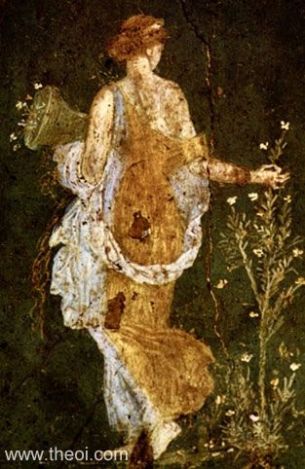
In Roman mythology, Flora was an Elysian Nymph and the goddess of flowers. It makes sense in my story that her powers would be derivative from Demeter, so I made her one of Demeter’s priestesses. She’s referenced, but never seen. Chloris, changed to Chloe in my story, is her Greek counterpart. She is the wife of Zephyrus (God of the West Wind), and an exceptionally minor deity.  Zephyrus courted her Boreas style, which is to say he swept down, raped her, and “made good” on the rape by making her his wife. In her own words she “has no complaints about my marriage” (Ovid, Fasti 5. 193 ff (trans.Boyle)).

Prior to her abduction, she did not have powers over nature or flowers. Her first flowers were made from the blood of sad people in unhappy tales (Hyacinth, Narcissus), so she’s obviously not depressed with her lot in life at all.

She was instrumental in the conception of Mars by lending Hera a particular flower to help her conceive (without Jupiter, by the way).

She was also super strategic about how she obtained worship. Flower crowns, gifts of flowers, splashes of colors in the field, all her doing. Seriously, look up the cult of Flora sometime. She was a very self-assured and interesting character, despite being an incredibly minor goddess.

Both versions of Flora’s persona are referenced in Persephone, because I felt bad about giving Persephone absolute domain over their powers.


Why can’t the people sent to Tartarus drink from the Lethe to give them a blank slate?

stairs-735995_1280

I get some variation of this question a lot, and understandably. The idea of Tartarus, of people suffering for all eternity, is very disturbing. It should bug people. But this was addressed in the book here:

“We also use it (The Lethe) on people who’ve done bad things in life,” Cassandra continued. “We take away all their memories, and they serve in the palace or around the Underworld until their sentence is up.”

That didn’t seem like much of a punishment. “Why?”

“For most people, their circumstances contributed to whatever crime they committed. This gives them a blank slate. When they finish their sentence they can live the rest of their afterlife in peace. Of course it doesn’t work like that for everyone, but between me and Moirae we can usually tell who should go straight to Tartarus.”

Anyone can choose to drink from the Lethe, but some people are sentenced to it. Some people are just evil. Not because of something that happened to them or was done to them, but because they just are. Those people still get the option of the Lethe, but because they’d be a danger to the other souls and they need a more severe punishment, are still sent to Tartarus.

I completely get why this is bothersome to a lot of people. But I did base this world off Greek mythology and Tartarus was absolutely a factor that can’t be ignored.


Writing on Vacation

luggage-1482697_1920

November is the worst possible month for Nanowrimo. Sorry, it’s the truth. Thanksgiving chaos, vacations, kids out of school. Plus for kids in school the semester is wrapping up so there’s that to deal with.

But as a professional writer, every month is Nanowrimo, so I had to learn to write on vacation without actually missing out on the vacation or my family.

For me that means squeezing writing in during down time. Between all the hustle and bustle and busy places. Morning is great too. People are tired, shuffling around, drinking coffee. It’s a socially acceptable time to be anti-social. I can squeeze at least an hour in. Which isn’t much in terms of writing time, but that’s the other thing about vacations. Daily expectations must shift to something realistic. If I get anything done, that’s a win. I’ve found I actually get more done when I take the laid back approach of not caring about word count goals during vacation than if I plug away until I reach a certain number. During the rest of the year, it’s the opposite, but if I do that on vacation, then it’s almost a guarantee that I won’t be able to use a word of what I wrote past what should have been my stopping point.

When do you get your writing in during vacation?

Mythology Monday: The God of Mist

mountains-889131_1280

“Life isn’t fair! Why should death be any different?”

“Did you ever stop and wonder if maybe that attitude is why the gods are dead?” I asked. “People don’t believe in gods because they can’t wrap their minds around the idea of someone allowing all the terrible things in the world to happen.”

“Reality has teeth and claws. It’s rarely pretty and never fair. Haven’t you figured that out yet?”

I clenched my fists. “Why? I get that no one has the power to interfere now, but when the gods were in power, how could they let things get this bad? You’re here every day! You hear the stories of murder, thievery, and worse. You see the children who starved to death. This isn’t a recent development. Why didn’t you stop it?”

“We gave humans free will—”

“That’s bull!” I exploded. “If you have the power to stop someone from getting killed and don’t, you’re just as guilty as whoever pulled the trigger.”

“Where do you draw that line, Persephone? There are billions of humans, and a handful of us—”

“Who allowed humans to get to the billions? That was greed, plain and simple. More humans equaled more worship. And really, between the God of Mist, and the God of Doorways, and the god of every other useless thing, you couldn’t at least try?”

“You’re angry. I understand. You didn’t see this side of the world back in your flower shop. Your mother kept you sheltered. It’s a bit of a shock at first, but—”

“But what? Over time I’ll get used to it? Used to seeing children in the court of the dead? Used to watching husbands cry over lost wives? Why should I get used to it when I can do something about it?”

“You can’t save everyone. You just don’t have that power.”

“But you did! You each had the power to grant immortality!” I threw my hands in the air. “Why were only some people given the gift? My mother has the power to make things grow anywhere. How come people are still starving? Are you all so full of yourselves that you think you’re any more deserving of these gifts than any one of those humans?”

~@~

Persephone’s remark about the God of Mist and the God of Doorways was a bit unfair. Achlys was the God of Mist, and in some versions she existed before Chaos (in others she was one of Nyx’s daughters, the Keres). Her other titles were The God of Eternal Night or the God of the Mist of Death. She was the personification of misery and sadness. Hercules carried her likeness on his shield. She looked pale, emaciated, and weeping, with chattering teeth, swollen knees, long nails on her fingers, bloody cheeks, and her shoulders thickly covered with dust.

So hardly a minor, inconsequential god, all things considered.

UGA Alumni Day AND Buford Barnes and Noble Signing

I have a busy weekend! Tonight, from 5:00-7:00 PM, I will be signing autographs and selling books at UGA’s campus bookstore Tomorrow, from 2:00-4:00, I will be signing books at the Mall of Georgia Barnes and Noble. Details for both below. I hope to see some of you there!

event-bookstore

The UGA Bookstore will host Alumni Day at the Bookstore on the Friday before the Georgia vs. UL Lafayette football game, and will offer UGA’s more than 300,00 alumni an additional 10 percent discount for a total of 20 percent off on merchandise. The discount also applies to items in the Clinique Closeout Sales Event. Be sure to stock up on holiday gifts or snag a diploma frame during this special gathering!

Uga X and Hairy Dawg will make appearances and free refreshments will be provided. The following authors will be in attendance from 5:00 to 7:00 p.m. to take photos and sign their books:

  • Rennie Curran (M ’15) – Free Agent: The Perspectives of a Young African American Athlete
  • L. D. “Neicy” Wells (AB ’96) and Dr. Francene Breakfield (BS ’95) – An Anthology of Sisterhood: 22 Shades of Red
  • Loran Smith (ABJ ’62) – Letters from Larry
  • Sonny Seiler (BBA ’56, JD ’57) – Damn Good Dogs
  • Charlene Thomas – The Munson Series
  • Lakeisha Poole (AB ’05, ABJ ’05) – Don’t Let Me Fall
  • Kaitlin Bevis (MAT ’13, EDS ’15) – Persephone
  • Celeste Marshall (AB ’95) – Memoirs of a Barren Woman
  • Tracy Adkins (AB ’98) – History and Haunting of Athens Georgia
  • Lynyetta Willis (MED ’03) – My Forgotten Self
  • Bridgette Burton (AB ’11, ABJ ’11) – The 365 Project: The Year of Getting Back to Me
  • Tara Hays (BBA ’88) – Friends and Rivals: Cheer for the Bulldogs
  • Emily Gaddy (BBA ’00) – Go Bulldogs
  • Mandi Mathis (ABJ ’01) and Danielle Ragogna (M ’15) – The Littlest Inventor
  • Suzanne Adams – Musings of an Earth Angel
  • Ina Hopkins (ABJ ’77) – Rock Eagle Centerpiece of Georgia 4-H
  • Patrick Garbin (BBA ’98) – About Them Dawgs

For directions and more information, click here:

2972

Saturday November 19, 2016 2:00 PM We are pleased to welcome author Kaitlin Bevis to sign her latest book in the Daughters of Zeus series, Aphrodite. It’s not easy being perfect. But Aphrodite is determined to prove that she’s more than a pretty face. When she’s asked to investigate strange events occurring on cruise ships, she’s all over it. Little does she guess how much this mission is going to cost her.

For directions and more information, click here.

The M.I.C.E Quotient

mastomys-443291_1920

My second favorite episode of Writing Excuses for all time was season six, episode ten, when they talked about the M.I.C.E Quotient.

The M.I.C.E Quotient was created by Orson Scott Card. M.I.C.E stands for Milieu, Idea, Character, and Event. Millieu is setting, so basically if your story revolves around a fantastic, neat, or meaningful setting, it may be a Millieu story. Stories like The Hobbit, or Chronicles of Narnia fit into that category. An Idea story revolves around a unique idea, something like Animal Farm or Brave New World would be an idea story in my opinion. The unique *thing* happening in the book outweighs everything else. Character is obvious. Event stories are stories where the thing that’s happening outweighs all. Like a volcano erupting.

While all stories have setting, character, ideas, and events, there’s a difference between having those elements and those elements being the defining trait of the story. A short story may focus on just one of the aspects, possibly two. A novel will have three or four, but in determining the focus, Mary suggested looking at it like nesting code or an equation. If your setting is ( the equation needs to end with ) and everything else needs to nest and resolve in-between. So if your story begins with your character stepping through  magical portal to a new world, it needs to end with them stepping back into the ordinary world. Everything else needs to be introduced and resolved inside those brackets in the order they were introduced.

It’s a really interesting way of looking at story building! Have a listen here or read the transcript here.


Mythology Monday: Calliope

calliope

“What can we do for you?” Hades repeated impatiently.

“Well, you see,” Orpheus said,  “I haven’t died yet.”

That news caused stirring amongst the judges. They muttered, glancing at each other. Hades shot a look at Cassandra.

“Then how did you come to be here?” she asked.

“My mother is the muse Calliope—”

“I should have known you were a demigod!” I interrupted. “I didn’t know about the eyes thing when I met you, but it was so obvious. I mean, well, if anyone was a demigod it would be you.”

“Well—” Orpheus shifted uncomfortably “—I’m human for all practical purposes. I’m just gifted with music.”

I sighed. “You sure are.” Oh my God! Did I just say that out loud? How humiliating.

“Calliope herself is a fairly minor deity,” Hades explained, ignoring my faux pas. “Well, sub-deity. She’s a singer of some renown herself. You may know her as . . . ” He paused. “What does she go by now, Cassandra?”

Cassandra supplied the name, and my jaw dropped. “She’s your mother?”

Orpheus shrugged. “Yes, but we don’t advertise that fact. The lack of age difference would be difficult to explain.”

~@~

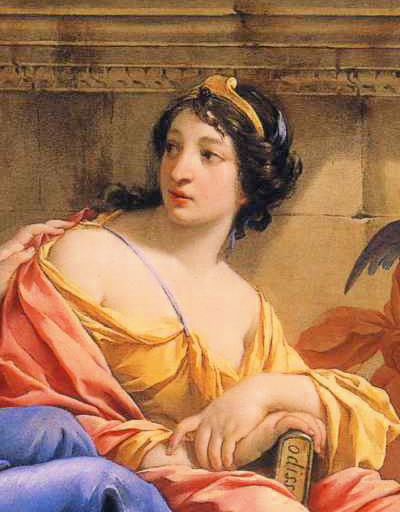
Orpheus’s mother, Calliope is the oldest of the nine muses (well, there’s some debate about that, but in most myths), and the goddess of music, song, dance, eloquence, and epic poetry. She was considered to be the wisest of all the muses and the most assertive. Depending on the myths, Orpheus’s father was either Apollo or a Thracian King named Oeagrus (that she was married to). Orpheus may have had a brother named Linus (or he could have been the child of another muse depending on the myth) who taught him music. She may have also had several children by Ares.

Once, she had a singing duel with several daughters of the King of Thessaly (Pierus), and upon soundly defeating the princesses, turned them into magpies.