Movie Monday: Return of Jafar

Until I can safely venture back into the realm of Mythology Monday’s (I’m out of myths that don’t pertain to the book AFTER my next book is released), I’m changing up my blog a little bit. Wednesdays I’ll be writing about writing, Fridays will still be about real world issues, they just won’t be linked to myths, and Mondays…I’m still playing around with. But for right now, how about Movie Mondays, where I overanalyze one of my daughter’s movies.

See here’s the thing. As a parent, I find myself watching the same movies over and over and over again. And as a writer, that gives me a lot of time to stare into the gaping plot holes and grumble. Since these grumblings amuse me, I figured why not use it for a blog post in case it amuses you too? So as I watch a movie for the umpteenth time, I’ll summarize and record my thoughts in these blog entries. Let me know what you think.

And to show you how little control I have over these movies, rather than this blog feature starting with the Little Mermaid, Tangled, or Aladdin, we’re starting with The Return of Jafar. Because THAT’S what my daughter wants to watch for some reason. *grumble grumble*
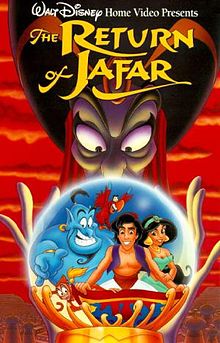
220px-returnofjafar


Return of Jafar starts exactly like Aladdin. SO much like Aladdin, I thought I was starting the wrong movie, until I noticed just how jerky the animation is. It took me a few seconds to convince Bella I hadn’t just made a mistake and restarted Aladdin, but she caught on when a group of thieves started counting their loot. A small furry hand darts in and takes a piece of treasure while Abis Mal shows off his poor leadership skills. Aladdin shows up to steal the loot and for a moment, I got really confused. Why is he stealing when he’s essentially a prince? Is this just setting up how he and Abis Mal know each other and in a few seconds we’ll flash for–nope, because there’s Carpet. What’s going on? It’s been a while since I saw this movie, but I didn’t expect to be so confused.
Meanwhile, Jafar and Iago are bickering and Iago, after singing a song that sparked a ton of random memories (seriously, I remembered every word, how weird is that), decides to go take over Agrabah by becoming friends with Aladdin.

Back to Aladdin, he’s playing Robin Hood and throwing stolen gold to starving children on the streets. Very impractical solution that’s no doubt wreaking havoc with Agrahbah’s economy, putting those street children in danger by giving them something bigger, stronger, meaner people can take, and/or getting them in trouble with the over zealous guards. Kind of surprised that there hasn’t been a lot of reform since Jafar was deposed. Jasmine clearly didn’t know how bad things were on the streets in the first movie, and how much the Sultan was told was questionable given his advisor, but what’s the excuse for the rampant starvation and homelessness now? And why is Aladdin the only one doing anything about it?

tumblr_mdjxgyyhgz1qd20ie

This will totally last us until the next time Aladdin decides to go on an adventure.

Aladdin and Iago meet up just as Aladdin bumps into the group of thieves. They bicker but eventually Aladdin and Iago team up after Iago convinces Aladdin Jafar hypnotized him into being bad and saved Aladdin from the thieves. Aladdin realizes he owes Iago his life, but says he still has to turn him over to the Sultan. First he’ll soften the royals up though so they won’t kill Iago on site.

aladdin-how-dare-you1
Jasmine pops up, and my god, her voice is so…I don’t know why it annoys me so much, but I really don’t like it. Also, her character has done a total 180. She used to be such a spitfire and now she’s all “Oh darling, you rescued a princess.” I guess love “softened” her, but she didn’t need to be softened. Also, she had a pretty big hand in saving the day in the first movie and that’s swept totally under the rug here.

return-jafar-6

“I’m even more useless now!”

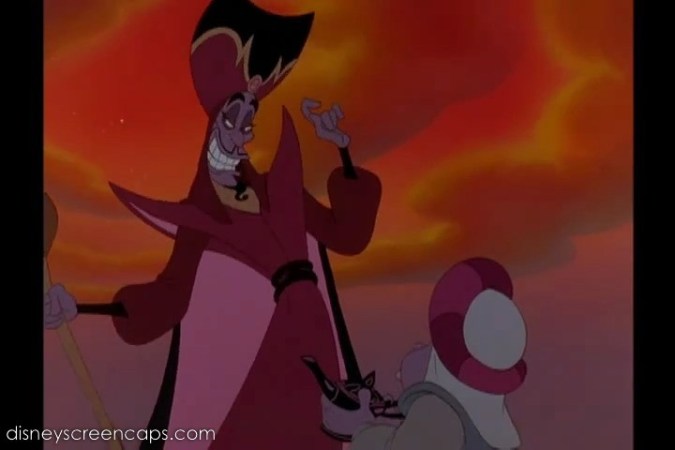
Genie comes back for a visit because he missed his friends and sings a song I had literally no memory of. He also manages to establish that as a free genie he’s not as strong as he used to be. Nicely done on avoiding the God Complex, Disney. Though honestly, Genie never seemed to be truly powerful. After all, he technically never granted Aladdin his original wish, to BE a prince. Not to pretend to be a prince, not to impersonate a prince, but to be one. Genie’s always been real good with illusion, not so much in actual delivery. The main characters depart for dinner and the scene switches to Abis Mal discovering Jafar’s lamp.
1024932_1336665819717_full

You aint never had a friend like me!

The sequence where Jafar takes Mal through his wishes is the reason I spent more hours than I can count as a child perfecting the phrasing of my three wishes should I ever find a genie. Honestly, that scene had a much more profound impact on my life than it should have. It’s probably influenced why my characters can’t lie and all my practice getting them to say things so specifically. Language games are fun 🙂

The Sultan makes Aladdin his royal advisor but then all hell breaks loose when the royals discover that Aladdin was harboring Iago. Jasmine and Aladdin argue about Aladdin hiding things from her again, and then Iago helps them patch things up with the “Forget about Romance” song. Another song I knew every word of. I loved this song. I honestly think they wrote this movie because they didn’t include Iago in enough songs in the first movie.
Speaking of Iago, it’s really amazing how much more  common sense he has than genie. He gets hints that Al and Jas want to be alone. He picks up on nuances. It’s really refreshing having a side kick that isn’t clueless so the protagonist can look good and he really rounds out the team for the TV series. This movie did a really good job setting the tone for the TV series over all.

7702265e133ac777071d838983f250a6

Anyway, Jasmine is appeased, but her father’s still pissed, so the group decides that Aladdin just needs to spend more time with him to win him over. Aladdin, Iago, Carpet, and Sultan fly off for a picnic the next day, which is of course a trap. Jafar and Abis Mal attack. For some reason the carpet doesn’t just sweep up the Sultan and fly away with him, and instead tries to defend the Sultan by tripping the bad guys. Can I just say how much better Jafar is as a genie than Genie. I mean, he’s obviously evil, but in terms of using powers he puts Genie to shame. Anyway, Aladdin is tossed into a raging river and the Sultan is carried away and Jafar congratulates Iago on his betrayal.
Aladdin wakes up, yells at Iago and returns to Agrabah only to realize he’s been framed for killing the Sultan (apparently torn hats = bodies? I don’t know, I feel like a more ambitious palace guard would…like…search for their missing ruler.) Jasmine comes in, acting all not Jasmine like at all, and yells at Aladdin for killing her father, sentences him to death, and runs off in tears before morphing into Jafar and revealing dun-dun-dun! The real Jasmine and Sultan chained up in another part of the castle (great job searching, guards) and Genie trapped in a magical bubble.

tumblr_lybovg2whz1r9mp5uo1_500

Disturbing on so many levels

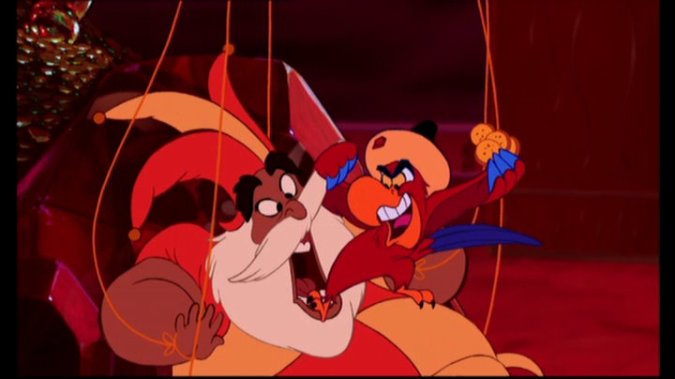
Meanwhile, my daughter is experiencing major sympathy pains for Iago. “He didn’t have a choice, Mommy. Why are they so mad?” I’m struggling for the words to explain how people often blame the victims in emotionally abusive relationships and how she’s right, it’s not fair. Iago is a tiny, helpless bird. All he has is his attitude and what’s that against an evil wizard, much less an all powerful genie. Jafar, as a human, put a full grown man-child of a king under his thumb. What exactly could a bird have done differently? Maybe the characters are so angry at Iago because he represents their helplessness?

Although, to be fair, first movie Iago had no nuance. He delighted in Jafar’s evil plans.And he started this movie out to take over Agrabah…so…. Some pre-planning would have made this whole transition a lot more believable.
iago

LOL,  JK!

Anyway, Iago flies to the dungeon and while ignoring all Jasmine and the Sultan’s bashing, frees the genie first, because he’s the most intelligent member of team Aladdin. The others realize what he’s doing and have a change of heart regarding their alliance with Iago just in time for them to be freed as well. Genie announces that if they destroy Jafar’s lamp, they destroy Jafar. And here I pause the movie and stare dumbly for a second because…what?
What?!


I’m sorry….destroying the lamp was an option? WHY DIDN’T THEY DESTROY IT AT THE END OF THE FIRST MOVIE? Why would they rely on the cave of Wonders? By the way, how did Jafar escape from the Cave of Wonders? That was kind of unclear. I mean, the start of the movie shows Iago digging the lamp out of the sand, but um…was it really that easy? Why couldn’t Jafar have dug INTO the cave of wonders to get the lamp in the first movie then? And why would Jafar sitting in a lamp for 10,000 years before being released into the world with major powers be a good thing? This completely undid the cleverness of the end of the first movie.

4815e8d8547cbdf07a5d65b348e8ef79

Itty Bitty Brain

Anyway, they release Aladdin, and team Aladdin go on a mission to destroy the lamp. Mal is supposed to use his third wish to release Jafar, but he hesitates because what if all of his wishes go away without the genie there (nice call back to Aladdin’s hesitation in movie one, although, again I maintain that if the genies actually granted the wishes, not the illusion of them,this wouldn’t be an issue). During their argument, team Aladdin makes a play for the lamp,but failed to reach it. Iago swoops in to save the day and flys off with the lamp (instead of just dropping it in the lava, but okay, and gets critically hit by Jafar. The lamp and Iago land on a rock. Aladdin tries to knock it off the rock, but can’t reach, and Iago summons just enough strength to kick the lamp into the lava. The ground starts to shake, Aladdin is somehow magically able to reach Iago on the same rock he couldn’t reach the lamp on, and takes him to safety. Iago looks dead,but this is Disney, so they manage to work in the phrase “you’d be surprised what you can live through” into the movie 10001 times, Aladdin turns down the position of royal advisor and goes off to see the world with Jasmine.

aladdin-disneyscreencaps-com-6964

We don’t give a flying f*ck about out people!

Um…okay, selfish much? First of all, royal advisor was part of the Sultan’s slow plan to legitimize Aladdin in the eyes of his subjects so he could marry his daughter. Secondly, as a former street rat who better than anyone in the palace know how the subjects feel about their king and what they need, he could do a lot of good? Maybe instead of stealing treasure, he could point out that…I don’t know, the sultan’s people are STARVING.

Eh, at least I know why I only watched this movie once as a kid. And it entertained Bella for a while. 3 Stars.


For Real Friday: Mourning

People died. It happened. And more often than not, death wasn’t right or fair. I wasn’t going to twist myself into knots about it. But if I told Persephone how I felt, she’d attribute my lack of grief as divine callousness.

But here’s the thing. Humans were modeled after us. How else could they watch the news—a montage of war, death, and human suffering—over coffee then go about their day like nothing was wrong? People needed a certain level of callousness to get by without drowning in the horror story of life.

~Aphrodite

I’ve been pretty quiet on the Paris front. At first it was ignorance. I was at YALLFEST when the attacks occurred and in an effort to be more present in the moment, I wasn’t checking my phone or logging into social media much over the weekend.

But then I checked back into the real world and felt horrified at the violence I found there, but almost before I had a chance to process that, came the guilt. Social Justice Warriors united as one to condemn the mainstream media for their grief over Paris when so many OTHER places had suffered without an ounce of media coverage.

I wanted to react right away. I wanted to sit and write this blog and comment on every post I saw. But I stopped myself because engaging would only detract from the real issue at hand and that’s not respectful to all the Parisians who lost their lives. I also stopped to evaluate my feelings and make sure my knee jerk reaction wasn’t just me being defensive.

And mostly, it was. Because yeah, I feel guilty. There is a massive double standard when it comes to news from Western Countries as opposed to the rest of the world. Yes, it is problematic that trivial stories about celebrity gossip made the front page on days hundreds died in countries most westerners aren’t sure how to pronounce. But telling people when and who they should mourn is not the way to get that message across. Hijacking a tragedy to prove a point is never going to be respectful and it’s not going to change anyone’s minds. Worse, guilt tripping other people is slacktavism at its finest. Instead, DO something. Next time you want to share a Facebook post shaming people for not caring enough about a thing, anything, stop and make a donation to support that cause. I promise there’s a button to share the donation you made with a link to information about the issue you support and a way to take action.

As for the sins of the mainstream media, we live in the information era. Why limit yourself to mainstream media? Seek out news from a variety of sources. The mainstream media reports what they think people want to read. If you want to change that, be the person that doesn’t fit their algorithm and share the stories that you think people need to read. But do it in a way that doesn’t condemn people for what they do and don’t know or how much they do or don’t care. Because as messed up as it is, to some degree we have to cherry pick what we do and don’t care about because if we stopped to acknowledge every tragedy, even on identical scales, we’d never stop. And even for the tragedies we do stop to acknowledge, we’re never going to mourn enough. I had school on September 12th, 2001. I’m willing to bet that 90% of the people here in the states saw the news about Paris, read the story, forwarded the status and then went right back to work, saddened, but not on the level that death demands.

Unless we are personally affected by a tragedy, we cannot care enough. It’s not possible. And while that sounds like a horrible thing, it’s a survival mechanism we have to have in order to keep going. But making people feel guilty for the moment they did (and sorry, no matter how many caveats there were in all those statuses and articles about how we should still mourn Paris but we should mourn equally, doesn’t change the fact that at the core, people were being guilt tripped for caring), that’s not going to make them care more. It’s only going to make them more callous the next time around and the world we live in is callous enough.

My thoughts are with Paris. My thoughts are with the world. Want to make a difference instead of just talking about it? Click here to make a donation to Doctors Without Borders or The Red Cross or any organization you feel is making a positive difference in a place you feel needs it. A dollar goes a lot further than a like.

YA Lit Fest Day 1

yall-fest-2014-charleston-author-lineup

On Friday,  I went to the YALLFEST. There were no workshops or anything on Friday, just signings, but because I only read eBooks, I had a problem. I’m a fan of 90% of the authors who attended YALLFEST. Not a small fan, like I’ve read everything they’ve ever penned, but I didn’t have copies of their books and their books are nearly $20 a piece. You see my dilemma? So I bought four books and a notebook for the other authors to sign with writerly advice.

A bit on the authors I got autographs from on Friday. Brandon Sanderson is 99% why I was there. I’ve said it more than once, and I’m not embarrassed to say it again. He’s a writing god. I love him, in a totally platonic way, I mean. So…less like love, more like I think I may worship him? 

 He wrote the Mistborn series, Elantris, and he finished the Wheel of Time series because he’s that amazing. He does a podcast called Writing Excuses where he talks a lot about his process, and as a human being he’s just pretty amazing. Example: Anytime he has a spare minute in an airport he goes to the bookstore nearest him and signs every copy of his books in stock so that the next person who buys his books gets an amazing surprise. He’s also pretty awesome to follow on twitter.

In person, he’s just as amazing. He signed my Mistborn book, my notebook of writing advice, and cards for members of my writer’s group when I mentioned how much they loved him as well and how we’re essentially his cult.

Here’s what he wrote in my notebook: Write what you love, finish what you write. You’re out of excuses.

Rae Carson was my next signature in the notebook. She wrote the Fire and Thorns trilogy, which I haven’t read, but I’ve been eyeing them on kindle for weeks now. I’m going to kick myself if I read them and they end up being my favorite books. But what can you do?

Her advice: Don’t waste time on projects you don’t love. Pursue passion.  

Melissa De La Cruz is most famous for writing Disney’s Descendents, but she also wrote the Blue Bloods series among many other books. I think she’s also the mind behind Witches of East End? She was on every panel I attended and she was pretty awesome in each of them.

Her advice: Never Give Up!

Margaret Stohl is famous for her Beautiful Creatures series. I was not the biggest fan of that book, because while I felt it had a great message for young women, (Claim Yourself), it fell short when the dark/evil girl’s only defining “evil” feature was that she was promiscuous. Like prior to being evil she wasn’t? I don’t like the message that sends, that everything that matters about young girls is wrapped up in their sexuality one way or another. So I was fully prepared to dislike this author, but after listening to her talk at a few panels (more on those later) I really like her. I’m really interested in where she goes from Beautiful Creatures. 

Her advice: Put your butt in the chair and do it.

It was an awesome beginning to a great conference. Just wait till you hear about the panels.

Some (Temporary) Changes

Photo on 11-16-15 at 4.59 PM

So I’ve run into a problem with my blog format.

I’m out of myths.

I don’t mean I’ve retold every myth that’s ever been, but I have caught up to the myths I’ve used in the Persephone trilogy and the first Aphrodite book (twice). Going further into the myths behind the next two books opens up a world of spoilers, but not even in a fun way since you’ll be missing the context for the spoilers in the next book.

So Mythology Monday is going on hiatus for a while, at least until Aphrodite is released (I should have a date soon. I’m actually waiting on a phone call from my editor to clarify a few details in about thirty minutes.)

But for the meantime, I can’t just not blog. That’s no fun.  I was thinking maybe set up a temporary schedule of Writing Wednesdays, where I talk about what I learned at YA Lit Fest (YALLFEST) and writer’s group and occasionally throw in some of my WIP drafts. I haven’t decided how to approach Monday and Friday yet, but I’m brainstorming some ideas. Maybe mythology Monday could continue with guest blogs? I’d love to hear some of your favorite myths. I’ve been toying with the idea of fairy tale Friday, where  I overanalyze my daughter’s recent disney obsession. I don’t know. But I’m open to suggestions 🙂 What would you like to read about?

On My Way to YALLFEST!

I’m not going in any official capacity. Mostly I’ll be there to completely fan girl over Brandon Sanderson and Scott Westerfeld and Gail Carriger, and Veronica Roth and, and, and….OMG!!! I’m so excited by the list of authors I might actually get to meet. But I’d be happy to meet readers too! Send me a message if you’re there. Maybe we can meet up.

For Real Friday: Grief, by Raye Wagner

*Quick Note* Persephone is on sale for 1.99 at all retailers for Columbus Day Weekend. Share the good news and buy it here! 

I just want to thank Raye Wagner again for taking over my blog this week while I get some much needed editing done. Raye is the author of The Origin of the Sphinx and The Curse of the Sphinx, two very entertaining books about an ancient mystery that doesn’t get nearly enough attention. Today she’s here to talk to us about a very real issue her fictional character deals with in her novel. Grief.

sad-505857_1280

I’m not a psychologist, but I work in healthcare, and I frequently deal with individuals who’ve gone through a major life event. While death of a loved one brings understandable sorrow, other major life changes will bring similar stages of grief and/or adaptation. The top 5 major life changes are death of a loved one, marriage, divorce, job change, and moving.

I’m always surprised when I ask about stress and a patient denies anything significant, only to disclose that they’ve moved, had a job change, and oh, yeah, just broke up with their boyfriend. (Statistically, more women than men go to healthcare providers, so I use ‘boyfriend’ solely because I see more heterosexual women than men, or gay, lesbian, bisexual, or transgender individuals).

Individuals suffering with intense emotional distress frequently experience physical symptoms, which is why 60-70% of patients seen in a specialty practices have what would be classified as “functional disorders” (no organic pathology). Receptors for neurotransmitters are not limited to the brain. In fact, serotonin, the “happy hormone” has a significant percentage of receptor sites on the GI tract. Interestingly enough, serotonin and cortisol (stress hormone) have an inverse relationship so if one is up the other is physiologically depressed. I tell patients that if they are stressed out enough, it can physiologically induce a chemical depression, and quite often make them physically ill.

Grief associated with significant loss, be it job change, or the mourning of a loved one that is deceased, has several stages (5 or 7 depending on which model you look at) and an individual’s journey through those stages is highly variable. Some people move quickly through them, and other’s get stuck, either lacking the tools, skills, or support system to adjust to their loss in a healthy way. The stages include: Denial and Isolation, Anger, Bargaining, Depression, and Acceptance.

In Curse of the Sphinx, Hope carries a curse from Apollo that forces her to move over and over, developing no lasting relationships. Her isolated life pretty much sucks, and she knows it. She has her mom, who is also cursed, and a family friend who visits semi-regularly, and that’s it. Then she loses her mother. No more spoilers, but things go from bad to worse.

Hope has several challenges, not the least of which is her grief, and she goes through each of the stages throughout the first novel, and even into the second (not yet released). Because of her immortal state, she can’t get physically ill, but we see (and hopefully feel) the emotional strain, and the effects it has on her life.

But isn’t that what we want? We want to read about protagonists who triumph over weaknesses, insecurities, or trials. We want to feel their pain, knowing it isn’t our own, and yet in some small part reflective of something in us. And when a character we identify with takes a risk, or makes a sacrifice, we collectively hold our breath, and hope for the best. We feel their sorrow, pain and loss, just like we feel their victories and achievements. It is part of the human condition, this empathy for one another.

If at the end of a book, we feel a little braver, a little stronger, a little more courageous, a little more hopeful, grateful, or empowered. . . Isn’t that what leaves the sweetness of the story imprinted on our soul?

And did you know reading a well-written novel releases neurotransmitters in our brain (and the rest of the body, too)? It’s these chemicals that lend to the emotions we feel towards the characters who, when the author does a really good job, are just as human as the guy you sit next to on the subway, or the barista at the coffee shop, or even a loved one.

Happy Reading!

Review: The Curse of the Sphinx

On Monday, I had Raye Wagner on my blog, telling her version of the Origin of the Sphinx. Today, I’ll be posting my review on the first novel of the series, the Curse of the Sphinx.

As an author who focuses on modern day retellings, I’m always interested in how other authors approach the bringing the ancient into modern day aspect of the world building. Raye Wagner took a unique approach by making the Greek myths not just well known, but real to all the citizens in her society. Modern teens worship the Greek gods. Demigods are a known phenomenon walking among them. Monsters and curses are an every day part of life. The book maintains this fantastical sense of a magical AU without ever losing focus of the truly modern day. The high school is a normal high school, the students in it, just as much. This book *feels* like a really good representation of what the world would actually be like if all the magic of mythology was real. Everyone wouldn’t be a demigod, humans wouldn’t dare hunt/experiment/or otherwise go after demigods and monsters because friendly reminder, the greek gods do not take mortals trifling in their business lightly. Wagner pulled off a very believable society.

The actual protagonist is a victim of one of those generational curses so common in Greek mythology. Readers hoping for more background should definitely check out the prequel. I’ve read it, so I can’t say whether or not readers would be lost without it. The romance was as anti-instalove as you could get. And the pace had a slow, gradual build up that kept me reading well into the night. I will say the story felt a little fragmented at first, but once the character arrives in Goldendale, the plot smooths out and takes off.

All in all a very unique and interesting take on Greek mythology.

Mythology Monday: The Origin of the Sphinx Guest post by Raye Wagner

20130815-113433.jpg

I wanted to thank Raye Wagner, and her version of Artemis for hosting today’s Mythology Monday. Raye is the author of a novel called Curse of the Sphinx and it’s prequel novella, The Sphinx. To see my review of the novella, click here.

~@~

The Origin of the Sphinx is a tale that haunts like a somber lullaby; the ache lingering even after the melody has faded.

I’ve tried to be understanding, sympathetic even; after all Apollo is my brother. He’s always been a bit rash, impulsive… impetuous. And there can be good in that at times. But not in this story.
It was said by some that Hera created the beast. That she was responsible for setting the Sphinx at Thebes to cause horror and loss to the city and its populace. Hera’s infidelity was nothing if not retaliation, and giving birth to your daughter is hardly the creation of a monster.
Phoibe, born of Hera, was the result of a dalliance with a Greek shepherd. She was raised by her father and his wife for only a few years before being entrusted to a humble weaver-woman. The woman loved the young demigod, and watched over her carefully…tenderly.
Are you familiar with the tale of the Judgment of Paris? It illustrates both Hera’s beauty, and her power. She is like a bright rose nestled amongst sharp thorns. Or lightening that strikes a blackened sky; Hera is a dazzling presence that commands attention. The mortal tongue lacks words to describe her exquisiteness, and her daughter was similarly blessed. Or cursed? She was every bit as magnificent as her mother in appearance, but Phoibe’s sweet vulnerability set her apart.
Of course, she would attract attention of the gods.
Apollo saw her first and made his claim. He swore he would destroy anyone or anything that harmed her. I have never seen him so enamored. His eyes lit up when he spoke of her, and his happiness radiated until it was nearly palpable. The sun shone brightly that year; the summer was much longer than it should have been. He would leave Olympus in the middle of counsel meetings, sneak out from his temple – even when worshipers were present – just to be with her. He laughingly told me of a time that a petitioner was making a sacrifice to him and he just disappeared: Phoibe had called his name.
Apollo was reckless in his love. Phoibe was his air, his song, his sunshine.
She refused him. She had never been in love with him, or if she had, it was not of the lasting persuasion. Mad with grief, Apollo fled, and buried himself in… only the gods know what. But immortality kept him from utter destruction.
His love turned sour, and Apollo festered in his agony. Drunk with bitter jealousy, he appeared the night Phoibe gave birth to her first child. He killed his rival and again begged Phoibe to be with him. When she refused, he lashed out. His pain was a weapon and he cursed the young daughter that should have been his. That should have loved him. That should have called him father.
Apollo’s curse transformed the cherubic baby into an immortal monster. Part human, part eagle, part lion. Still breathtaking. The Sphinx.
The weaver-woman raised the creature. She gave her the love of a mother, but this love could not erase the bitterness of Apollo’s curse. She has travelled much, this cursed one. Egypt, the Far East, Thebes…
It was in Thebes that she found happiness; a sense of belonging. It was in Thebes that the Sphinx fell in love.
Love. It is gentle and warm as soft candle glow. Yet the flame has power to become an inferno, capable of consuming even the gods.
The dawn of the Sphinx? It is a tale filled with love.

Rachel's head shot 2013, II

Author Bio:
Raye has spent half her life immersed in books (reading not swimming), but stopped believing she could write fiction after the sixth grade. Her teacher thought her writing was “disturbed”, and, at a parent-teacher conference, asked her mother to seek counseling for her.
Years later, with both Bachelors and Masters degrees in nursing, Raye reduced her practice to be at home with her family. Her children would say she read more, which is probably be true. One afternoon, as she sat out on the patio watching her boys play in the kiddie pool, inspiration struck, and she began recording the legend behind the Greek myth of the Sphinx.
Raye lives in Middle Tennessee with her husband, a pair of kids she claims as her own, and a dog named George.
Origin of the Sphinx is her first publication, and the beginning of the Sphinx series.
Incidentally, she didn’t get counseling all those years ago.
She might still need it.

Happy Halloween!

halloween-151362_1280

Halloween may not officially happen until tomorrow, but I know a lot of the fun begins tonight, so I’m off to prepare for my favorite holiday.  Be safe and have a great weekend!

Halloween Mythology Part 2: Hecate

the-witch-525958_1280

Hecate got really popular in (comparably) recent history. She started as a chthonic deity a generation above the Olympians. She was an only child, which was rare in Greek mythology, and her parents were Perses and Asteria, relatively minor deities in mythology. She was mostly a household goddess of good fortune who for no apparent reason, Zeus was really really in awe of. She was sort of replaced by Artemis, and I say sort of, because Hecate was worshiped in a very small region, and Artemis grew in popularity throughout most of the country. Hecate may predate Artemis, but very few people were aware of her during height of that myth.

Now Artemis and Selene both had dominion over the moon like Hecate, but Hecate had a lot more power. Artemis was sort of a moon goddess, Selene more so, and Hecate had the power OF the moon over the earth, sea, and skies. She influenced the tides, earthquakes, wind storms, you name it.

In the Persephone myth, Hecate helped Demeter find her daughter, and accompanied her to the Underworld every six months as a figure of comfort. She was either a virgin goddess, or the mother to Scylla depending on the myth. She seems fond of dogs (There’s almost always one depicted with her), garlic, and cypress trees.

Hecate was skilled with herb lore, both the healing and the poisoning variety. She taught this lore to Medea, and we all know how that went. At some point Hecate got very popular with pagan cults and her whole persona changed, but that’s going way off the beaten path of Greek mythology. I think it’s fascinating how her role evolved, but there are still people who actively worship this goddess, so I will do them the courtesy of not discussing their goddess beyond the basics.