For Real Friday: Super Special People

No, I could think of some who had it worse. Normal humans who knew about the gods. How many books had I read, or movies had I watched, where some normal teenager discovered they were special or had some ability that set them apart? Mortals craved that distinction, that power. They dreamed and wished and wondered. How much would it suck to realize all those things you’d dreamed of and hoped for were real, just not for you?

~@~

Growing up in the nineties, I was bombarded with super special people. Mutants, superheroes, vampires, and pretty much any other unique species. Most of the time the agent into the story was someone who thought they were normal, right up until they figured out that they were secretly a super special person.

There’s nothing wrong with that plot line. The idea that somewhere within you lies this untapped potential to be something better, something more, it’s not a bad thing. Personally, I can remember the day when I realized I was a lot happier with my life as it was then I would be if I found out I was really a super hero, or a lost princess, or some random alien species. But I never stopped wanting something that each and every one of those characters had.

The super special coloring or marking they had.

There’s always something. An unusual (yet conventionally attractive) birthmark. Unusual (and once again conventionally attractive) hair or eye colors. Glowing symbols that appear on your forehead when you shout out magic words. YA protagonists could never just be average looking. OR worse, when they were “average looking” they were always described as too thin and had three or more guys chasing after them at any given time (I’m looking at you Vicky Austin). And I kept the trope going. My gods and demigods are very attractive people. They’re gods. Unrealistic, unobtainable beauty just kind of made sense. But it’s not something I plan to keep up with outside of this series because I remember hating the way I looked because I had nothing that set me a part, nothing special. It wasn’t until I had a kid and actually got upset when her eyes changed from blue to brown (at 18 months, that six month thing is a lie) that I realized how deep my bias against the way I looked went.

The thing with super special markings or coloring is, as cool as it was, in a way it was just as damaging to me as the unobtainable models and movie stars I’m surrounded by every day. It made being normal, not having some super special (but don’t forget conventionally attractive) thing that set me apart seem like it wasn’t normal. I couldn’t see myself in the books I was reading or the shows I watched, but I wanted to. Books like Twilight and the Hunger Games would have meant a lot to me as a kid. And I’m still luckier than most. Ever notice how often the super special hair color/eye color/symbol code the character as white? Even when they don’t. I got an email complaining that I’d white washed the demigods by turning them gold. And despite the fact that gold skin/hair/eye tones can exist across every ethnicity, I completely understand how the reader got that impression. We’re so used to it that we don’t see anything else.

It’s entirely possible I was just over sensitive as a kid reading those books. I didn’t beg my mom for plastic surgery so I could look like a super model, I begged for purple contacts so I could look magic. It is entirely possible I’m just weird. But on the off chance that it’s not just me, I’m going to try harder not to fall into that trope in books I write outside of the Daughters of Zeus series.

Way Back Wednesday: Special Markings

I grew up on L. J Smith and Sailor Moon. Every single show I watched or book I read marked their supernatural beings with some super special physical marker. Be it unnatural beauty, purple eyes, or crescent moons on their foreheads. So naturally when I wrote my gods, I had to follow suite. So my gods are ridiculously attractive ala L. J Smith and my demigods have a very distinct look determined by the ichor in their blood.

There are more examples of this than I can detail (though do chime in with your favorite ones!) but I thought I’d share this extremely funny comic that toys with that trope.

Mythology Monday: Ichor

olive-oil-601487_1280

“How will I know who’s a demigod?”

“By sight. Halflings have ichor running through their veins.” When I looked at him blankly, he sighed. “The golden blood of the gods?”

“I have gold blood?” I asked incredulously. At this point, why not, I thought ruefully. Hell, I can probably fly.

“Not in color,” Hades clarified. “In essence. Though it does affect their appearance.”

“How?”

“They look gold.” At my disbelieving look he sighed again. I thought about offering him an inhaler, but he continued. “Gold hair, skin, eyes—they practically glow. Surely you’ve met a demigod, either here or on the surface. It’s a useful marker we decided on long ago. Accidentally killing or cursing another god’s child is rife with political complications.”

~@~

Ichor is the golden blood of the gods and is deadly to humans. The blood is enhanced by the divine diet of nectar and ambrosia. Actually, it’s been hinted at that the gods are immortal because they only eat and drink nectar and ambrosia. As in if they would become mortal if they ate human food. Food is often binding in mythology. Mortal food makes souls mortal. Food from the Underworld makes souls, living or dead, bound to that realm. I didn’t stick to that line of logic in my story. Persephone eats both the food of mortals and the food of the Underworld with no ill effects.

There’s an interesting myth about a man named Talos who was created either Daedalus or Hephaestus with single vein of ichor nailed to his spine in such a way that it was stopped up from entering the rest of his body. Oh, and his body was made of bronze and had wings. The ichor made him super strong so he could protect Europa and her island.

When the Argonauts sailed past Talus threw rocks at them to protect his island. Medea either convinced him to remove the nail holding the ichor contained within his body, or removed it herself, releasing the ichor and killing Talus.

In my books, Ichor is responsible for giving demigods their golden coloring. It’s also the source of the gods divinity and power. Ichor is going to have a pretty important role in the next trilogy, I’d tell you more, but you know… spoilers.

For Real Friday: Unrealistic Relationships

l-116503

I remember the day when I figured out that I would hate every single character I was in love with if I met them in real life. The soulmate trope is often accompanied by love/hate the love/hate relationship trope until the two characters mutually agree they’re in love, at which point they become sappy, uninteresting, and obsessed with one another. I knew I didn’t have the patience or the inclination to get involved with a love/hate relationship. If I hate someone, I hate them. There’s no romantic tension, no hidden attraction. They have done something that makes them unattractive to me on that level until they either drastically change or enough time passes by without them around that I forget why I hate them. That may just be me though. I don’t know.

The love/hate thing is actually kind of dangerous, because it often plays into the aggression is sexy myth and it teaches women to ignore their instincts. Even if a guy isn’t actually dangerous, if you don’t like him, can’t stand to be around him, and do nothing but argue if you’re near each other, chances are your relationship won’t be a happy one. I was very careful with this in my books. Persephone and Hades snark at each other a good bit when they meet, but I was very, very, very careful to keep it about circumstance. Once she got to know Hades, she liked him. The circumstances under which they met sucked. But personality wise they were never incompatible.

I was a lot older when I figured out that the other side of the coin was equally unrealistic. All the romances I’d read or watched featured this unbelievably romantic guy who would go to the ends of the earth for his significant other. He’d be obsessed and didn’t actually appear to have a life outside of who they’re interested in beyond the basic trappings that were used to show what an amazing guy he was for that particular girl  (his job showed he was stable/creative/whatever, his family showed he cared about people, and sometimes he’d have a pet). Whatever personality he had when the love/hate trope was going on vanished into the relationship once he got the girl. It wasn’t until I started dating that I realized that, while romantic, this trope is every bit as damaging as the love/hate trope.

When you are in a relationship with another person, you are in a relationship with another entire person. Even if they’re your soulmate. Trust me, I married my high school sweetheart. I met him, we clicked, and lived happily ever after. If soulmates are a thing, I found mine and we knew it instantly. But he’s a complete person with or without me. He has a life and if I wasn’t in it, maybe it wouldn’t be as awesome, but he wouldn’t wither away to nothingness because he’s a healthy human. You want your significant other to have a life outside of you.

There have been a few points since I met my husband where for some reason or another we were all we had. We’d just moved to a new place where we knew no one, a job change took one of us away from everyone in our social circle, random emotional stuff like say, giving birth and all the chemicals that come with that that make you feel like nothing outside of your little family matters. We celebrated when those moments ended because while we love each other lots and lots it gets super super frustrating to be the only person in a relationship with a life outside of it if you ever say, want to hang out with your friends, enjoy your hobby, or just be away from that other person for a minute. We’re always there to lean on, but your significant other shouldn’t be all you have. That’s not healthy. Which is another thing I was careful to convey in Persephone. She and Hades have full lives outside of one another. They have friends and family and hobbies and purposes that don’t revolve around their relationship.

As for the last part of the trope. It’s cool to be with someone who wants to move the moon and stars for you, but they should never have to. Gender reverse that particular expectation and consider how uncomfortable it makes you. There’s a reason for that. If someone loves you, they shouldn’t expect you to give up some major thing that makes you you for the sake of your relationship. If someone loves you, they shouldn’t want you to sacrifice something that makes you happy so you can prove how much you love them. If someone loves you, they shouldn’t want you to do something impossible, frustrating, or difficult just to make them happy. It means a lot when they do, but it shouldn’t be an expectation. That is why I didn’t set up my series as Persephone having to choose between the living realm and Hades. She at a certain point had to choose between having a normal life and being a goddess, but it wasn’t actually a choice and Hades was never part of that equation. He was a given no matter which life she stuck with. I also never had them make massive, life changing decisions because of each other. They influenced each other’s choices, sure. That’s pretty typical of all relationships, but if you look closely, there were never choices they made because it was the only way they would work. Every character in the third book made the assumption that Hades was willing to destroy everything to save Persephone but he outright explained that wasn’t the case. He wanted to save her, and acknowledged she was worth paying that price but he also explained the lengths he was willing to go to had more to do with saving the living realm and the Underworld from Zeus. Remember, he can’t lie.

I love reading romances. I like watching romances. I love the love/hate dynamic and the extreme love dynamic. Just know it’s not a realistic expectation to bring to your own relationships. If you did find that exact relationship you read about, you’d hate it because those models work in fiction but in real life they aren’t healthy. So read, enjoy, but know you deserve a relationship that’s better than fiction.

Way Back Wednesday: Soulmates

Orpheus and Eurydice’s souls poured into my hands. They felt the way candlelight looked. Tenuous and flickering, but aglow with energy that, left uncontrolled, could destroy everything in its path. They resonated with one another. Two parts of a whole, reunited as one.

Joel had been right, or rather, it seemed his long lost myth had been accurate. My mother hadn’t been sure of the origins of that myth. She had little to do with the creation of humans. Her energy had been focused on sustaining them. The souls had been Zeus’ department.

I used Orpheus’ soul as a guide to mold Eurydice’s renewed soul back into her body. His soul flowed effortlessly into her to fill in the missing connections. The souls merged easily, the trouble was getting them to split apart. I pulled more power from the Reapers, shoving each soul back to its rightful place.

~@~

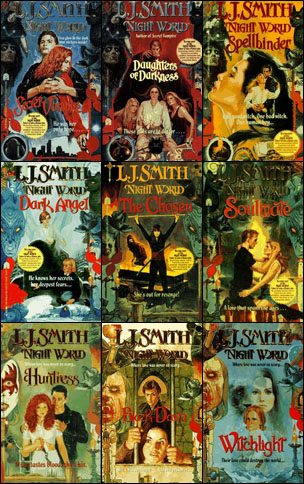
nightworldold

Without a doubt L.J Smith influenced my view on soulmates more than any other writer or bit of media. The silver thread she described at some point in every series she wrote, but particularly in Nightworld is the thing that pops into my head if you say soul mate. I honestly can’t even quantify how much her work influenced mine. I read her books over and over and over again when I was younger. Her words have been hardwired into my DNA.

There’s no reason to include any other sources in this list. If you haven’t read everything there is to read by L.J Smith, do so. Her books don’t stand up to the test of time that well if you read them through a modern sense, but here’s the thing. Young Adult literature has changed. We have Harry Potter to thank for that, but before the Harry Potter series got long and complex, you couldn’t get something of that quality published for children. YA was barely a recognized genre and formula was king. When I (and most other young adult writers of today) was younger, we had a tiny section of the bookstore devoted to YA books. That section held over a hundred babysitter club and sweet valley books, some stuff by Judy Bloom, Deane Coontz, and Caroline B Cooney (but most book stores actually put those with the grown up books, at least here in the south) and then there was a tiny, tiny, tiny bit of shelf space dedicated to the books with dark spines. R.L Stine, Christopher Pike, and L.J Smith were this section, and L. J Smith was the only woman of the big three.  Children’s fiction had a lot more variety as did adult fiction, but I promise you, every female YA author you’ve read has been influenced by L.J Smith, she’s all over Meyer’s work, and I catch references to her all the time in literally everything I read. Read it so you can catch them to. You owe her a debt if you enjoy the supernatural romance genre.

Mythology Monday: The creation of man

heart-583895_1280

“There’s a myth about broken souls,” Joel said finally. “I’m surprised Orpheus hasn’t heard it. As crazy as he is about all that stuff.”

I leaned against Joel, and he draped his arm over my shoulder. “What is it?”

“When the gods created humans, they didn’t look like us. They had four legs, four arms, two faces, and one soul. They were complete and happy. But they were too fulfilled. Too powerful.”

“They were a threat,” I murmured.

“Exactly. Zeus split them in two saying that men would never amount to anything if they spent half of their lives searching for their other half.” He gave me a significant look. “Some people get lucky and find their soul mates, but the rest will always be searching to fill that void in their lives.”

“Do you think the gods have soul mates?” I winced at the wistfulness in my voice.

“Why would they need them?”

~@~

Once the titans were defeated, Zeus and his siblings divided their roles. Zeus took the domain of the skies and of Olympus, the palace/mountain of the gods, Hades took the Underworld, Poseidon too the ocean, Demeter became goddess of the harvest, Hestia became goddess of the hearth and home, and Hera became queen of the gods.

Zeus was terrified of having children. He’d seen the pattern of divine children killing their parents and decided it wasn’t for him, so when his first child, Athena, was born, he ate her. That lasted for all of a day before she popped out if his head fully grown, wearing full armor, in the world’s worst migraine. After that he gave up and had a ton of kids. Then the gods created humans. Prometheus and two other Titans who did not take sides during the Titan war helped to fashion humans out of clay and Athena breathed life into them.

Humans didn’t used to look like we do now. They had four arms, legs, and two faces and one soul. But they were too happy and too fulfilled and didn’t fear or worship the gods enough to be useful. So Zeus cut them in half, into us. So long as humans spent their lives searching for their missing halves they could never amount to anything.

Zeus also tormented man by giving some men more intelligence, strength, and power than others, and by creating a perfect woman. Pandora. He sent her to Prometheus’s brother, Epimethius. Prometheus had warned him to never accept a gift from Zeus, but at the sight of her beauty he couldn’t resist. He gave her a box and told her she must never open it.

Naturally she did and in it all the horrors of the world flew out. Evil, mistrust, sickness, worry, the only good thing in the box was at the very bottom, hope.

The humans fell into a half-existence. The world was harsh and unforgiving and the humans were hungry and cold. Prometheus saw their suffering and brought them the gift of fire. Zeus saw this betrayal and punished him by staking him to a boulder. Every day he is picked apart and rated by an eagle only to heal overnight and begin the torture anew the next day.

I’ve made lists!

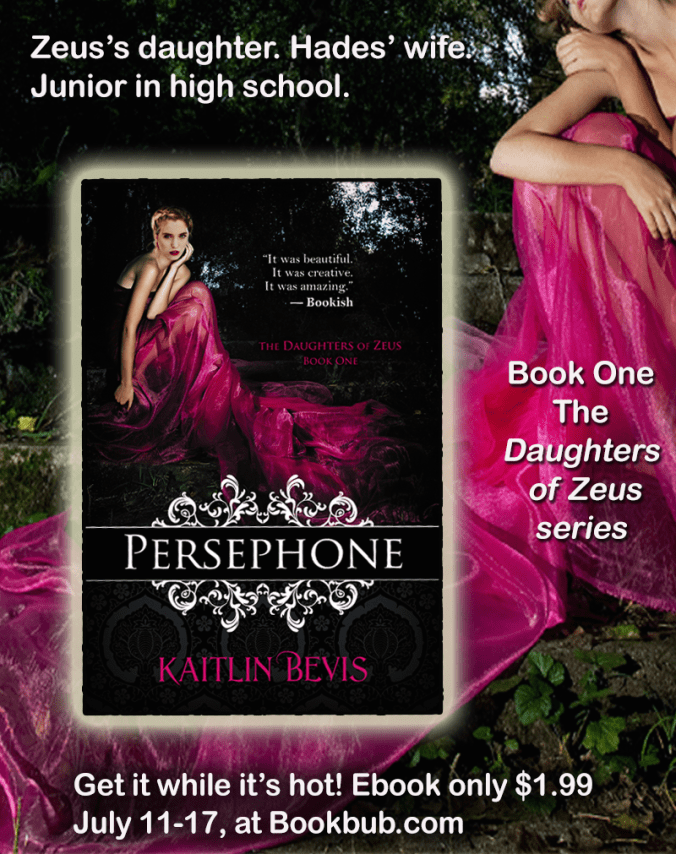
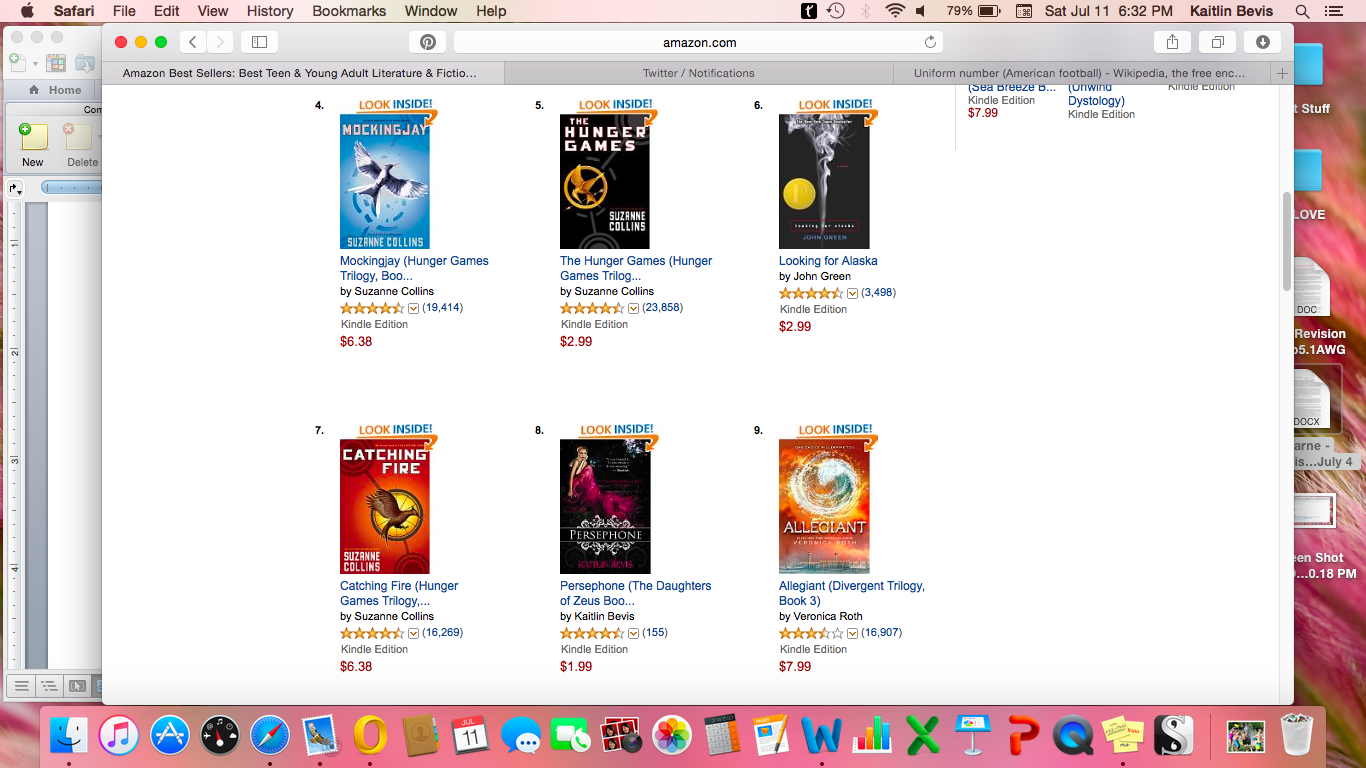
persephone promo graphicSo in case you didn’t know, Persephone is on sale for 1.99 right now. And it’s doing really well! I’m number My sales rank at the moment is 402 so I’m just here with my writer’s group jumping up and down. #1 in Greek mythology books and kindle books and 8 in YA fiction and literature with ALL these writers!So forgive me in advance for the 8 million tweets, fb updates, and whatnot that are coming, because oh my gosh!

Screen Shot 2015-07-11 at 6.32.20 PM

For Real Friday: Identity and Perfection

lipstick-791761_1280

Scott Westerfeld linked the Pygmalion myth with plastic surgery and brain damage in Uglies, and it was beautifully done because in one fell swoop he nailed the two reasons why the Pygmalion myth is so pervasive in our culture. We’re terrified of being forced to become something we’re not or being replaced by something or someone that can fill our role better that we can. The fear behind this myth is why it keeps popping up as a cautionary tale in AI stories or Frankenstine stories or Pinocchio stories or any other inanimate object turned to life story. If you want to know a cultures fear, study its stories.

But there’s something else that makes it into the cultures stories. Longing. And that is where the second variation of this myth comes along. It is just as popular, just as pervasive, and the beauty industry absolutely thrives on it. We want to be remade. Reshaped. Plucked from our ordinary lives by a rich stranger and remade into a better version of ourselves. We want the make up, the surgery, the weight loss miracle. We want more.

And that’s fine, when the wanting is healthy. It’s okay to want to get into great shape and look wonderful. It’s when we cross the line from healthy wanting and unhealthy obsessing that it becomes a problem. Its when girls look at models who’ve been given the pygmalion treatment, reshaped, retouched, recreated so much that the models don’t even recognize themselves, and starve or despair because they can’t become that, that it becomes a problem.

It’s a problem when a person looks at their significant other and tries to reshape them to meet unrealistic expectations.

It’s a problem when parents put so much pressure on their kids to make them better, smarter, prettier, more perfect, that the children snap.

It’s a problem when schools are so focused on the perfect score they forget about the people the numbers represent.

Pygmalion is alive and well in our culture and that is why I hate that myth. Because it’s not a myth. It’s our reality. And rather than see it for what it is, we romanticize it. Reshape it. Remold it until it tells the story we want to hear.

And that’s a problem.

Way Back Wednesday: Pygmalion

I could never name all the Pygmalion references and tropes that popped up when I was growing up. It’s a myth our culture is obsessed with. But I’ll try to hit the highlights.

My Fair Lady/Pygmalion

Both versions of this play, the original and the now famous production pictured above influenced my perception of this myth. Eliza was no man’s statue and she resented being remade as much as she didn’t. She’s a pretty complex character. The original ending leaves her stranded between two world’s, something only hinted at as a potential outcome in the movie. That always resonated with me for some reason, and it works as a theme in a trilogy that’s going to focus so much on demigods.

The reshaping an already living person to fit an idealized version of them was revisited in a lot of other media before and after My Fair Lady. Namely

— The Taming of the Shrew

— She’s All That

— The Princess Diaries

— Anastasia

— Vertigo

— Greece

— Josie and the Pussycats the movie

— Jem and the Holograms

— Aladin

— Pretty Woman

— Literally every other movie or book that features a character needing a makeover and etiquette lessons to pass themselves off as something they’re not. Usually at some point in the story the disturbing/sexist/classist implications of this are explored and the person doing the shaping either figures out the person is perfect as is or the person figures out how to use both who they ARE and the skills the learned to be someone else to be a better version of someone true to themselves.

This variation of the trope was beautifully subverted in Scott Westerfeld’s Uglies series.

Frankenstein

Obviously subverted but echoes of the myth are there loud and clear.

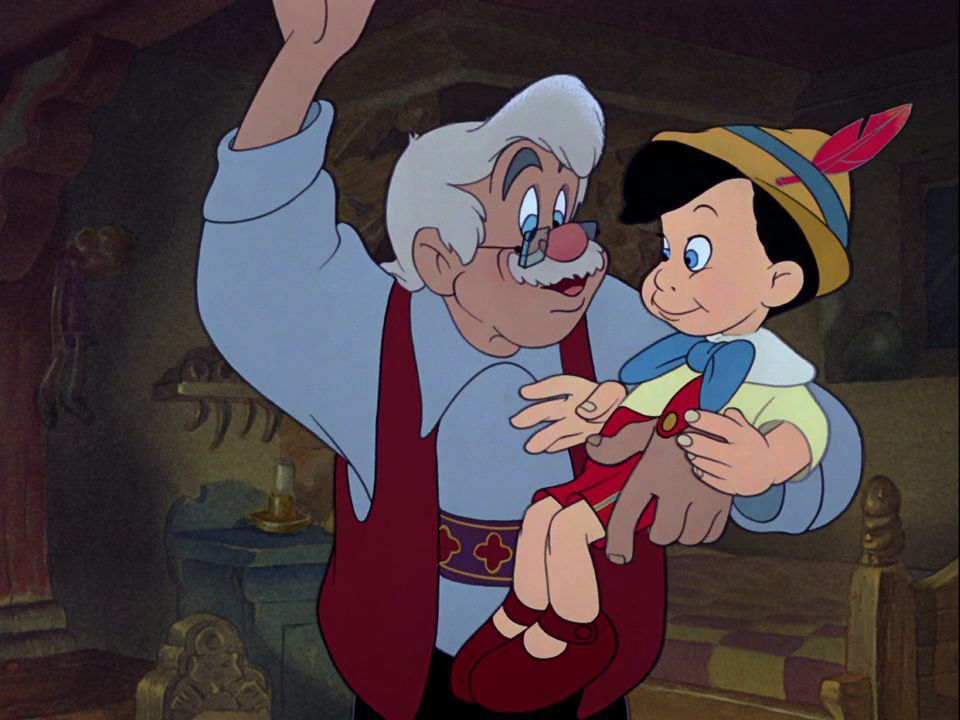
Pinocchio

Possibly the only version of this myth that isn’t disturbing, inherently sexist, classist, or fetishy. Yet I still hate it. Seriously, the move scared me when I was little so much that I only remember fragments of it.

Pixel Perfect

Disney’s answer to the Pygmalion myth. I don’t remember much of this other than the girl who liked the guy the entire time was super upset to find the hologram he’d made had her ears. I actually thought that was an interesting touch though. He pulled all the bits of the hologram from features of people he knew.

Also the same girl tried to be like the hologram, which really added layers upon layers to the myth.

A whole slew of anime:

Chobits, Dears, Ghost in the Shell and others followed the theme of creating perfect women or AI interfaces being made real. I watched a lot of anime in my teenage years. Some of these series handled all the implications and complications of this trope well, others were more interested in hyper sexualizing the myth.

And of course: Buffy The Vampire Slayer

Of course there’s a callback to the myth with the robot girlfriend and the Buffy Bot. But Dawn also fits the myth as do the slayers themselves. There are a lot of Galatea echoes in Buffy the Vampire Slayer

Mythology Monday: Pygmalion and Galatea

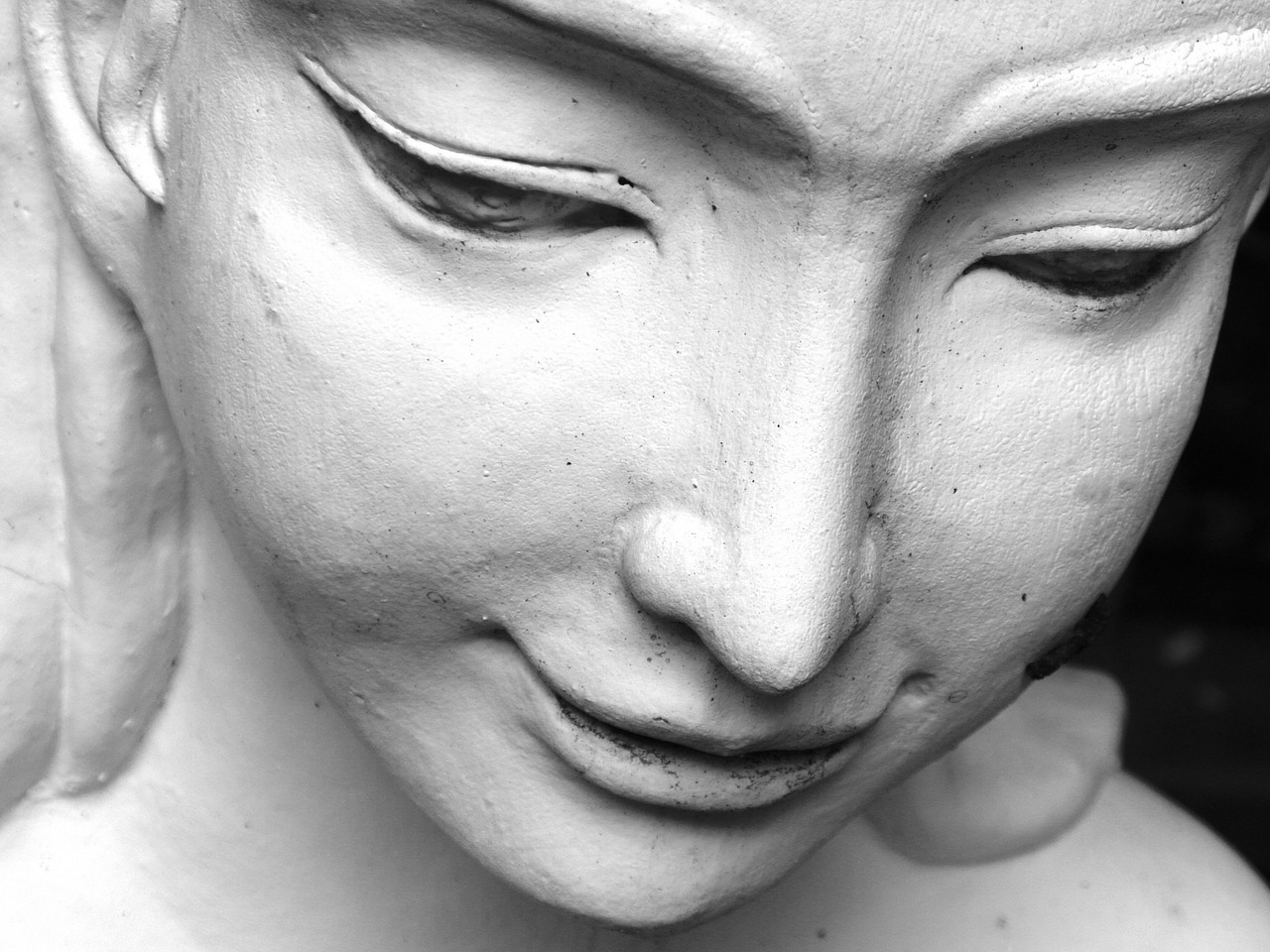
women-220103_1280

Once upon a time, there was a woman made of stone. She was beautiful and perfect and strong. Until one day, she was found by a lonely man who could not find a woman to love him.

Blind to her beauty, Pygmalion took a chisel to her and reshaped her to better fit his desires. Though her flesh softened and her shape changed, she remained strong and unchanged within.

Frustrated, the man appealed to the gods. “The women of Cyprus are all poor and whores and unsuited to a man of my station. Breathe life into this stone, and I shall build a great temple in your honor.”

“The city of Cyprus is filled with women made of flesh and bone,” The goddess of wisdom reasoned. “Perhaps the problem does not lie with them.”

“Do not blame the prey when you are not worthy of the hunt,” said Artemis.

“Never.” Ares’s eyes glittered with disdain.

“Build me a temple that touches the sky and the woman is yours,” decreed the God-King.

Pygmalion agreed and when the last stone of the temple was set into place, Zeus breathed life into the statue, hollowing out her insides, removing every trace of who she once was and replacing her very essence with what Pygmalion wished her to be.

According to the myth, she was beautiful, dedicated, and obedient to her husband’s every whim. The perfect wife.

But I know better than anyone that perfection has a price.

~@~

I’m going to be honest, I *hate* this myth. I hate the message it sends. I hate that it’s so popular. Everything about this myth makes me feel kind of sick. So be warned, my distaste WILL be reflected in my tone. But it’s important in my next book. So…mine it for spoilers.

Pygmalion was a skilled sculptor who grew tired of he local prostitutes (technically these women pissed off Aphrodite, so she cursed them into prostitution). Apparently every woman he met, ever, was unworthy of his love, so he made one of his own. He carved a beautiful, pure, clean woman, and fell in love with it.

Like, really in love with it.

At Venus’ next festival, Pygmalion made a sacrifice on the alter and prayed for a girl who was like his statue. He later returned home, began to make out with his statue, and noticed its lips were warm.

Let’s pause there for a minute. Pygmalion did not go home assuming his statue would be alive. He didn’t check it for a pulse or anything. He didn’t even ask Aphrodite to bring his statue to life. He asked for a girl *like* his statue to appear on his doorstep (where he likely would declare she was unworthy, slam the door, and start a war of epic proportions). The idea that his statue could come to life had not actually occurred to him before he started making out with it.

Take from that what you will.

Anyhow, the statue comes to life and Pygmlion names it Galatea, or Galathea, or Elise. That last name you may want to remember when you read Venus and Adonis. Just sayin.

They get married and have a daughter named Paphos, who had the Island of Paphos named for her, near the rock of Aphrodite (where Aphrodite was born). They also had another daughter named Metharme who married King Cinryas, who had a daughter named Myrrah, who slept with her father and had a child named Adonis. More on him next week.

As much as I hate this myth, it’s become a major part of Aphrodite’s trilogy.  My favorite part of studying mythology is seeing where the myths intersect. They’re all connected, which makes my job of rewriting them a lot more fun.