Mythology Monday: Cassandra

model-659534_1920

Cassandra caught my quizzical look and shrugged. “Problems adjusting. You just missed the latest of the new souls. It would seem none of us are quite as good with people as you are.”

That was an understatement. With any luck, Cassandra hadn’t caused any psychological scarring with her “Yeah, you’re dead, get over it” speech. She wasn’t a people person. Ordinarily, I greeted the new souls and took special care to deal with any “adjustment problems.” I enjoyed that part of my work. It was one of the few good deeds I could credit myself with. But as much as I’d love to tell myself otherwise, I wasn’t settling in the souls out of the goodness of my heart. Just lack of better alternatives. The other gods had difficulties relating to humans. But those difficulties were nothing compared to the problems the humans in my court had relating to each other. Souls lose something the longer they’re dead. They forget what it was like to worry, to be scared, to be human. Just yesterday, I’d caught Cassandra telling a frightened new soul I’d gone through a dark phase back when Dante passed through, but not to worry. I hadn’t gone off my meds for centuries.

~@~

Cassandra was a Trojan Princess and by all accounts a royal beauty. She definitely caught the eye of Apollo, her patron god. He granted her and in some versions of the myth, her twin brother Helenus the gift of prophecy and tried to seduce her, but when she spat in his face (literally) he twisted gift. She would see the future, but try as she might, no one would believe her visions. Her brother was still believed according to Virgil.

Can you imagine what it would be like to know something horrible was going to happen and not do anything to stop it? She saw the Trojan War, saw every one she cared about die. Saw herself raped in the temple of Apollo by Ajax and her own death at the hands of Clytemnestra (long story, we’ll get there in another Mythology Monday). And she could do nothing to stop it.

In some version of the story she had twin boys but they were killed. Had they lived the gift of prophesy and her curse would have been passed down to her descendants.

Cassandra pops up in other myths from time to time (like Hercules) each time she is portrayed as being insane and her warnings are never taken seriously. She’s also popped up in books, movies, and television shows for centuries.  But every incarnation I’ve ever seen of Cassandra focused on one thing.

Her life sucked.

But that was life. My Cassandra’s a bit different because she’s dead. And she’s having a great time. She still has the visions, but that whole bit about no one believing her so long as she lived no longer applies. She’s Hades’ most trusted advisor, and she practically runs the Underworld. She’s over the top cheerful, but she’s got a healthy sense of snark. She doesn’t put up with much drama and has a very practical way of looking at things.

Overall, she’s one of my favorite characters

Spring Has Returned

l-70649

Today is the first day of spring, and in my universe, Persephone’s birthday. In the original myth, it’s the day she returns from the depths of the Underworld to rejoin her mother in the living realm. All in all, a fitting day to share my good news.  🙂

Persephone is coming back.

The Persephone trilogy has been picked up by Belle Bridge Publishing. As always, the trilogy will be available in e-copy and audio formats, but for the first time ever, Persephone will be available in print. I don’t have a specific date yet, but I’ve been assured the publication date won’t be very far out.

I’m really excited to be a part of Belle Bridge because I’ve been a major fan of their books for a long time, especially Parker Blue’s Bite Me series and Marilee Brother’s Moonstone series.

I’ll post more news as I get it, but I’m really excited about this 🙂  Thank you guys all so much for your patience and for your advice and for all your support when Musa went under. You have no idea what your emails and tweets and comments meant to me. You guys are amazing.

Stay tuned for exact dates and all that fun stuff. You’ll all get news as I hear it

For Real Friday: Boreas

I thought long and hard about what kind of real life issue is reflected in the myth of Boreas and Oreithyia. There’s  rape culture, but I already talked about that, there’s stalking, but he didn’t really stalk Oreithyia, it was an impulse thing. There’s kidnapping, but I talked about that too, and there’s mental illness in general, but that seems like a post better reserved for Zeus. Then I lost patience, because  I have a major announcement that requires its own post. So here’s my for real Friday about winter.

in some climates, it is inadvisable to go outside in the cold without proper protection. You could freeze to death, and stuff. Take proper precautions in inclement weather.

Moving on….stay tuned to my blog for an important news.

Way Back Wednesday: Winter Personifications

l-70588

I apologize for the delay in this posting. I’m not sure why this didn’t go through Wednesday but I’ll go ahead and put this up now.
Winter as a personified concept happens a lot. It is often cold, cruel, and deadly, but rarely does it stoop to the level of deranged that the mythological Boreas did. Early inspiration in my imagination for Boreas definitely shaped his powers and appearance, not his personality.
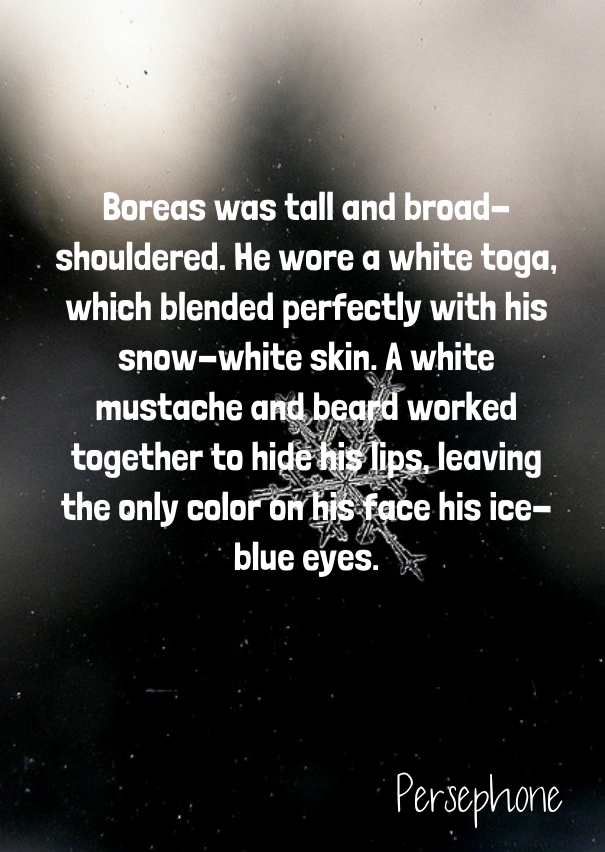
In appearance, Boreas is a cross between Old Man Winter and Jack Frost. Gods in my universe don’t age past their prime, so he’s younger than the traditional elderly yet oddly muscled old man with a long white beard. But he’s older than the youthful Jack Frost. So my character ended up with the short white hair Frost favors in most animations, the classic white beard, paper white skin, and muscles.

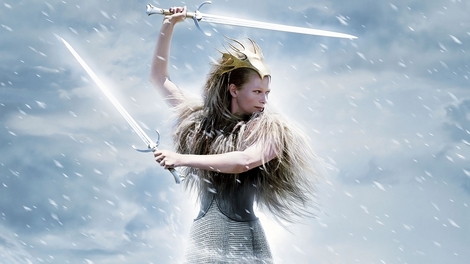
His powers of course are also a combination of the two, he brings winter, but the weaponized variety of his abilities were likely at least partially inspired from The White Witch of Narnia and Reiha of Vampire Princess Miyu.

Reiha is a pretty interesting character. I would consider her more like Khione (Boreas’s daughter and goddess of snow) than Boreas. She’s based off the Japanese myth of Yuki-Onna.

In Japanese mythology, Yuki Onna is like a Siren, only instead of popping up in the ocean and luring sailors to their death, she appears on cold, snowy mountains and either saves travelers or lures them to their death with her Elsa-like control of the weather. She’s got long black hair, snow white skin, and pale blue lips, and naturally is unbelievably beautiful. She’s sometimes a goddess like creature and others portrayed as more of a ghost story. A beautiful young woman perished in a snow storm and now her spirit haunts the mountains. Sometimes she’s like a frost vampire who after being invited into someone’s home freezes the place and all the inhabitants. There’s an interesting love story I could tell you about, but since it has nothing to do with Boreas, I may have to wait for another mythology Monday.

Mythology Monday: Boreas and Oreithyia

winter-488834_1920

A shift in my teacher’s tone caught my attention. He rolled up the sleeves of his blue dress shirt, moving his hands as he told the story. He leaned forward, voice becoming ominous.

“Oreithyia danced upon the river bank, unaware she was being watched.”

A cloud passed over the sun, bathing the class in sudden shade. Goose bumps rose on my arms as the temperature plummeted. I flinched when a gust of wind knocked over the legal pad with a thump. The yellow pages fluttered open, sending loose scraps of paper floating toward the lake.

“Suddenly, the God of Winter, Boreas, swept her away in a cloud and…” Professor Homer faltered at the sight of the escaping papers. “Married her.”

I rolled my eyes. At sixteen, it wasn’t as though Melissa and I were clueless about what happened to poor Oreithyia. Beside me, Melissa nodded as though I’d spoken aloud.

Professor Homer continued. “For nearly a century afterward, the people of Athens traced their lineage back to Oreithyia and Boreas, claiming to share the blood of the gods.

~@~

That’s pretty much the myth. So why include it, verbatim in Persephone?

The Persephone myth is one of the first myths people learn because it explains the seasons. If Persephone didn’t exist until modern day, there would need to be a myth to substitute as an explanation for winter. Using the myth as *the*explanation for winter was supposed to alert my readers we were in a world where Persephone’s myth hadn’t happened yet because she didn’t exist yet. Judging by the number of reviews wondering why Persephone doesn’t recognize her own name in mythology, I should have made that a bit clearer. I’m still trying to figure out something I can slide into the next edition of the book that indicates that in this universe, some myths (the older ones involving the big six) have happened while others are still in the process of unfolding. But it’s not like something I can have Persephone think about or casually point out in dialogue. The people of this world don’t know they’re missing myths.

This myth was similar enough to the Persephone myth to fit in nicely. Plus the god of winter makes would be a natural enemy of the goddess of spring, and Boreas is associated with the sky, which was logical given who we was working for. So luckily, it worked on a lot of levels.

For Real Friday: Scapegoating

Helen of Troy

Helen of Troy

Troy fell because of a beautiful woman. At least that’s what we’re taught. Helen was a trojan scapegoat and if you go back before her the entire thing was the “fault” of the goddess Nemesis. Rarely is Paris blamed. Even more rare are the tensions between the two factions involved in the war brought up.

Helen spent her entire mythical life reduced to an object. She was a thing that Theseus wanted, she was a prize Paris won, she was a face that launched a thousand ships, she is the thing that destroyed Troy. Rarely is she viewed as a person with thoughts and wants and agency. Rarely is the reality that she was a young woman who was abducted since childhood with an alarming frequency brought into the story. Modern day adaptions love to make Helen a lovesick girl unconcerned for the fate of her people. She’s painted as this spoiled, vain, selfish creature and everyone forgets it takes two to tango. That as prince of Troy, Paris had a greater responsible to consider the impact of his actions, and that’s assuming she was abducted with consent. I almost never see the Trojan War portrayed as a horror story where Paris abducts an unwilling woman. I wonder why that is?

Society loves to blame the victims, especially when they’re women. If a man cheats on his wife it’s his wife’s fault for not being enough and his mistresses fault for tempting him. When a man rapes a woman society bends over backward to pin the blame on her. What was she wearing? Why was she there? She shouldn’t have tempted him.

Though Helen is by no means a major character in my story, I tried to portray her as a three dimensional character and a victim. A person with limited control in a bad situation that just kept getting worse. I tried to address the guilt she would feel, rightfully or not. I don’t know if I accomplished that, but one of my goals is to eventually do a duel-POV prequel with Cassandra and Helen to cover the Trojan War my way.

Way Back Wednesday: Helen of Troy

Helen of Troy is a fascinating character in Greek mythology. Equally fascinating is they way she’s treated in rewrites. There’s rarely middle ground with her. In most depictions she’s either an evil, selfish, vindictive temptress or a pretty airhead victim. She turned up a lot in material I watched and read in my younger years. Here are a few of my favorite depictions of her that may have had an impact on how I saw her character.

Goddess of Yesterday
In this amazing Caroline B Cooney novel, Helen a side character and the Trojan War a background event to the protagonist’s, a historically un-notable young woman, coming of age story. It’s like…Johny Tremain and the civil war. I mean, when the background and the side characters of this coming of age story are this epic, you know the protagonist is something else.

The protagonist is a young girl named Annaxandra who is kidnapped and sold into slavery as a young child. She’s chosen as the playmate to the young and sickly Princess Calisto. When Callisto’s kingdom is sacked, Annaxandra assumes her identity to save her life and ends up in a sort of protective custody with Menelaus, Helen of Troy, and their two children. It’s a really interesting story with a very fresh take on the Trojan War. I love the way Cassandra was portrayed as well. In this novel, Helen was positively the evilest evil step mother type figure I’d ever read. If you ever have an opportunity, read this book. It’s amazing.

 Nobody’s Princess and Nobody’s Prize

This series follows Helen of Troy’s younger years and fleshes her out to more than just a pretty face. Completely worth the read. One of the most three dimensional takes of Helen I’ve ever seen in literature. The fact that the series doesn’t focus on the Trojan War only makes it that much of a fresher take and a better story. Helen had a really interesting life and family well before Troy.

The Trojan Women

This is a classic play but it questioned Helen’s role in the fall of Troy and deliberated on whether or not she was to blame or if she was just a scapegoat. It’s old and the language is a old and the production is old. But it’s basically a really awesome bottle episode of the Trojan War and a great read or view.

The movie is good as well and it follows the play and has some well known actresses from the 70’s. But if you have a chance to see it live instead (rare, I know) go for it. It’s a really fascinating look at the live’s impacted by the Trojan War. Not my favorite take on Cassandra but accurate in her fate according to the Orestes trilogy.

 Troy

A lot of characters were fully fleshed on in the movie Troy, unfortunately Helen was not one of them. It was still a great movie and I really enjoyed their take on Achilles and the casting for the movie was fantastic. I actually found it kind of refreshing that the movie focused on what are now some of the less notable players in the game. It’s truer to the original source material.

Mythology Monday: Helen of Troy

blonde-hair-240944_1920

“So,” I said when they fell silent for a minute, “you two knew each other when you were alive, right? In Troy? What was it like?”

The quality of the silence changed. I peeked through half open eyes to see Cassandra and Helen share a long look.

“I’m so sorry,” I stammered. I couldn’t believe I’d just asked that. “I didn’t think about… You two must want to forget all about—”

“It’s okay,” Helen assured me, collecting some pink powder onto an angled brush. “There are days I would give anything to drink from the Lethe.” She paused for a second before putting the blush on my face. I closed my eyes instinctively. “I think about it every morning when I wake up. Just forgetting all those horrible things. But all those people died for me. It wouldn’t be right to forget them.”

“It wasn’t your fault,” Cassandra said as though reciting a familiar line from a familiar argument. “Menelaus was bound to attack Troy eventually. He was greedy. You were just—”

“A convenient excuse.” Helen’s voice was bitter.

“What happened?” I asked. “If you don’t mind my asking.”

“You’ve heard the stories, I’m sure. You’re a daughter of Zeus, so you understand better than most the way people can change around us.”

“It’s not change,” Cassandra said. “You just bring out the—”

“I understand that,” Helen replied. “It’s still not something ordinary girls would have to worry about. But then we’re not ordinary, are we, Persephone? We’re lucky.”

I looked at her, and she saw that I understood.

“I was taken from my husband and daughter and given to Paris as a prize.”

“You had a daughter?” I shook off my surprise, remembering how different things were back then.

“Hermione.” Helen smiled fondly. “The last time I saw her was her ninth birthday. I imagine she’s down here somewhere, but she probably drank from the Lethe to forget me. They all hated me in the end.”

“You were just a scapegoat,” Cassandra reminded her.

“I wish they would have just listened to you,” Helen replied.

“Even without the curse, my brother was too much of a moron to listen to anyone.”

Helen of Troy had a pretty crazy life. She was conceived when Zeus raped Leda….as a swan. Her half brothers were Castor and Pollux, the gemini twins. The twins were also demigods, but the way it broke down with them is that one of them was a full god, the other was a full human. 

~@~

 As a child she was already lovely and turning heads. When Theseus and Pirithous made their pact to marry daughters of Zeus, Theseus chose the then ten year old Helen. The two kidnapped her and stashed her with Theseus’ mom for safe keeping then went down to the Underworld to try to abduct Persephone. We all know how that went.

Meanwhile,Helen was rescued by her brothers and returned home where she was later married off to Menelaus. She had a daughter named Hermione, and by some accounts an infant son when she was taken to Troy by Paris. Sources are conflicted here as to whether she went with Paris of her own volition or was abducted. Either way, her disappearance was just the excuse Menelaus needed to go to war with the very wealthy kingdom of Troy. The Trojan war was fought for ten years before Troy fell, and Helen, according to different accounts, either captured, killed, or escaped with Paris.

I always felt sorry for Helen so I tried to portray her as a sympathetic character in my story and give her a happier life in the Underworld.

For Real Friday: Kidnapping

l-63764

On Monday, I shared a scene from an early chapter in my novel, Persephone where Pirithous attempts to abduct Persephone from her mother’s flower shop. Kidnapping is one of a parent’s worst fears and missing children are one of the most sensationalized types of news stories in America. The constant media coverage and books and movies. It was also a pretty frequent plot point in children’s media for a huge chunk of my childhood. The constant coverage has likely contributed to the rise of helicopter parents and an entire generation of slightly paranoid children.

Seriously. Every friend I’ve asked about this said they had kidnapping “plan.” For me, it was small things that were mostly games. I’d see if I could untie knots or unlock doors in the event I was even kidnapped. Another friend grew up memorizing her location and major landmarks she passed in case she got a chance to use the phone to call 911. Everyone went through stranger danger planning and some extra lucky children like myself were told to avoid hallways in hotels when we were traveling because “a stranger could just pull you into a room and I’d never see you again, Katie.”  Another friend was told she could never have a convertible, not because of price mind you, but because “someone could just hop in the car and take you away.”

What’s sad is how crazy that’s not. Everyone has a story like that. The fear of kidnapping was a constant presence in my generation’s childhood and one that is no doubt being passed along to our children.

It’s also incredibly unlikely. I included the threat of abduction in my book because, hello, Persephone. Both attempts are a plot point in her myth. But I did so with mixed feelings because I didn’t want to add to the hysteria.

Most abductions are committed by acquaintances and family and are found within hours of their abduction alive. Putting this in real numbers, out of 800,000 kids reported missing during the peak of the kidnapping hysteria in 1991,  only 115 of them were kidnapped by strangers, and kidnapping stats are going down. The rest were committed by family and acquaintances and the vast majority of those children were found within hours alive.

Now those 115 kids did fall into the scary pattern of being mostly female, mostly grabbed outdoors or lured into cars and roughly twenty of those children didn’t survive the abduction, so yes, there was reason to fear and it’s not like acquaintance or family kidnapping is a good thing but the sheer amount of fear everyone had for an outcome less likely than getting struck by lightning is in itself pretty scary.

Way Back Wednesday: Be Careful What You Wish For

l-62586

In my universe, Pirithous wanted Persephone so he could have a chance at immortality. He got his wish…in a manner of speaking. Greek Mythology is full of the “be careful what you wish for” trope, in which the  characters get exactly what they wanted in a manner they wouldn’t have wished upon their worst enemies. That idea of getting the ultimate wish all wrong carried on into modern day and into my childhood in the following examples.  

Aladin

Jafar wanted unlimited wishes and became a slave to them. Return of Jafar took the trope even further. Thanks to Jafar’s trickery, I know exactly how I’d phrase my three wishes should it ever come up. King of Theives took the wish for riches to a very dark place. In the series an ancient character whose name escapes me asked for immortal life but forgot to request immortal youth.


Full Metal Alchemist

This series took be careful what you wish for to an exponentially worse level than I ever would have thought possible. I remember being sixteen and watching the Nina episode and bawling for an hour straight. And that wasn’t even the worst thing that happened in the series. This show has an amazing plot, great character development, and it’s great all round. But I can never watch it again. Ever. It scarred me for life.

Buffy the Vampire Slayer Wishes and birthdays tend to go awry in the Buffyverse. There’s an entire species devoted to subverting wishes for maximum vengeance and an episode actually called Be Careful What You Wish For. My favorite example of this is the musical episode.

Gargoyles

Gargoyles did an amazing thing anytime they put Shakespeare in the mix. The Macbeth plot line really highlighted the irony of getting what you want in an unimaginable way and the entire be careful what you wish for trope was personified in my absolutely favorite character in the series, Puck.