Starting today, you can preorder Aphrodite! Here’s the link! Stick around for some bonus content and Valentine Fun!
Daughters of Zeus
For Real Friday: #wheresrey

So my brother and I recently got into a weeks long text dispute over whether or not the Where’s Rey hash tag was something worth being offended about.
His take: No. There are tons of Rey toys, he bought my daughter one for Christmas. They aren’t hard to find, with right before Christmas being an exception because they were sold out. Not including her in the group sets creates a market scarcity, and how awesome of a money making strategy was it that Hasbro now has two sets of Star Wars monopoly? Plus they were trying to avoid spoilers. It created an air of mystery about the character. Women should be more focused on big, actual issues not whining about this unimportant stuff. Especially when the biggest movie of the year just had a super strong, capable, amazing female protagonist.

My take: What spoilers? Every toy but two shows Rey with the staff she had in the preview. There was no reason to delay launch based on what I’ve seen of these toys. The protagonist of the story should be (and in literally every other movie is) in every set with three or more characters unless said set is specifically “Droids” or “Sidekicks” or some other weird category. The protagonist has never before been an add on character you can only buy separate. Particularly when that protagonist is an underrepresented facet of society.
Look, I like princesses as much as the next person. Better, probably. But it sends a message that a girl can be an awesome pilot of a certain space ship and be left out of that set. That a girl can be a great fighter, but not show up alongside her opponent in boxed sets. That a girl can be the protagonist of the entire story and not be included in the games and major merchandise for the movie she starred in. You don’t create market scarcity with the protagonist. You do it with the adorable robot or a random sidekick. You take a not as valued character, like say Sailor Mercury or the ugly beanie babies and make that character 10,000 times more valued by making her harder to find.
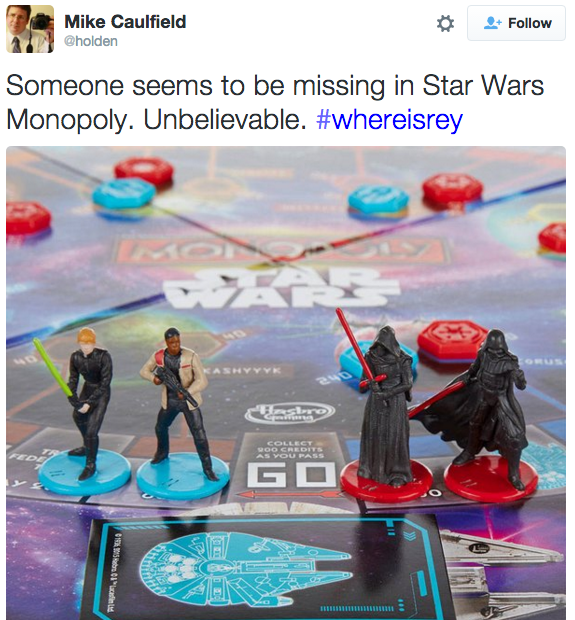
As for worrying about real issues, the toy aisle is a real issue. Representation matters. The fact that the toy aisle is moving backward matters. Maybe not as much as rape or the big issues surrounding feminism, but that argument is a slippery slope. There’s always a bigger issue more worthy of getting upset over. That doesn’t mean the small stuff doesn’t matter or doesn’t contribute to those bigger issues. Especially when you’re talking about messages being sent to small children. They internalize those messages as they grow, and they don’t stop coming.
Girls do not exist in traditional “boy toys” like star wars sets, or they are very, very rare. You can’t find Black Widow in the “complete avengers set.” In the toy aisle, boys can pretend girls don’t exist at all. Incidentally, this doesn’t happen to the same degree in the girl toy aisle. There’s a prince for every princess.
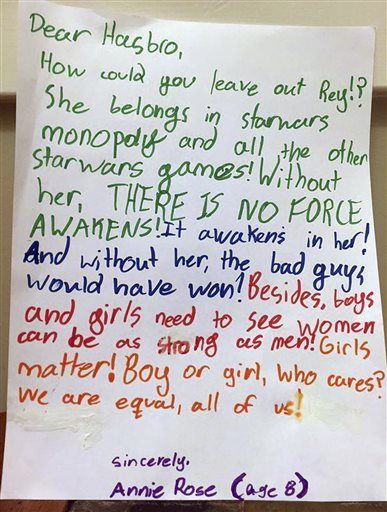
“Boy” shows that too many girls like disappear and are pulled off the air. But if boys like a girls show, its a smash hit. In fact, if you look at the marketing for the most recent princess movies, you’ll find the previews “designed to appeal to boys” did so by creating a complete absence of girls. Remember that weird Olaf/Sven commercial? That whole thing where the names of the movies are no longer the names of the protagonists? That was thought up to create a crossover audience. Movies are headed in the right direction, but marketing is moving backward.
As boys grow, this absence continues in the classroom, where boys out talk girls and girls who speak as third as often as they do are labeled as chatty and distracting and accused of talking more than anyone else in the classroom. There’s a reason girls preface questions or comments in lecture like settings with “I’m sorry.” They are taught to from a very early age. It continues movies where the absence of girls has become so commonplace that people literally interpret a crowd of 17 women, 83 men as having an equal number of men and women. At 33 women to 67 men, women are seen as outnumbering the men. There’s a reason girls try to take up as little space as possible in public settings (though I maintain it’s just good manners not to sprawl out and take up as much space as possible, there IS a reason it’s a gendered phenomenon).
And let’s not even go into the absence of female historical figures despite their actual prevalence in history. Or of female authors. Or how anything that girls like en-masse is criticized and belittled into non-existence (think of all the criticism princess movies get compared to their super hero counterparts?).

We KNOW girls are absorbing all these subconscious messages. There have been countless studies to prove just how huge of an impact that socialized silence, and manners, and mannerisms have in every aspect of our lives.
But what impact is it having on boys? What does it mean that when they hear girls talk it’s instantly interpreted as taking over the conversation? What does it mean that when they see a crowd with 30% women they see themselves as outnumbered? What does it mean that from an incredibly early age on the toy aisle, they are trained to expect girls to vanish from their own stories so they don’t have to deal with having a female action figure spoiling their set. What message does it send that when they go with their sisters down the pink aisle they see space carved out for them their but the opposite isn’t true. What message does it send that when a little girl dresses up as batman she’s praised for breaking boundaries but little boys are shamed for dressing as princesses? That all their lives they hear girls stories, toys, movies, books, whatever thing is being geared toward girls trashed while their own play escapes the same scrutiny. That the worst thing you can imply about a boy is that he’s girly and in the inevitable romantic subplot of “boy” books and movies one of the go to lines is that “she’s not like other girls.”
It starts on the toy aisle.
The toy companies are fixing the Rey thing because of a hash tag. Or maybe my brother’s right, and the whole thing was a marketing tactic designed to get everyone offended and taking about the lack of toys so the second they made them, they’d be snatched off the shelf. Either way, leaving her out was damaging.
Representation matters. Because when people aren’t represented, they disappear. Even when they’re standing front and center in the spotlight. Amazing how that works.
Movie Monday: Interstellar

Let’s talk about plot holes.
A plot hole is when there is a glaringly obvious hole in your story telling that should have ended your story or altered the outcome of the plot. It is not something you wish the main character had done differently. It is not events that you wish would have played out a different way. A plot hole is when the willing suspension of disbelief snaps because the author hasn’t paid enough attention to their own details.
Take Interstellar for example. It’s a good movie. It must be a good movie, because I watched it days ago and I’m still furious. A good story is one that gets a reaction out of the people experiencing it. I connected to the plot and cared deeply about the outcome. But good or not, there are some glaring and unavoidable plot holes.
Interstellar features a dying earth gasping its last breath. A blight that thrives on nitrogen has been killing off all the plant life on earth. People are starving. With every infected plant type, the blight gets stronger because the lack of plants = less oxygen in our already nitrogen rich air.
The movie spends a lot of time establishing earth and making you care about one family scrounging their way by on their farm. The family features an adorable, brilliant little girl, an obedient, happy son, a sentimental grandfather, and an unhappy dad. He doesn’t want to be a farmer, he was a great pilot once.
So stuff happens and pilot ends up getting hired by NASA to take a space ship through a wormhole into another galaxy in search of a new earth. There’s other people, but plot wise no one matters quite as much as the father and daughter. Dad chooses to leave his family behind on a dying planet for an untold number of years in hopes of saving them one day. This is a point of contention for me. I’m sad he left his family. I think he should have negotiated that they go into cryosleep (that’s a thing in this story) on the ship where they could be awoken either when they find a nice planet or when they return home unsuccessful. It’s a thing that makes me angry. It is not however a plot hole.
A plot hole is a society in the future having less capabilities but more technology then we do now when it comes to exploring new planets. A decade ago, NASA sent twelve scientists to explore potential planets and see if they were habitable. They indicated they sent probes prior to the people (which in terms of the time planet makes no sense because they shouldn’t have gotten results yet, but whatever). They chose people instead of their super advanced robots who could communicate because humans can improvise. Okay. Sure. I mean, sending the robots first and THEN people would make more sense,but there’s some bigger issues here.
Let’s look at some of the planets. Planet 1. A water planet where time is warped due to its proximity to a black hole. The scientist has been sending back good readings. Lots of them. But when they get there they discover she’s dead because it’s a water planet (giant waves, no apparent land) and the same signal just sent over and over again because of time and stuff. But by their own math, the lady was only down there for an hour and a half. So shouldn’t they have been wondering why they had a decades worth of messages from her? Also, why land there at all? The woman, who is a scientist for NASA would have only needed to make an orbit around the planet to note that there’s no apparent land and massive waves that will kill you dead. Those are the sorts of things you can see in space. Sort of like how we’ve never been on Jupiter but we know there’s a giant storm there?
Next planet. Frozen tundra with frozen clouds and ammonia for air. We can tell what planets are made of just by looking at them. It’s called spectrography. We’ve had the ability to do that since the 1800’s. No need to send a scientist there.
A character drives through a black hole instead of being crushed into a singularity. Plan B for humanity is a billion frozen fertilized eggs and they sent only one woman on the mission. I actually feel like I missed an explanation there, so if I did please enlighten me. A character causes a major paradox in the time space continuum that really shouldn’t be possible, but that one I’d be willing to suspend belief for if the other plot holes weren’t so maddening.
Like why not have three technically habitable planets with some other massive issue a probe couldn’t pick up? Like maybe other forms of monstrous life? There was so much more that could be done. And again, why go to the planet that cost the main character so much precious time away from his super cute daughter when you can SEE it isn’t habitable and even if there’s some reason they can’t see that (maybe black holes interfere with vision) maybe give your scientist already on the planet more than an day on the surface to investigate? Every hour that passes there = 7 years on earth. So…maybe go to that one last if none of the others work out because really, what were they hoping to discover? It was so important to retrieve the scientists data but they literally forgot she wouldn’t have had time to gather it (she was sent ten years ago, it takes two years to get there).
Another major plot hole is a big spoiler.
Big Spoiler!!!!
Okay so if the professor solving the math problem knew that there was no hope for the people on earth, shouldn’t they have sent more people with each mission? I mean, in the interest of potentially getting more people off earth and into space? Just seems like a thing that should have been considered. Use those ships to their max. Also, I get not telling everyone and spreading panic, but he broke up a family. Sorry, no. You don’t get to decide, “the human race is gonna die unless we send these eggs to a habitable planet. So this guy doesn’t get to die with his kids. He’s going to think he’s coming back, but not really.” No. Saving all the people on earth is a noble goal. Creating new people on another planet, not so much. Humans don’t deserve to continue on just by virtue of being human. The people alive matter more than the people who would have never existed if plan A had any chance of succeeding. Don’t lie and tell this guy he’s saving his kids when he’s really leaving them to die. And as a parent, don’t fricken leave your kids on a dying planet! Like, best case scenario, you find a habitable planet. Your kids are breathing in more and more dust and life sucks at home, but yay, you saved them. What’s to say NASA doesn’t have a list of who can fit on that space station? I mean, from what I can tell, literally every other country on the planet ceased to exist, so what happens if the one percent decides there’s more resources if the farmers stay home? They don’t know the planet is dying anyway. You have no assurances your family is going to be rescued once they leave your sight. Take care of your fricken kids.
Grr! Okay, last half of that paragraph not a plot hole, just a plot preference, but it really bothered me!
Anyway, plot holes are infuriating and you should try to avoid them in your work because they take readers out of the story.
For Real Friday: Gas Stations and Shopping Carts
not my child, photo credit from pixabay
So I had a thing happen the other day. I was at the gas station and prepaid. There was no line, took all of two seconds to walk in, hand my money to the cashier, and walk out. Or it would of. If I hadn’t had to get my daughter out of the car, walk her in to the store full of candy, pay, walk her out, have a heart attack when she narrowly being missed getting hit by a truck rushing through the parking lot, and buckle her back in before pumping gas.
I didn’t do it for her safety. I did it for mine. And when a police officer pulled into the parking lot, I went, oh, thank goodness I didn’t leave her in the car, because people have literally been arrested for leaving achild in the car for an observed time of two minutes on a cool day.
It’s a mental debate I have with myself every time I take the grocery cart from my car to the cart return. “Should I bring her? But people are backing out, pulling it, it’s so dangerous. If I don’t, am I going to lose her?”
Let’s be clear, I’m not talking extreme heat. I’m not talking about extreme cold. I’m not talking about walking into a store, searching the aisles and checking out. I’m so sick of these “Awareness”campaigns and slanted statistics creating this massive danger where there’s not one. I’m tired of literally putting my child’s life in more danger than she would have been in in the car to protect her from an imaginary threat that has almost no chance of happening if any logic is used whatsoever.
“Oh, but Kaitlin, I heard from a friend of a friend of a friend that one time someone jumped into one of those cars and drove off, not realizing there was a child in the backseat.”
Yeah, you know whose fault that is? THE PERSON WHO STOLE THE CAR. And by the way, that completely fictitious scenario has only a .0002% change of happening at all, ever.
If that is parental neglect, so is letting your child sleep in their own bedroom because a home invader COULD come and kill them while they sleep but bypass your room completely. It’s possible. It’s happened before in the entire history of the world (actually it happens a lot more frequently than children die from getting left in a car. Just sayin’).
Let’s break down the statistics. About 24 children died last year from being left in the car.
“Wow, those horrible parents,” you might be thinking. Not so fast.
Only four of those children were intentionally left in the car. 13 Were left in the car by accident.
HOW CAN YOU FORGET YOUR CHILD IN THE CAR?
Easily. Every driven somewhere and realized you can’t remember the drive? Driving has a way of making people zone out. There’s science behind it but I’m too lazy to look it up. But here’s what happens.
Mom or Dad drove past the daycare on autopilot. When they got to work they walked right in because they remembered dropping their kid off at daycare. They didn’t realize they were remembering yesterday. The same thing happened to them that happens to non-parents all the time. They left point a, arrived at point b, and somewhere in the middle spaced out and don’t remember the drive. Mom or Dad drives back to daycare at the end of the day to pick up their kid, and only when they realize their child isn’t at daycare do they remember they are in the car. The child died hours ago. It’s horrible, it’s tragic, it was a mistake. And I promise, nothing you can do to those parents will touch them inside because they will carry the guilt with them forever.
What should we outlaw? Oh, oh! I know! We should make it illegal to get out of your car without checking the backseat. Any parent seen getting out of their car without looking in the backseat will be fined or thrown in jail for neglect. That’s reasonable, right?
Wait, no, it’s ridiculous.
Seven of those children weren’t left in the car at all. They snuck in. Yup. That’s a thing. Kids want to play taxi driver, so while mom is in the shower, they grab the car keys and run to play with the steering wheel. Sometimes they accidentally turn on the car in their garage. Sometimes it’s a million degrees. Sometimes they get in but can’t figure out how to get themselves out. Should we outlaw showers? Car keys? Cars in general?
Compared to the number of children who died because they were shot (555 in 2015) or in car accidents (THE leading cause of death for children in the US so why not outlaw cars? That’s reasonable, right? ) it’s not much.
“One death is too many Kaitlin.”
True, so let’s not compare apples and oranges.
How many children were hit by cars in 2015, like how I’m scared of my daughter getting backed over in a parking lot? 44.
Oh, well, thats not so–
A day.
Oh.
The entire debate is ridiculous and I really don’t get why our society gets off on keeping parents chained to their children 24/7 and blaming parents for absolutely every potential thing that could ever go wrong, ever. Our world is not more dangerous now than it once was. Statistically, it’s actually less. So can we give parents some breathing room here? Not much. Just enough to return their grocery carts without the very real possibility their child will be traumatized by being sent to a foster home for months on end while the legal system tries to determine whether or not the kid was in danger? It’s not much to ask.
Writing on Wednesday: Sneak Peek
Enjoy this incredibly, super rough draft of a scene that MAY open one of the books in the Daughters of Zeus series. Disclaimer. It is very rough. It may change or disappear completely. Also, this scene links three entirely different myths that are not actually linked in mythology. Do not count on this to be an accurate representation of the Pandora myth.
Pandora was the box. The myths always get that part wrong. When the mortals overstepped and stole fire from the God-King’s domain, Zeus molded the perfect woman out of clay and breathed, not a soul into the woman’s small frame, but something darker. Ingredients to break mankind.
“She looks like us,” Ares said in surprise when he set eyes on the first mortal woman. “Mostly.”
At the time, the human body held an entire soul, two heads, four arms, and four legs. They were complete and perfect beings. However, perfection did not bring them satisfaction. The human drive to always do more, have more, be more, left them hungry for more. Already they had stolen the fire of knowledge from the gods. Now they longed for Ichor and the secrets of immortality.
“This is the only way?” Artemis asked, glancing at the woman with unease. “Are you certain?”
“I’ve seen it,” Apollo replied. “The mortals current path will destroy us all, god and man alike.”
Resolved, all the gods of Olympus came forward to contribute to Pandora’s creation. Athena taught her wisdom, Hephaestus curiosity, Ares passion, and Artemis strength. As her lessons progressed, Pandora’s love for all but one of the gods grew.
Zeus frightened her. She saw the way he treated his children and it was not with kindness. So when he sent her to live among traitorous gods and men alike, she resisted.
“You’re asking me to infiltrate, to spy, to destroy,” she protested. “There must be another way. Please, don’t make me do this. Don’t send me to them.”
“You were made for this,” the God King decreed.
Eventually her love for the gods prevailed. She loved Zeus’ children and knew that if men no longer had need of the gods, the gods would soon die for want of worship.
Love makes monsters of us all.
The humans regarded Pandora as a curiosity, as she did not resemble them. Little did they know they were looking upon their future. The humans were kind to Pandora. She grew to love their company, but sensing their nature found she could not entirely dismiss Zeus’ plan. She broke off pieces of her not-soul and sowed them among mankind. But all her attempts to cause division within the human soul were met with failure. They were too complete, too content, too perfect in their formation to bend and break to the plagues, cold, and darkness.
The traitorous gods on the other hand were more amenable to distraction. Pandora was too much like the goddesses the brothers left behind on Olympus to ignore. Devoted though they were to the cause of man, they still longed for home. Epimetheus resisted her charms not at all, Prometheus for little longer. The brothers fell to infighting, and when, nine months past and the first demigods were born, chaos swept across the land.
The children only held half a soul, yet for all their inadequacies, the humans could not help but love them, could not help but want them, could not wish but to be them. Here was the answer they’d been waiting for. A single, golden step between the mortal and divine. First one soul, then another rent in two and remade themselves in the semidivine children’s image.
But instead of becoming stronger, the humans became weak. The worst traits amplified, their best halved. They spread across the globe, intent on consuming more and ever more. By the time they realized their mistake, they could no longer find the missing pieces of their souls.
Her grim mission complete, Pandora returned to her Olympian home, eager to be reunited with her gods.
But Zeus did not welcome her back to Olympus.
“Where am I to go?” she demanded, heartbroken.
“Live among men or throw yourself off this mountain for all I care. You’ve outlived your usefulness.”
Unsurprised, Pandora took her box and left. It did not take long for Ares to find her.
“Did you know what would become of us?” he asked, already wearied of his new role of war god.
“When their souls split, your role expanded to include the dark sides of your gift,” Pandora replied. “Man must always need you if you’ve any hope of surviving. There’s a price to balance.”
Ares shook his head, staring down the mountain as if his gaze could pierce the fog so he could see the battle and bloodshed below. “This is no kind of balance.”
“It will be.” Pandora drew Ares to her and whispered the last piece of her soul into his ear. A single word that had never before been uttered.
“Why me?” he asked, voice hoarse.
“You’ll need it more than anyone.”
Te Last Airbender and Character Arcs
The TV series Avatar: The Last Airbender was an exercise in character development. Every.Single.Character in that show was ridiculously thoroughly developed, had incredible arcs, and memorable character traits. They had distinct voices, personalities, and motives.

Step one in creating a character arc is to create a distinct character. Take Zuko for example. He’s immediately distinct due to his physical scars and angry personality. Not a word of his dialogue would sound natural coming from the mouth of another character.
Step two to a great arc is to add depth. This is most often achieved through weaknesses, flaws, and motivation. Zuko’s flaws seem obvious at first glance. He’s a bad guy. He’s impulsive. He’s got an attitude problem and a temper, he’s an ungrateful brat to his uncle, and he’s obsessed with honor and his duty as prince of the fire nation. He’s a perfect foil for Aang who is calm in matters of temper, happy, well mannered, on the side of good, and terrified of being forced to do his duty. Opening scene Zuko wants nothing more to be prince, opening scene Aang wants nothing less than to be Avatar. One is exiled from his role and has no other goal but to return to it. The other is actively running away.
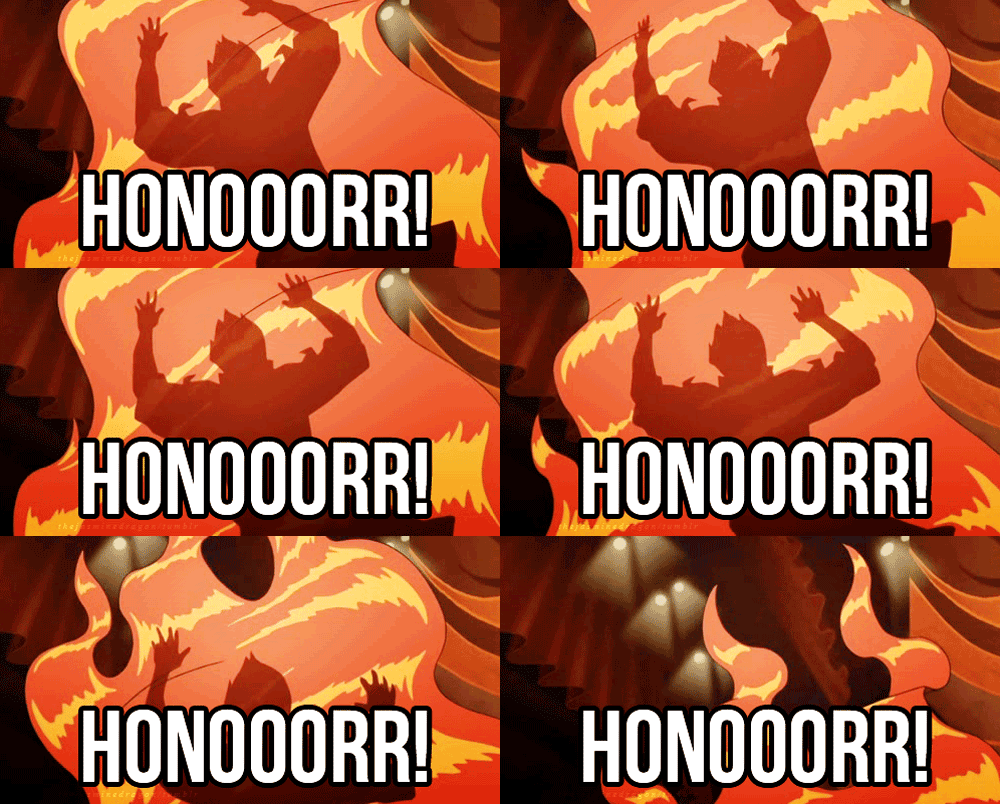
Each scene Zukko is in chips away at his exterior to reveal what he’s like inside and to reveal his backstory. He’s a victim of abuse, he’s afraid, he’s desperate to regain his honor, not for himself, but because he thinks if he’s just good enough his family will accept him. The writers gave him very concrete, very universal motivations so viewers, while frowning at his methods, can’t help but feel sorry for him.

Halfway through the character arc there’s typically a major character transformation in motives, not flaws or methodology. Most often this is achieved by the character getting what he wants, only to discover the price was too high or that what they wanted wasn’t what they wanted after all. Zuko makes a choice that results to him being welcomed back to the Fire Nation only to find that there’s no honor in being on the side of evil. At this point he joins team Avatar, but he still has a long way to go.

During the downward slope of the characters arc the character gains strength, whittles away at flaws, takes a major stand and is tested in the worst ways. This is where that belly of the whale moment comes in. For the character arc, this is called the dark night of the soul. If the character survives it, they come out the other side stronger, resolved, and at peace with their transformation.
His is the most obvious arc in the story, but it’s not the only one. Every character was brilliantly developed, even his sister. Gosh, that episode on the beach…If you haven’t watched Avatar: The Last Airbender, do. It’s amazing.


I won’t be at Athcon after all
I will be attending Athcon next year, but for this year it’s just not in the cards. There just wasn’t enough notice. It was really nice of them to offer me a place on the panels and a table to sell and sign my books, and I’m absolutely signed up for next year. But for this year there was just no feasible way to stock that table in enough time for the convention or prepare for the panels. I tried everything I could to make it work on such short notice, but at the end of the day I had to come to terms with the fact that as excited as I was to do my first panel and my first signing, going in half prepared would do more harm then good to everyone involved.
To anyone hoping to see me at Athcon, email me. I will coordinate a time to meet up with you this weekend. Promise.
AthCon!

I just found out I’ve been invited to my first Con! Well, the first as a guest, I’ve attended a few. If you’re in the area, come out and meet me and some other cool guests this weekend at AthCon in Athens, Georgia. January 16 – 18. Learn more at www.ath-con.com
I’ll be posting photos to social media from the event through Instagram, which will filter through to Facebook and Twitter. Please follow along at those sites. I’ll make sure to tag the posts with #AthCon.
Writing on Wednesday: Maintaining Your Writers Groups

As a writer, the single best thing I’ve ever done for my writing is join a writers group. I can’t speak for all writers, but for me, having the steady deadline keeps me writing with a specific goal. The feedback of my group becomes the voices in my head when I write saying random gems like “‘it’ is a missed opportunity.” Reading other people’s raw work through a critique lens helps me see errors in my own. There are many benefits to joining a writers group, more than I can count.
But writers groups are very delicate things. They only work when everyone in them feels like they are getting just as much from the group as they put into it. Our group doesn’t have issues with one person slacking yet expecting a lot out of their critiques, our issues are more numbers based.
Too many people in a writers group can kill the group. Members get bogged down in submissions and the actual meetings last all night while the members say their piece. You can institute things like comment limits, and shorter word counts, but my group likes being thorough, we like round-tabling submissions, we like the freedom to interrupt each other with our opinion on “x” or clarification of what “y” is. So when we grew too large we put a cap on membership and started screening new members to make sure their genre was something we could critique (living in a university town we often had writers come through with academic papers and such).
We did such a good job that a little over a year later we had the opposite issue. Our group shrank to the point where we had an average of three people at each meeting, which doesn’t sound so bad except that if each of those people submit something, there’s only two people to give feedback on their work. That’s more of a critique partnership, which does have its place, but critique groups meet for a different purpose. We all have our strengths and weaknesses. We balance each other out. Plus, with numbers, if one person doesn’t get something that eight other people did, then it might just be them, if seven people don’t get it, it’s an issue with the writing.
This isn’t the first time this has happened. Groups ebb and flow. The new year brought with it more members and we’re slowly stabilizing. The important thing is what we did in the meantime to hang on in both cases. We made adjustments. We hosted write-ins instead of critiques when we didn’t have enough voices. We held book clubs on books on writing when we didn’t have full manuscripts to read. We found new ways to reach out to the writing community to bolster our numbers.
Keeping a writers group together takes effort. It takes commitment. It takes time. But that time is worth it. Today is the seventh anniversary of our writers group. I’ve been a member for six years and in that time, I’ve written five books start to finish, published four (one will be out shortly, the other is in queries), and I can say without a doubt, that wouldn’t have happened without my group. It’s a major time commitment, no doubt, but that time has more than paid off in my writing.
So Happy Birthday Writers Group. I owe you big time.
For Real Friday: Hermione Granger
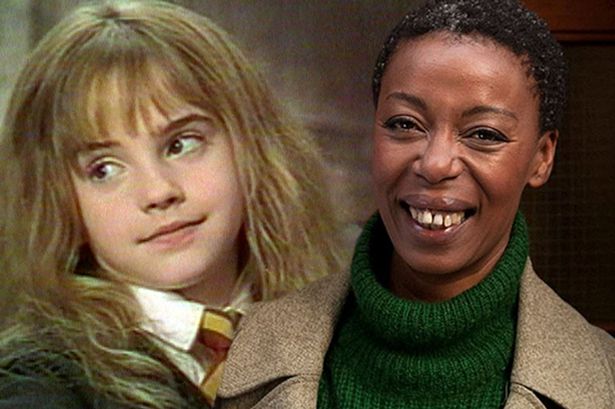
I’ve seen a lot of people celebrating the casting of Hermione for the newest Harry Potter adventure.
I’ve also seen a lot of people getting upset.
I side with the author:

Movie Hermione being white doesn’t mean anything, book cover Hermione being white doesn’t mean anything. Historically speaking, both book covers and movie adaptations are frequently wrong and authors rarely get a voice with either. Black characters and historical figures are often turned white on book covers and in their films. (Cleopatra anyone?) Like, a disturbing amount of time. On a lesser scale, hair colors and eye colors are changed all the time. Harry Potter’s eyes for instance, Elena Gilbert’s hair, eye color, and basic personality in the Vampire Diaries, Ella Enchanted’s age, Breakfast at Tiffanys changed a characters sexuality to make him a romantic lead, entirely new characters and subplots were added to the Hobbit, the list goes on forever. A voracious reader learns to get over the covers vs. film vs. book description contradictions pretty early on. They may whine about it (I’ve complained about Ella Enchanted ad nauseam) but these types of changes provide a good opportunity for introspection. When do the changes from book to film upset you? Should they?
There’s a pretty disturbing trend of when people get upset over changes. Within the Harry Potter film universe, Lavendar Brown was played by a black girl until the sixth movie when she got dialogue and was cast as white. Comparably there was minimal outrage. When Orphan Annie was cast with a black girl instead of a spunky redhead the internet lost their collective minds. Ghostbusters was cast with three women, men pitched a fit. Katniss Everdeen is canonically vague when it comes to race, however the casting call specified the access playing her MUST be white and while a few people called out the studio for that overt bit of racism, a much larger percentage of the population was pitching a fit about Rue being cast as black. For every example like Gods of Egypt, where enough people got upset about the white washing to draw attention to a major problem in hollywood, there are thousands of Rue’s. Literally, there are thousands. There was a study done showing that over the past seven years, 73.1% of actors in major films are white. Given the number of these films that feature historical events or books that were praised for diversity THAT number means a large number of races were changed with barely a ripple.
S0 if you’re upset about the casting take a moment and examine your anger. Consider other instances of that happening. Did they upset you then? Were you as vocal about it? Don’t get defensive, don’t get uncomfortable, get introspective. And if you are just upset because it’s a change from the movie, pitch as big of a fit over the next Lavender Brown.
 Kaitlin Bevis