Romances

In honor of Valentines, I’m reposting this blog for my writing on Wednesday feature.

Disney handles romance well.

That may be the most controversial sentence I’ve ever written. But when it comes to crafting romances from a plot perspective, they know what they’re doing.

The romantic plot arc is a simple one. That’s why it tends to run as a subplot. That doesn’t make it less important, it just means that the plot points of a romance line up with the plot points of the external conflict.

romantic-arc1

Like it or not, this is the basic plot structure for every romance ever. “But what about–” you may protest. No, seriously. This is like the monomyth for romance. If a story has a romantic element in it at all, ever, it follows these points, maybe not in this order, but they’re there. Even if the author didn’t do it consciously.

Disney used to get to simplify the attraction stage. Boy sees girl, girl sees boy, boom. Expectations set. Because the early days of Ariel just happening to spot Prince Eric on the boat were done so well, they’ve become cliche. So lately they’ve been poking fun at that expectation with movies like Enchanted or Frozen. Oddly enough in doing so, they created the best example of the initial attraction yet in “Love is an Open Door” simply because they didn’t have the rest of the movie to develop it.

Love is an open door meets all the best requirements for the initial attraction. The characters don’t just connect on a physical level, they see each other. The name of the song has meaning to Anna in that this relationship embodies everything she’s been denied growing up. It’s simultaneously an escape and the thing she’s been missing from her life. Ignoring the whole marriage thing, by the end of the song the audience is rooting for this couple.

The next stage, conflict keeps them apart tends to be where the main plot line rears its ugly head. Ariel is a mermaid not a human, Aladdin is a street rat, not a prince, Anna is already engaged, the spell wears off at midnight, or my favorite, they disagree on fundamentally different levels. Best example of this, the absolute best version of Peter Pan ever made (not disney but included due to awesomeness).

Wendy loves him, she’s pretty sure he loves her, but fear and a fundamentally different outlook on life keep them apart. You’ll notice all my favorite examples come out of movies that did something different with the scenes. Like I said, they can be in different order or be used for a different purpose. Understanding the plot points that are being changed makes those choices stronger.

First kiss is often tied into the resolution of children’s movies and many YA books because  true love’s kiss has become a symbol of finding your one true love. Once you’ve established the characters are together, the tension for that subplot is gone. It’s no longer a building romance. But there are some examples of this. However there are no examples of first kiss coming before the discovery/growing closer stage and few in YA for obvious reasons so I’m gonna tie those together. My favorite example is Aladdin. Their initial attraction was when they were both in Aladdin’s hovel. Their initial conflict keeping them apart was a difference in station, resolving that conflict led to another when Aladdin just kept screwing up, and he finally fixed it by finding common ground in their growing closer scene which was the magic carper ride, which ended with their first kiss.

aladdin-disneyscreencaps-com-7299

Worsening conflict is Wendy being taken by Pirates, Aladdin almost drowning, Ursula impersonating Ariel, Kokoum getting shot, Anna discovering Hans betrayed her. In the children and YA romance structure, there’s almost no breathing room between worsening conflict and black moment, because one leads to another. Aladdin finds himself helpless, powerless and flung far from Jasmine, Ariel finds herself alone on a dock while she watches her love go off to marry another. Anna is freezing to death behind a locked door, Pocahontas hears her love sentenced to death. Pan falling out of the sky. It’s in these moments the characters find their inner strength or break completely. The dark moment leads straight to the climax because finally the characters have what they need to fight and in romance that strength comes from each other. The movie that handled this the best romance wise is Tangled. You think her darkest moment is when she thinks Flynn betrayed her, but that was just worsening conflict. She finds her inner core of strength “Did I mumble, Mother? Or should I even call you that?” But none of that matters when Flynn is stabbed. She breaks. She sacrifices her newfound backbone, her ability to fight to save him and she does it in a strong way. But what makes this scene great is that it’s not just her moment of strength. It’s his. He arcs. The selfish thief is every bit as willing to sacrifice his life to save hers as she is to save his. And for a romance, that’s pretty awesome.

The happily ever after in most romances is true loves kiss, wedding bells in the future, and a happy resolution on all plot points. But sometimes that’s not the case. Peter Pan has Wendy growing up while Peter stays behind and her knowing a part of her will always be with him. UP’s romance ends with the knowledge that Ellie (symbolically the house) is waiting for Carl in paradise and he’ll always miss her but he still has things to live for. Pocahontas ends with John Smith sailing away. Sometimes the best romances are bittersweet.

The ending is never, should never feel like a given. That’s what makes a great romance.

FAQ Friday: Instalove

daisy-712898_1920

One thing I’ve noticed getting debated in reviews is the question of whether or not Persephone and Hades count as instalove.

Instalove is a trend in YA lit that reaches back to the 80’s (and beyond). Girl sees guy, girl falls helplessly in love with guy despite guy kind of being a dick, girl spends entire book pining for guy and then, *gasp* discovers he’s completely obsessed with her too, and has been since the moment they met. That’s why he’s such a dick, because what girl doesn’t know is that guy is a vampire/in witness protection/a werewolf/some other thing that would be dangerous for the human girl.

Sometimes you see the trope reversed, and sometimes you see the trope work on both sides. They both see each other and fall for each other and the book just throws obstacles at them to stop them from being together. Or they hook up and go on their merry way together.

My book doesn’t have instalove. But at the same time, it kind of does.

Persephone hates Hades when she first meets him. She wants nothing to do with him or the Underworld. She just wants to go home. She has all these assumptions about who Hades is and over the course of the next four months, slowly begins to realize that he’s not a disney caricature. She over-corrects. Assumes that he’s nothing but this great, caring guy, and is quickly corrected. There’s darkness to Hades, there’s light, there’s everything inbetween. She doesn’t really consider whether or not she has feelings for Hades until she learns he has feelings for her. Sure, she likes looking at him. But he never registered as a possibility until she found out he was and then she got interested.

That’s, in my experience, how people work. Finding out someone likes you makes you consider whether or not you like them. I’ve seen it over and over again with myself and my friends. They know this guy, don’t really think anything of him, then find out he has a crush on them and suddenly start evaluating whether or not he’s datable.

Persephone has maybe a minute of blind devotion at the start of book two before she’s jolted back to reality when she has to come up with something true to tell Hades to convince him to go back to the Underworld. That truth is all these doubt bubbling up inside of her about how their relationship could possibly work. Even at the end of book two, she tells her mother that she loves Hades for now, but she knows they might not last forever. It’s not until book three, nearly two years after they meet, that Hades and Persephone become an unquestionable fact. And even at the end of book three, there’s some indication the ground ahead is rocky at best.

Persephone’s perspective tends to make my readers go “yay! It wasn’t instalove!” So where does the debate come in?

Hades.

Hades states outright that the second he saw her he knew he’d fall in love with her. He doesn’t act on it. He doesn’t not act on it. He accepts it as a part of life and does his best to make sure she survives. It doesn’t exactly fit the trope, because we never see it from his perspective, so an irrational, sudden interest isn’t the driving force of the plot. But technically, yeah, it’s instalove.

So why did I include it?

I thought long and hard about it, trust me. It would have been super easy to leave out that one line and just let my readers think it was a build up months in the making on both side. But I couldn’t. Hades is a good guy, but he’s not entirely unselfish. He wouldn’t bind himself to Persephone for all time just to save her if she wasn’t someone he had feelings toward. He would have tried to find another way. What he did was somewhat selfishly motivated. He didn’t stop to think, he acted to save her, but he could have stopped to think. He could have just faced Boreas on his own (granted she could have been caught in the cross-fire). My point is, there were options. He had to be far enough gone to not even pause to consider them.

So I included the line, and almost included a prologue that shows Hades seeing her for the first time and the absolute conviction he feels.

Hades, as stated by the narrative, has a way of looking at people and seeing everything they are, everything they could be, weighing their every thought and motivation, and leaving them with the unmistakable feeling that they’ve been judged and found wanting. Persephone feels this happen when she wakes up in the Underworld, and it’s not just her using flowery language.

Hades is a god.

While he employs help, he absolutely has the ability to determine whether or not a soul should go to Tartarus, Elysium, or Asphodel.  I don’t think Hades could ever experience anything other than instalove because when he looks at someone, he can weigh their soul. And he’s been around long enough to cut through all the self-doubt and questioning. He knows what he likes, he knows what he loves. And when he saw everything Persephone was, and the potential for everything she could be stripped bare, he fell in love with her.

It is instalove in the sense that it’s instant. But it’s not the typical use of the trope. His love isn’t irrational, built with nothing to go on but a glance and a snap judgment because the plot demanded it. He had more information than a normal person would get, even after decades of marriage. Hades knew what he was falling for.

Of course, it would have been way better if I’d done more than hint at that in the narrative.


The Story Grid

I’ve talked extensively about outlining using  the Snowflake Method, but I wanted to share a great self-editing tool for after you finish the novel. And that’s called The Story Grid. The Story Grid is a book (get the physical version, the charts aren’t great in eBook), a podcast, a video series, and a super helpful website. Over the next few weeks, I’ll show you how I apply concepts from The Story Grid to my work using the most recent novel I took through the grid, Venus Rising. Spoilers will be hidden with links.

But first, an introduction from Shawn Coyne.

Sneak Peek: Venus Rising

venus-1351056_1280

Enjoy a first look at a scene from Venus Rising. SPOILER WARNING for anyone who has not yet read Love and War.

“I can do this,” My numb fingers scrabbled to keep hold of the sheer cliff face. The Island of the DAMNED was a shaped like a tall, mutated teardrop, only a jagged curve sloped into the ocean. I’d edged my way around to lower ground. Unfortunately, the cliff still wasn’t low enough for me to climb given the rough shape I was in.

Between waves, I sputtered specifics, locking myself into the promise, forcing the words true. Now there was no choice in the matter. I had to survive.

Poseidon, I thought, drawing my palm against a rock jutting from the face of the island. The sharp edge pierced my spongy palm without resistance. Blood could pass through the weak shield surrounding the island as well as water. Mine was still divine enough to get Poseidon’s attention.

I hoped.

Shivers racked my body, hard enough to threaten my tenuous hold on the cliff face. Exposure, I added to my mental list of ways I could die. When the entire fricken island teleported across gods know how many time zones, it traded sunny, warm, placid water for a dark night, icy chill, and choppy waves.

“She moved the island.” I spat out the sentence with as much disgust as I could muster. “That stupid…” A litany of curse words followed, but not a single one of them made me feel better. Medea had probably killed herself doing this. And for what?

I squinted against the utter blackness, wishing for a moon, stars, or light of any kind.

Some part of me knew my thrashing could attract creatures living in the water, but that fear had to move aside for the more practical need to keep air in my lungs.

Lightning cracked across the sky, cruelly granting my wish for light in a blinding slash. Of course, Persephone was enraged. The meeting, ostensibly to establish peace with the demigods, had gone horribly wrong when Ares had been outed as an imposter. He’d gotten away, but I’d been dragged along when the island teleported.

So now, not only did the demigods have a weapons cache that could end every god in the Pantheon, they had two hostages. Me and the fricken Lord of the Underworld.

Maybe my cover isn’t blown. They didn’t know I was a goddess. Just that Ares was a god.

And I’d been living with him.

And that we’d arrived on the island at the exact same time.

Yeah, they’d be idiots not to at least suspect. And since gods were physically incapable of telling lies, all it would take to confirm their suspicion was a yes or no question.

Assuming I didn’t drown first.

Something slick brushed against my legs. What was that? I twisted in the water, limbs jerking in all directions like a tangled marionette, but the waves might as well have been made of midnight. Between the pitch-black night and the chaos the island’s teleportation churned, I couldn’t make out my own flesh beneath the waves. I lost my grip on the cliff-face and felt a wave of dizziness as my feet kicked into the endless depths.

Probably just a scared fish, I tried to convince myself. My fear of the ocean depths was mostly instinctive, bred into me by design to keep me from visiting Poseidon’s realm. Having his permission to be here should have quelled the fear. But in the dark of the night with gods knew what swimming around me, that old, instinctual fear no longer listened to reason. I was someplace foreign. Other. I didn’t belong here.

“Just keep moving,” I told myself through gritted teeth, kicking toward the cliff face.

A wave slammed into me, shoving me beneath the inky blackness. I pushed to the surface, gasping for air, but just as I inhaled, another wave slammed into me. Then another. Then another.

Sneak Peek: Venus Rising

venus-1351056_1280

This is incredibly rough, and will likely change before publication, but enjoy a first look at Venus Rising. (No, that is not the cover).


Prologue

Aphrodite

I’m not perfect. But I was designed to be. Once upon a time, Zeus sculpted me from foam and death. He made me into a puppet. A box. A symbol. A thing designed to be perfectly obedient to him.

I bent and twisted beneath his onslaught of lightning and thunder, but when the storm cleared, I remained. Fragile and broken, but still alive. His death released me from his vision of perfection, leaving me free to find my own. That’s when I discovered how far from perfect I truly was.

I’ve been called whore, shallow, arrogant, self-centered, annoying, and worse by beings who physically can’t lie. They’re not wrong. I’m riddled with flaws. I am neither strong nor brave. I cling too tightly, love too freely, and fear that without my beauty, there’s nothing left of me. Nothing real.

But life goes on, regardless of my uncertainty. As time passed, I had no choice but to learn to stand on my own two legs, shaky as they may be.

Here’s what I’ve learned. I’m nobody’s statue or posable doll. I am neither a box nor a symbol. Yes, I’ve been loved by war, struck by lightning, hugged by spring, and mauled by the sea, but I’m more than a victim. I am greater than my story.

I’m real, flaws and all, and that’s terrifying. Every day, I become someone else. Someone stronger. Wiser. Better. I’m becoming myself.

But that process isn’t always pretty.

Elemental Genres

wx-11-cover-palegradient4-300x300In season eleven of Writing Excuses, they dived into the definitions of elemental genres. Here’s the framework they posted. I’m included their definition because it’s better worded than mine.

Elemental genres are the things that make you read, the emotional resonance that drives a story. Not bookshelf genres, but elemental genres. The 11 elemental genres planned are wonder, idea, adventure, horror, mystery, thriller, humor, relationship, drama, issue, and ensemble. This is a framework for talking about what makes readers turn the page and have emotional responses, not a hard-and-fast set of categories or rules. Elemental genres let you mix-and-match underneath the veneer of the bookshelf categories.

It was a fantastic season. They talked a lot about what defines the different genres and how to layer them with the plot, subplot, and character arcs. I particularly enjoyed Newton’s Laws of Writing.

[1] A word count at rest tends to remain at rest, while a word count in motion tends to remain in motion. Motivation? To keep writing, write some more! To start writing, start slow, then bump your goal. Build your writing inertia by writing every day! Oh, at the end of a session, don’t stop at the end of a chapter. Write the first page of the next scene, and then pick up with that jumpstart. Dan it all! Don’t sweat the zone — fight to make the most of each chance, and make sure people understand don’t interrupt me! Think before you start writing, don’t waste time ramping up. [2] Word count equals motivation times focus. Motivate by thinking about what comes next. Focus BICHOK and clear distractions. Consider word count per hour. Try a timer (sand timers don’t beep!). Meditation might be your ticket to a clearer mind? [3] For every action, there is an equal and opposite reaction. When you write words, the words write you. You also are affected. Writing is its own reward. Every word you write builds your writing skill. The goal of writing stories is to become a better writer. The equal and opposite reaction to writing is that you become a better writer!

Go ahead and give it a listen!

Writing Excuses Master Class

zRhDg3p.png

Season ten of Writing Excuses introduces an entirely new format. Instead of doing 15 minute episodes, each focusing on a different topic, they decided to string the topics together. So while still fifteen minutes long, they took listeners through the entire process of creating a story start to finish. My favorite part about this change was that the writing prompts began to build on each other, which made them way more useful.

There were still wild card episodes with special guests that were one-off topics. I’m glad, because while I’m never going to not take advantage of the opportunity to get amazing advice from writers like Brandon Sanderson, I’m not new at crafting stories. Brainstorming techniques are fantastic, but I’m under deadlines for books I’ve already brainstormed, plotted, and started. To me the very best bits of writing excuses are the things that I can use to build on to my existing story in a revision pass.

But the podcast wasn’t created just for me. As the season progressed into character development and world building. I really liked their podcast on the magical 1% (chosen ones in an otherwise less magical society).

This is probably the best season to start with for new writers. If you listen on your computer, the liner notes have links to any of the podcasts they’ve covered in a similar vein, so you can catch up on the last nine seasons with a focused direction.

Here’s the link to season ten, I hope you enjoy it!

Combining Dialogue, Blocking, and Description

0aHT_Z2t

I had several favorite episodes from season eight of writing excuses. They did an episode on writing pets, which made me realize none of my characters, not one, ever, has had a pet. No cats, no dogs, no horses. Hades had a dog once, but in the book, nope. No pets. I must work to fix this in the future. They did a great episode on retellings,   narrative rhythm, and chapter breakdowns that were super helpful to me.

But my favorite episode was the one on combining dialogue, blocking, and description. Integration is something that comes up in my writers group a LOT. You don’t want to have entire paragraphs of any one thing. Note I said paragraphs, plural. Occasionally having a paragraph or two of one thing makes it a focal point. It can be stylistic. But if you’re not doing it on purpose, description, thought, action, and dialogue should be interwoven. Dialogue requires natural beats. Places where the talking pauses and the reader gets to transition between who is saying what. Rather than just constantly writing he said she said, you can, and should, use description and action as those beats.

So

“Hi,” she said.

She leaned against the wooden table in a beam of sunlight doing something distracting.

You’d write something like,

“Hi.” Kelsey leaned against the wooden table in a beam of sunlight. More description or action.

There’s a balance to it. You don’t want your characters to get hyper.

“Hi!” Kelsey leaned against the table.”

“Hey.” I rocked back and forth on my feet.

“How are you?” Kelsey drummed her nails on the table.

“Great.” I slid into my seat. “You?”

You get the idea.

See how I use this technique in my work:

Poseidon cleared his throat. “As much as I’m sure you’d love to just lay here and ignore me the entire night, we need to talk.”

“Fine.” I craned my neck, squinting against the sunlight that blazed around the Poseidon-shaped silhouette. Motioning to the lounge chair beside me, I tried to pretend I felt safe. That I didn’t still remember the way he’d crushed me to him, his tongue snaking down my throat. After all, I had the upper hand now. Time to act like it. “Did you guys find Narcissus?”

The sea god nodded. “We’re watching him from a distance for now, hoping he’ll lead us to Jason. I maintain it would be better to question him, but . . .”

“You were overruled,” I guessed.

“Athena agrees with Persephone.” When Poseidon crossed his arms, sunlight spilled over his shoulders. “There’s more to gain through observation than interrogation. Plus, if he were to escape, it would lend more credibility to Tantalus’s story, and that could hurt your cover.”

“Have you guys figured out how Tantalus escaped from the Underworld in the first place?” The last I’d seen of the demigod, he was locked in one of his own cages with Ares’s spear in his chest, waiting for Persephone or one of the others to come lift his immortality curse. I’d been assured the demigod was now firmly dead and wasn’t going anywhere outside of his own special hell.

Integration is key. Thoughts, backstory, action, description, dialogue. Anything you could spend entire pages on will probably read a lot smoother if it’s all interwoven. Especially description. In writers group a question I ask people to consider is if you randomly look at 3-5 (sequential) paragraphs of dialogue, could your characters be on the moon. If the answer is yes, your characters need to interact with their environment. This is also called talking head syndrome.

And it’s important not just to have multiple elements in a paragraph, but to have them serving different functions. You can say “she said, angrily.” Or you can have her interact with the environment in a  way that shows she’s angry.

Brandon Sanderson took my integration spiel and did one better in this concept that I absolutely love, called the Pyramid of Abstraction.

The bottom of the pyramid, the scene setting, is the concrete foundation. The layers atop it can be more and more abstract, like tagless dialog without concrete descriptions, if that original foundation is firm enough.

You should listen to the episode, it really was fantastic.


Out of Excuses Anthology

21844946-_uy475_ss475_

Season nine of Writing Excuses had more amazing episodes than I could summarize. They went into depth on each of the prongs for three prong character development. They had guest speakers. You should listen to the entire season.

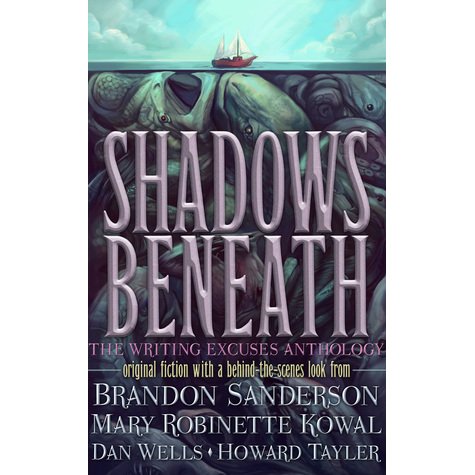
But this season, I have to talk about the Writing Excuses Anthology. Each podcaster brainstormed a short story on the podcast (technically that happened in season 8). They wrote those shorts then edited them during a podcast in season 9. The anthology was then sold with transcripts of the podcasts and their edited drafts as well as the final product. Great stories from great authors and an in depth look at what editing looks like.

You can buy the anthology on Amazon here, or you can do what I did as my Christmas gift and get the hardback edition off Brandon Sanderson’s website, and get it autographed here (plus you get the ebook free anyway).

This is a fantastic inside look for any aspiring writer. As a writer myself, I can confirm this is exactly what brainstorming and revising looks like. At least in my writer’s group.

Now for a completely unrelated, friendly reminder. Aphrodite is still on sale for .99 cents! Be sure to check it out.


Holiday Author Meet and Greet

insta_meetgreet_12-8-1

Avid Bookshop will be hosting an author signing extravaganza on Thursday, December 8, from 5:30 p.m. to 7:30 p.m. Participating authors include Valerie Frey, Mandi Mathis, Larry Dendy, Kaitlin Bevis, Melia Keeton-Digby with more to come!

Come accomplish much of your holiday shopping at Avid! Get a book signed by some of your favorite local authors and peruse our selection of books and gifts that are sure to please this holiday season.

Make sure you also stop by the annual holiday market at Big City Bread Cafe! Peruse the many great wares by local artists, where you’ll undoubtedly find unique Athens gifts to give your loved ones.

For more information, go to Avid’s website or facebook page.