Out of Excuses Anthology

21844946-_uy475_ss475_

Season nine of Writing Excuses had more amazing episodes than I could summarize. They went into depth on each of the prongs for three prong character development. They had guest speakers. You should listen to the entire season.

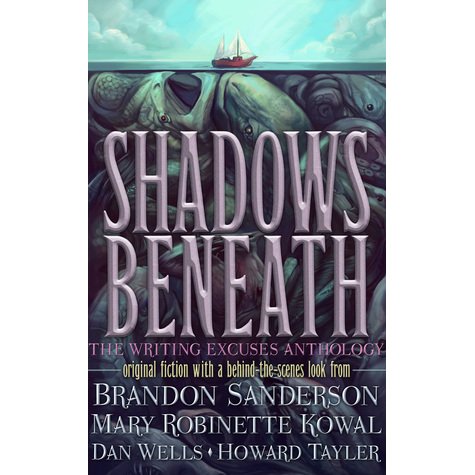
But this season, I have to talk about the Writing Excuses Anthology. Each podcaster brainstormed a short story on the podcast (technically that happened in season 8). They wrote those shorts then edited them during a podcast in season 9. The anthology was then sold with transcripts of the podcasts and their edited drafts as well as the final product. Great stories from great authors and an in depth look at what editing looks like.

You can buy the anthology on Amazon here, or you can do what I did as my Christmas gift and get the hardback edition off Brandon Sanderson’s website, and get it autographed here (plus you get the ebook free anyway).

This is a fantastic inside look for any aspiring writer. As a writer myself, I can confirm this is exactly what brainstorming and revising looks like. At least in my writer’s group.

Now for a completely unrelated, friendly reminder. Aphrodite is still on sale for .99 cents! Be sure to check it out.


 

Writing on Vacation

luggage-1482697_1920

November is the worst possible month for Nanowrimo. Sorry, it’s the truth. Thanksgiving chaos, vacations, kids out of school. Plus for kids in school the semester is wrapping up so there’s that to deal with.

But as a professional writer, every month is Nanowrimo, so I had to learn to write on vacation without actually missing out on the vacation or my family.

For me that means squeezing writing in during down time. Between all the hustle and bustle and busy places. Morning is great too. People are tired, shuffling around, drinking coffee. It’s a socially acceptable time to be anti-social. I can squeeze at least an hour in. Which isn’t much in terms of writing time, but that’s the other thing about vacations. Daily expectations must shift to something realistic. If I get anything done, that’s a win. I’ve found I actually get more done when I take the laid back approach of not caring about word count goals during vacation than if I plug away until I reach a certain number. During the rest of the year, it’s the opposite, but if I do that on vacation, then it’s almost a guarantee that I won’t be able to use a word of what I wrote past what should have been my stopping point.

When do you get your writing in during vacation?

Story Bibles

wx-wordpressbanner-wdtrophy2016

In season five of Writing Excuses, my favorite episode focused on Story Bibles (though they had a lot of great episodes on POV as well).

Story Bibles are a document, a wiki, or some other webpage or something you have that help you keep up with your universe. I use scrivener to some degree for this, but I’m toying with the idea of creating a wiki for the Persephone Universe where I go through the real life connections of the myth, the powers and how they work in my universe, the characters, and the rules. In fact, right now I’m writing a blog post that will link to all the existing content I have on all of that in my blog.

That’ll be the public equivalent of my story bible. Eventually, I may post the private one. The scrivener character profiles that go into all the development of each character in each story. The plot summary for that story. The layout of different places in that story, and the rules of the universe in that story.

The biggest reason I haven’t made the jump and created an actual wiki for the Persephone universe is because right now, I have everything I need in scrivener, so anything I do in wiki will just basically be me procrastinating on writing the next book. I don’t want to get world-builders disease (where you use world building to procrastinate actual writing). But I also don’t need to do that much because Persephone is basically set in our world. It’s an alternate reality of our world, but it’s not very far alternate. If I need to remember something about the setting, I can visit it. If I need to know how long it takes to get port to port in Aphrodite’s cruise ship, I can google it. I know my rules well enough to avoid getting tangled in them (gods can’t lie, charm isn’t forever, glamours work like x). But my magic system is fairly simplistic because my characters are actual gods. I don’t have to worry much about god complexes, because if any creature deserved to have one, it would be the ones who created the world.

But if I were to write a new story, set somewhere else with different rules, a story bible would be a must. So this podcast gave me a lot of great tips on creating one.

You can listen to it here or read the transcript here.

Juggling Multiple Viewpoints

smilies-1607163_1920

In season four of writing excuses, my favorite episode was one that focused on juggling multiple viewpoints. I primarily write in first person single narrative, however every now and then, my story leads to a place where I *have* to have another viewpoint character or two.

In Iron Queen, I had to add in Hades and Aphrodite because Persephone wasn’t where the action was. The story from her POV wouldn’t have explained how the gods found her, what was happening on their end, or the struggles they went through. If I’d only done her and Hades or her and Aphrodite, I would have been missing places where the three characters diverged,because plot wise it made no sense for Aphrodite and Hades to stick together during the entire search for Persephone given the fact that Aphrodite was a liability. Hades’s POV was needed to show Zeus going after the gods. Aphrodite’s POV was needed to show Zeus going after the demigods. Both were very important threads.

But it’s not always location based. In Love and War and Venus Rising, I had to add Medea because while Aphrodite and Medea are on the same island, Medea knows things Aphrodite can’t and make no sense plot wise for Aphrodite to learn. I needed an insider. I needed someone on the demigod side otherwise it was going to be a very short, very one-sided story.

I write them all in first person for my current series because that’s been the format so far for my series, but writing multiple viewpoints works best in third limited. I got some complaints about the change in format from Iron Queen, and I’m anticipating them for Love and War. But the story demands it, so all I can do is try to jump POV’s better.

Cue writing excuses. Some of their advice was obvious. Make it obvious who your POV character is right off the bat. My chapter names were the character names, I always had someone refer to them by name within the first few chapters or some other major identifying (“watching my wife chase after a human boy was hell” could really only be one character). And by giving them different voices. I worked very hard on those different voices and some readers will say I succeeded, others wills say I failed. So that’s something I still need to work on. It’s doubly hard for Aphrodite and Medea because the entire point of their characters is that they mirror each other. They are super similar characters that are just at different points in their development. They will be each other’s roads not taken. Eventually. And to do that, there needed to be some pretty heavy similarities.

They had a ton of great advice and pitfalls and over all it was a very informative episode of writing excuses. Take a listen here or read he transcript here.

The Four Principles of Puppetry

child-1381797_1920


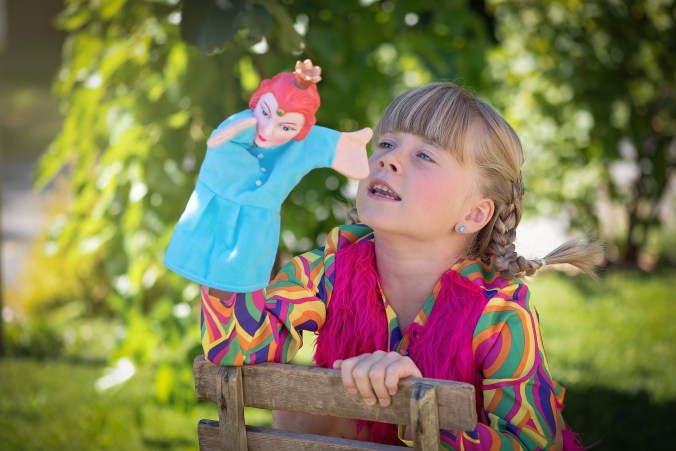
I’m almost caught up with the current episodes, but it’s been several seasons now and my favorite episode hasn’t changed, so I thought I’d share it with you. It’s The Four Principles of Puppetry with Mary Robinette Kowal. Mary explains what the four principles of puppetry are and how they relate to writing in general, and her insight is amazing. It completely changed the way I looked at character action. You can listen for free here or read the transcription here.


Writing Excuses: Endings

0aHT_Z2t

As you all know, I’ve struggled with my endings. Ending a book is hard. But my favorite episode in Writing Excuses season 2 focused on endings. How to write them, what to do, what not to do. The most useful tidbit that I got out of this is how Howard approaches his endings. He waits until he’s about ¾ of the way through an arc, then goes through the story with his writers group and asks “what promises have I made to the reader?”

Honestly, that’s genius. If I did that in my writer’s group, I’d instantly have 9 different opinions on how the book should end. People would make connections I hadn’t thought of in ways I hadn’t thought of it. It’s a great exercise, and one I intend to use going forward.

But not with a series, because 1. I can’t ask my writers group to go back and read the last 6 books. And 2. Series introduce their own ending problem.

When I wrote Venus Rising, my ending kept falling flat. I went through the book and asked myself what promises I made to the reader, and realized I was meeting all of those. So I went through the trilogy, what promises was I making? Well, I’d met all those, so what was the problem?

The problem was that this book, standing alone by itself didn’t make the promises I’d made to the reader in books 1 and 2 matter. If I’d ended the series at book 2, the ending I’d written would have resonated perfectly. But because book 3 was written without including more than a scene or two referencing some of the sub plots that were wrapped up in book 3 (because I didn’t have a POV character in the place where all the sub plot stuff was happening) the ending lost all its power. So identifying, yes, I’m keeping these promises is important, but identifying, well, I am keeping this promise but I didn’t make this promise this book, is also important. In the case of Venus Rising, it’s going to take some restructuring, possibly the addition of another POV character, at minimum more scenes with this specific group of characters to make those aspects of the ending feel like they matter.

You can listen to this episode of Writing Excuses here or read the transcript here.


Track my progress

Screen Shot 2016-07-29 at 8.15.53 PM

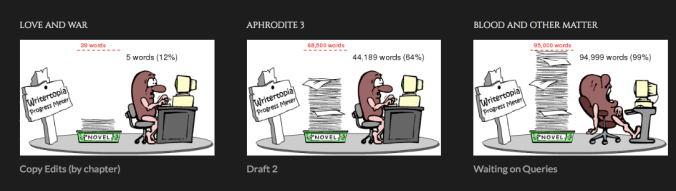
Did you know that you can see exactly where I am on all my writing projects? At the bottom of this page, you’ll see three word count trackers for three different projects I have going right now. I update those trackers at the end of every day. So you’ll always be up to date.

A few disclaimers. With the exception of the third Aphrodite book, none of my projects are trackable via word count right now. Love and War is going through the editing process right now. So I track it by what chapter I’m on (I promise the book is more than 39 words), because that’s a better indicator of where I’m at with that book. When I finish with whichever round of edits I happen to be on (they all blend together at the end), I update with “Waiting on X round of edits.”

Blood and Other Matter is a project that I’m querying right now. Hence the status waiting for queries. There’s not a lot for me to do with that book until I hear back from the agents who have requested the full manuscript. If any of them give me feedback, I’ll incorporate it into the book.

So if you want to know where I’m at with a given project, just scroll down! I update daily. Want your own super cool progress meter? Check it out here. 

Hero’s Journey Master Post

the_hero__s_journey_by_dunlavey

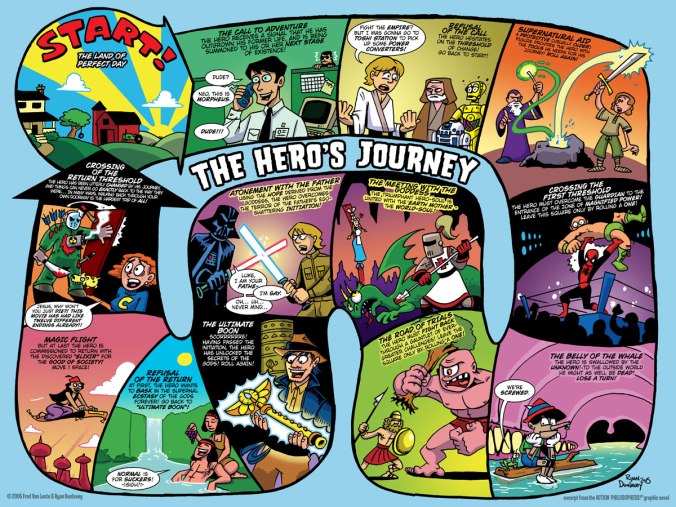
The hero’s journey pops up in virtually every story ever told. So it’s important to get at least a basic familiarity with the major steps. I’ve compiled a list of blogs I’ve written on the topic.

The first thing established in the hero’s journey is the ordinary world. Sometimes called the slice of life, this sets up what the day to day life of the hero looks like before he or she receives their call to adventure. The call to adventure is the moment when everything changes. The known becomes unknown, and whether the hero accepts the call or not, this is the point where they enter the extraordinary world.

The hero then embarks on the road of trials, where their skills will manifest in surprising ways and they’ll slowly build confidence in their emerging abilities until they meet with utter failure at the moment they needed success most. Typically there’s a death here and we enter the darkest part of the journey, the belly of the whale.

This moment is what separates heroes from villains. See, a good bad guy had their own journey. But when they reached their low point, they didn’t find humility and a new determination to succeed. They missed the transformation into a hero. When all the skills, lessons, and red herrings along the way come together to matter in a big way.  The journey ends with the road back, often fraught with its own perils to show just how much the hero has changed and how far they’ve come.

There are seventeen steps to the hero’s journey. I’ve only covered a handful, but there are tons of great resources out there for aspiring writers. Here’s a few of my favorites.

Hero with a Thousand Faces, by Joseph Campbell. This is THE source book about the hero’s journey. If you really want to learn all the intricacies of the journey, start here.

The Hero’s Journey in Game of Thrones: Jon Snow breaks down Snow’s journey. You can pretty much type in hero’s journey in insert any movie, book, show here and get the steps broken down. But this blog had some great visual resources as well.

The Writer’s Journey breaks down the steps and includes guidelines for writers to adapt the hero’s journey into novel form.


Friday Faves: Writing T-Shirts

A few weeks ago, I posted my favorite litograph shirts, which are shirts made up of the words of different books. This week, I thought I’d share my favorite writing t-shirts. So here they are in no particular order. One day I hope to own them all.

These shirts came from two different websites. Tee-Spring and SunFrog. Check them out.

This slideshow requires JavaScript.


The Snowflake Method Master Post

ice-crystal-1065155_1920

Over the last few weeks, I’ve been writing about each step of the Snowflake Method, with examples of how I’ve used it in my own work. I’m really excited about drafting this way, and it’s been very helpful with Aphrodite book 3.

Here’s all the posts I’ve written on the topic. But first…

Check out The Snowflake Method Website. Read about the method from the man who created it, Randy Ingermanson, himself. A much more concise guide.

And if you have Scrivener, check out these templates built with the snowflake method in mind.

Here’s a few great articles on the snowflake method as well.

Now for my blogs on each step.

Step 1– Write a one sentence summary of your book.

Step 2– Expand that sentence to a paragraph

Step 3– Write a one page summary of each character

Step 4– Expand each sentence in your one paragraph summary to one page

Step 5– Write the synopsis from the POV of each character.

Step 6– Expand each paragraph from your one page summary to a page

Step 7– Create full fledged character charts detailing each character’s arc over the story.

Step 8– Make a spreadsheet outline of each scene based on your four page summary

Step 9– Write a narrative summary of each scene

Step 10– Write that good book.