Way Back Wednesday: The Ferryman

l-79294

Charon didn’t have an active role in a lot of myths, but he makes appearances all over the place. That didn’t stop in ancient days. The ferryman is an archetype. A neutral character who serves to transport the protagonist from one place to another and give off a generally creepy vibe.  You’d be surprised where Charon popped up in recent history.

The Clash of the Titans

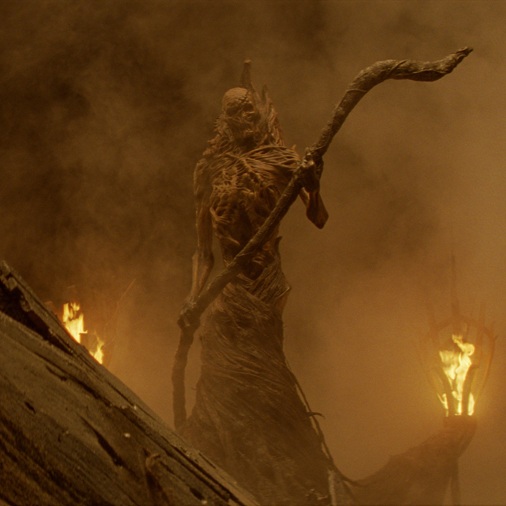
Charon appears in the original clash of the titans as a skeleton. It was a creepy moment and not one I saw fit to rewrite with my own version of Charon.

The Amber Spyglass

Another creepy ferryman, in a heart wrenching moment, he unwillingly ferries Lyra and Will across the river to the land of the dead.

Peter Pan

In a play on words, the fairies typically act as ferrymen for children who “fall out of their prams” or get lost. The children are taken to Neverland, a wonderful land that sounds a lot like a child’s paradise. It doesn’t take much to read between the lines here. Peter later acts as a ferryman to children who died, traveling with them for part of the way so they wouldn’t be frightened.

Have you seen any examples of ferrymen that stuck with you in books or movies? Comment below.

Mythology Monday: Charon

peer-173435_1280

 Dinner chatter began on the far side of the table, seeming to revolve around Charon recounting his day on the ferry. I stared down at the white tablecloth, trying to remember which of the silver utensils I needed to use for the first course. A silver plate was placed before me with a fried pink oyster mushroom served with grapefruit. It was topped with an orange nasturtium blossom. “So . . . ” I turned to Moirae, who glared daggers at me, and quickly turned back to Hades. “Uh, what did you do today?”

He looked surprised by the question. “It’s barely been an hour since I last saw you.”

“It’s called small talk,” I snapped. “You should try it some time.”

He sighed. “Fine. I spoke with Hestia about your history lessons, arranged for you to begin self-defense lessons with Charon—”

“What?” Charon piped up from his end of the table. “When did that happen?”

“Just now,” Hades said around a bite of chicken. “I’m multitasking.”

“Why does she need to learn self-defense?” Aeacus asked. I

popped the flower into my mouth, savoring the spicy flavor. I wondered how they’d known I was a vegan. Everyone had something different on their plates. Maybe it was just a cool Underworld trick, like the rooms decorating themselves.

“You’re going to have Charon teach her?” asked Thanatos. “He won’t be able to shut up long enough to teach her a single move. I’m way better at self-defense.”

“Not everyone can kill someone just by touching them,” Hypnos pointed out.

“You’ll be busy guarding Persephone any time she leaves the palace.” He looked at me. “You’re perfectly safe in all but the public areas of the palace. Only certain souls can enter the living quarters. Just stay out of the public sections, the ballroom, the front lobby, the banquet hall, and the court room, unless either myself, Cassandra, or Thanatos are with you.”

“Hah!” Thanatos laughed at Charon. “You may be the self-defense guru, or whatever, but I’m the one people want around if there’s any real trouble.”

 Charon snorted. “Give us a week, Thanatos. Persephone will be able to kick your bony ass across the Styx.”

The table erupted into cacophony. Everyone was talking over everyone else, adding wagers and jesting with each other. Lethians deftly ducked between the dueling deities, serving the main course. A plate of corn-filled phyllo tulips and eggplant topped with tomato sauce was put in front of me and I took a nervous bite.

“You’re on!” Thanatos replied. He gave me a devilish grin. “One week, Persephone.”

“That’s okay,” I squeaked. I didn’t want to go hand to hand against Death. No one heard me.

 ~@~

Charon is the ferryman of the Underworld. He takes the newly departed from the entrance of the Underworld across the River Styx. In most versions of his myth he charges a coin (usually an obelisk, and some myths say two) for the passage. This was the reasoning behind putting coins on the eyes of the dead. People didn’t want their loved ones stranded in the Underworld. My version of Charon charges no such fee, and he’s also much more friendly than his mythological counterpart.

He’s yet another child of Nyx and Erabus, so I guess he’s Thanatos’ and Hypnos’ half-brother. His name means “keen gaze” which may refer to that fixed, unmoving gaze that corpse have (you’re welcome for the creepy imagery of the day). There’s not a lot of active mythology about Charon. He’s present in a ton of artwork and is mentioned in most epics or heroic quests, but other than taking people back and forth he doesn’t have a very active roll.

He’s supposed to be ugly and unkept, with a long, straggly, greasy beard. My Charon is cleaner, but I suppose hand rowing a ferry full of people back and forth over a misty, swampy river multiple times a day could take a toll on your appearance.

For Real Friday a day early: Schizophrenia and Other Mental Disorders in Fiction

inadequacy-447731_1280

Posting early in honor of tomorrow’s cover reveal. When I portrayed Moirae as schizophrenic, I ran into a problem. Schizophrenia is not multiple personality disorder. Despite the media’s portrayals as schizophrenics being dangerous individuals with Jekyll/Hide syndrome, that’s actually an entirely different mental disorder. So why did I keep the same description? Because she doesn’t have multiple personality disorder either.

People with multiple personalities don’t have personalities that converse with each other. They experience black outs when the other personality is in charge. That’s not Moirae either. Because there’s a magical element there, she is all three people at once. Since one personality isn’t dominant and because they interact, that goes more toward the auditory hallucinations of schizophrenia. In the end, I wasn’t sure what to call her and after lengthy talks to my writer’s group and my editors, schizophrenic stuck, both because the symptoms were more true, though still not quite right with the illness and because on a colloquial level Persephone was a sixteen year old. She would have called it schizophrenic. She never said the word out loud so no one would have corrected her.

All the same, I was careful to never depict Moirae with the more stereotypical attributes associated with mental illness because books and movies do enough damage without me adding to them. She’s never violent and scary and she’s not some wonderful manic, pixie dream girl either. She’s a character, not quite as fleshed out as I’d like because the pacing of the story never really allowed for me to develop her like I wanted but hopefully future installments will let me do more with her, who just happens to have three voices in her head vying for attention at once and that does impact her life in a very big way but she still has a personality, friends, and a life.

Later in the series (as in not yet published) we learn Aphrodite suffers from anxiety (there’s a very plot oriented reason this hasn’t shown up in its entirety in Iron Queen, but you’ll have to read Venus and Adonis to learn why). That was another area I had to be careful because panic attacks and all the other symptoms that come with anxiety aren’t cute and it drives me nuts when plots give characters these very real issues just to make them vulnerable in the moment and then never revisit them or worse, treat it as a cute quirk.

That being said, I totally understand why authors polarize mental disorders, especially in POV characters. It’s not just that its easier to either romanticize or vilify them. It’s to some degree healthier. Moirae was one thing because she only existed on the periphery, Aphrodite on the other hand…I was in her head for a year writing Venus and Adonis and it was hell. Rewarding, yeah because at the end of the day, I think I might have done an okay job writing her experience. But mentally draining. So draining, I had to take a break between writing Venus and Adonis and Love and War to write an entirely different book that didn’t deal with anxiety. I *had* to.

All the same, the constant romanticizing/vilifying mental disorders is damaging both as representation of mental disorders and for people suffering with them. Scrubs did a good episode on this with an episode that had Michael J Fox playing a character with OCD. The episode begins by playing into the trope. Being OCD makes him a better doctor, he’s a magical and wise character who can solve everyone’s problems. But as the episode progresses, it goes into the dark/realistic side of OCD and it’s a really impactful moment.

Representation matters. And because I’m about to dive back into Aphrodite’s head to write Love and War, I’d really like some input. What are some books, shows, or movies that you really appreciate for their depictions of characters with mental disorders? I’d love to give them a read.

Way Back Wednesday: The Fates

Variations of the triple goddess and the fates abound through popular culture and were all over the place when I was growing up. On Monday, I explained why I chose to make Moirae a schizophrenic woman who embodies all three fates instead of three distinct individuals. But the following groups of three may give you a better idea of what those three voices sound like.

Gargoyles

The sisters three from Macbeth popped up a few times in the Gargoyles cartoon. Always creepy and awesome, there was something about their time onscreen that gave me chills.

Nightworld

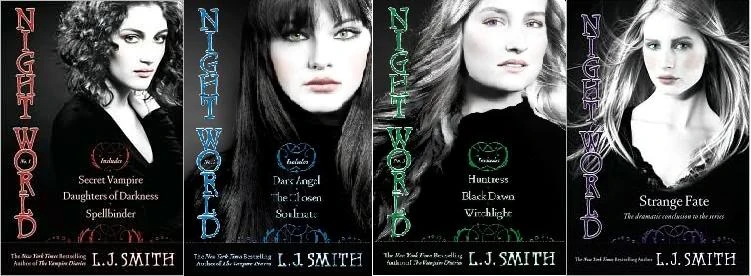
Yet another series by L.J Smith that I owe a debt of gratitude for. The Nightworld was a great series and within it, there were circles of witches that had positions for the mother, maiden, and crone. These three powerful women never acted as POV characters but the were always on the periphery.

Disney’s Hercules

Definitely the grossest version of the Fates out there. The three sisters sharing one eye thing was taken to a literal and gross level.

Can you think of any examples of the triple goddesses or Fates I may have missed?

Mythology Monday: The Fates

schizophrenia-388869_1280

Dinner was awkward, mostly because I finally got to meet Moirae. The “Fates” were embodied in this schizophrenic woman. She was middle-aged and average height, average build, average looking—brown hair, brown eyes, brown skin so light she could be any ethnicity. She referred to herself as “we,” and apparently had three voices vying for attention in her head at any given time. The past, present, and future; the young, middle-aged, and old; and the maiden, mother, and crone in one. Good times.

I sat next to Cassandra, and she moved me to an ornately carved wooden chair to the immediate right of where Hades would sit, heading the table. The banquet hall was surprisingly homey. I’d been expecting something as grandiose as the throne room. The floor was divided into wooden squares. The wooden paneled walls had sporadically placed paintings depicting different gods. Feeling out of place, I squirmed in my seat, watching as everyone else gathered around the table. Moirae turned in her chair to glare at me.

“It’s her,” she hissed, and then nodded in agreement with herself.

“Persephone,” I said helpfully. “Pleased to meet you.”

“You are the reason we’re down here.”

I looked at Cassandra for clarification and she shrugged. Leaning over, she whispered, “There’s a reason Hades keeps me around. She may be able to see the future too, but I’m way easier to talk to.” When I nodded in agreement, eyes wide, Cassandra laughed. “Okay, that’s not the only reason. She can’t see anyone who’s been marked.”

“Marked?”

“When a god gives someone a blessing or a curse, it interferes with their fate. They drop out of Moirae’s sight. She can’t see gods, either; that’s why Hades needs me.”

I nodded again, amazed at how badly I’d misjudged Cassandra. She was without a doubt the most important soul in the underworld. No wonder she felt comfortable taunting Hades; her position here was completely safe. I turned back to Moirae. I was dreading the answer, but had to ask, “How am I the reason you’re down here?”

“We are the fifth generation of Fates. We took our sisters’ place before the fall of the gods. Hecate, your mother, and you are meant to release us and be the sixth generation of Fates. Instead, you will choose to remain in the realm of the living. Hecate with her witches, your mother with her foolish crops. And you . . . ” She sneered. “What will you do while shirking your duties?”

I blinked. “I . . . uh . . . what? I haven’t even come into my powers yet!”

“You will.”

“There’s something to be said for a self-fulfilling prophecy,” I muttered, shaking my head. If she wanted to be mad at me for something I hadn’t even considered doing yet, fine. I wouldn’t have to feel bad for not stepping up as the next Fate later. Good. I didn’t want to be a Fate.

~@~

Pretty much every mythology has some version of the three women that control the threads of life.

They were called the Moirai. The main three in most myths were Clotho (the spinner), Lachesis (the allotter) and Atropos (the unturnable). The Moirai always belonged to the Underworld but through their weavings directed life on the surface. Every event in life was fated. If you did something awesome it wasn’t all that awesome because you were always going to do that. If you did something horrific, it was really the fates who determined that you did that horrible thing. People were helpless at the hands of the fates, but I imagine it took the pressure off.

The names of the fates rarely changed, but their parentage changed depending on the myth. In early mythology they were the daughters of Nyx (Night) and Ananke (Necessity.) Later myths say Zeus is their father, and their mother is Themis.

That there are three fates isn’t coincidence. Ancient Greeks were big fans of the whole mother-maiden-crone relationship so pretty much all female goddesses were part of one of these triads. Persephone, Demeter, and Hecate are one set of triple goddesses, or Artemis, Selene and Hecate, as are Athena, Brigid, and Gaia. The three furies and the three graces form two other triple sets. Athena, the virgin goddess, Aphrodite (the erm… experienced goddess), and Hera, who generationally would be considered their mother or grandmother standing in for the crone, formed another triad during their doomed beauty pageant.

I try to explain the reoccurrence of triple goddesses in my story by putting the fates as a temporary position. So the weavers would have been the first generation, Gaia and group the second, Moirae the schizophrenic the third (okay, she was never referred to as schizophrenic but there is a myth where she appeared as a single entity embodying all three of the fates, so I took that to the logical place in my head), and Persephone, Demeter, and Hecate presumably are a future generation as far as Moirae is concerned.

In my universe, Persephone and group are never going to take their place as fates, so Moirae is pretty mad about that. She can’t see the future of other gods, but she can see her own, and her position as the Fates isn’t going anywhere.

My fates don’t actually direct anything either. Free will prevails. The fates judge where souls go in the Underworld. Moirae can see the past, present, and future act of every mortal being that hasn’t been touched by a divine hand. So she can tell if drinking from the Lethe will reform a soul or if a soul truly belongs in Tartarus based on all their actions, including things they haven’t done yet.

It’s a bit of a different interpretation, but I think it works.
For Real Friday: The Afterlife

l-78510

Last week, I said that if you want to know what a society fears, tap into their fiction. We write our fears into stories that we can control. But if you want to know what terrifies a society, tap into the stories they’re afraid might be fiction. For humankind, as long as we’ve been aware of death, those stories have to do with the afterlife.

The fear of what comes next inspires us to make the most out of now. It also inspires us to be on our best behavior just in case that dictates the quality of the time after our time. Then there’a the fear that there is nothing after our time, and with that fear we do an interesting thing.

We bury it. People don’t think about death. Not really. There’s this odd kind of willful denial that even as we plan for it, are aware of it, and let our ideas of the afterlife dictate our behavior, we don’t really think about it. It’s an omnipresent fact to our existence but rarely do we dwell. It’s always a shock when it happens, either the death itself or the diagnoses that tells us its coming.

Part of that is self-preservation. The knowledge that time is running out doesn’t change the fact that it is. Being sad about it doesn’t change the fact that it is. Seizing the moment can get you in major trouble or give you a momentary joy but it doesn’t change the fact that the clock is ticking.

Nothing does.

I don’t know my thoughts on the Afterlife, but I like the version I came up with. That life just goes on but we’re happier for it. Here’s to hoping.

Way Back Wednesday: The Underworld

l-78492

When it comes to the Underworld, there’s been no shortage of sources that could have influenced the way I saw it. Here are a few of the more prominent examples that spring to mind.

embers-142515_1280

Hell

I live in the Bible belt so this imagery was unavoidable. I made a point to stay away from the more stereotypical hell-scape stuff, given that the Greek Underworld was an entirely different place, so the biblical version of Hell didn’t so much influence what my Underworld was like, but what it wasn’t.

The Inferno

As an English grad who lives in the Bible belt this was another set of imagery I couldn’t escape when considering the Underworld for my book. Especially since Dante linked the Greek Underworld with the biblical one. Much of Tartarus was modeled after Dante’s vision.

The Forbidden Games Trilogy

When it came to Tartarus, what wasn’t inspired by Dante was inspired by the bleak outside of the Shadow World, right down to the shambling, creepy figures and the hot/cold terrain. That imagery really stuck with me all these years later.  I really owe L.J Smith a debt of gratitude. I read so much of her work growing up. She’s the author that inspired me to become a writer. There’s this theory in writing that there’s always some writer you’re subconsciously inspired by/ holding your work up against. For me that is absolutely her.

What Dreams May Come and Hook

Here is no doubt where my living realm based layers of the Underworld were no doubt inspired from. You have the happy layer and the creepy layer but it’s all one afterlife. I have to be honest, I watched this movie once, ever, when I was like twelve or thirteen years old, so all I really have are basic impressions that for some reason keep mashing up with Neverland from Hook. So that unlikely combination is likely what inspired the whole if you imagine it, it will be there thing that existed in my Underworld.

The Amber Spyglass

The Underworld in this book was clearly inspired by Dante, but it held truer to the Greek version. Again, this is more a vision of Tartarus than of Elysium or Asphodel, but the bleakness of the landscape stuck with me long after I set down this book.

The Lovely Bones

This haunting book no doubt inspired the normalcy of the suburbs in my version of the Underworld. If you haven’t read this book, go read it now, before you have children. Because it’s honestly an amazing story and an incredible look at death. I just can never, ever, ever read it again now that I have a daughter.

What do you think of when you hear Underworld? And what have you read or watched that inspired it?

For Real Friday: Strong Female Characters

weights-652486_1280

On Wednesday I explained that as far as I’m concerned, Artemis was the original strong female character. When I think of modern day examples that best reflect Artemis, Buffy the Vampire Slayer springs to mind. But lately, strong female characters have gotten some bad press lately.

This article and this article (seriously read them, they’re great)  explains the issue with the strong female character better than I could, but it basically boils down to the fact that strong female characters have become a gimmick. Someone the hero can impress and use as a bench mark to move past or someone who’s given a moment of beating someone up to make viewers happy before the hero has to save her. This, by the way, is not Buffy the Vampire Slayer at all and by the way, Buffy does not fall into the other strong female character trap, which is to make her the only type of female character. Buffy is strong but she’s also multi dimensional, there’s more to her than that she can kick but and on top of that, the cast is exploding with examples of different female characters with different strengths, weaknesses, and complexities.

If the Greek myths had been written today, I’d want Artemis to be a Buffy figure. A single, strong and otherwise complex character who exists to do more than just motivate the hero and who is just one example of what a goddess could be like out of many. Part of my motivation for writing the Daughters of Zeus series was to do just that.

Persephone is an (I hope) complex character with different strengths and weaknesses. People in the book keep calling her strong and brave and all these wonderful things that shallow-strong characters are supposed to be, but she’s the first to point out that they’re wrong. She’s not strong in the physical sense, not because of lack of ability, but because until she ended up down in the Underworld, it never occurred to her to try to be. She’s not the brightest crayon in the box but she’s resourceful. She’s naive and idealistic and that naive idealism helps and hurts her at different points in the plot. Her plot is a romance and but she exists outside of her relationship with Hades. She has strengths but she also has flaws, enough of them that some readers can’t stand her, which is a great thing. A character that everyone loves is a flat character. Universal appeal doesn’t exist in three dimensional characters.

Aphrodite isn’t a strong character at all. She’s weak. She’s one-hundred percent defined by her relationships. She’s confident to a fault and on the surface seems very shallow, but inside she’s dealing with a lot of pain and that confidence and those relationships are the only thing holding her together while she deals with that, and that’s okay because there are people like that and they deserve to see themselves in fiction too. Also, she’s not static, she’ll grow as her series does, but in ways that are very different than Persephone.

Artemis is strong and confident and unlike both Persephone and Aphrodite she’s not trying to live up to some self-imposed ideal, she’s completely happy with who and what she is. Her arc won’t deal with growth but with other things I can’t get into because of spoilers. She’s had relationships but they don’t define her and they aren’t important enough to the plot to bear much mentioning.

There’s different ways to be strong and there’s room for all of them in fiction. Don’t settle for shallow “strong” characters who don’t even pass the sexy lamp test.

For Real Friday: Kidnapping

l-63764

On Monday, I shared a scene from an early chapter in my novel, Persephone where Pirithous attempts to abduct Persephone from her mother’s flower shop. Kidnapping is one of a parent’s worst fears and missing children are one of the most sensationalized types of news stories in America. The constant media coverage and books and movies. It was also a pretty frequent plot point in children’s media for a huge chunk of my childhood. The constant coverage has likely contributed to the rise of helicopter parents and an entire generation of slightly paranoid children.

Seriously. Every friend I’ve asked about this said they had kidnapping “plan.” For me, it was small things that were mostly games. I’d see if I could untie knots or unlock doors in the event I was even kidnapped. Another friend grew up memorizing her location and major landmarks she passed in case she got a chance to use the phone to call 911. Everyone went through stranger danger planning and some extra lucky children like myself were told to avoid hallways in hotels when we were traveling because “a stranger could just pull you into a room and I’d never see you again, Katie.”  Another friend was told she could never have a convertible, not because of price mind you, but because “someone could just hop in the car and take you away.”

What’s sad is how crazy that’s not. Everyone has a story like that. The fear of kidnapping was a constant presence in my generation’s childhood and one that is no doubt being passed along to our children.

It’s also incredibly unlikely. I included the threat of abduction in my book because, hello, Persephone. Both attempts are a plot point in her myth. But I did so with mixed feelings because I didn’t want to add to the hysteria.

Most abductions are committed by acquaintances and family and are found within hours of their abduction alive. Putting this in real numbers, out of 800,000 kids reported missing during the peak of the kidnapping hysteria in 1991,  only 115 of them were kidnapped by strangers, and kidnapping stats are going down. The rest were committed by family and acquaintances and the vast majority of those children were found within hours alive.

Now those 115 kids did fall into the scary pattern of being mostly female, mostly grabbed outdoors or lured into cars and roughly twenty of those children didn’t survive the abduction, so yes, there was reason to fear and it’s not like acquaintance or family kidnapping is a good thing but the sheer amount of fear everyone had for an outcome less likely than getting struck by lightning is in itself pretty scary.